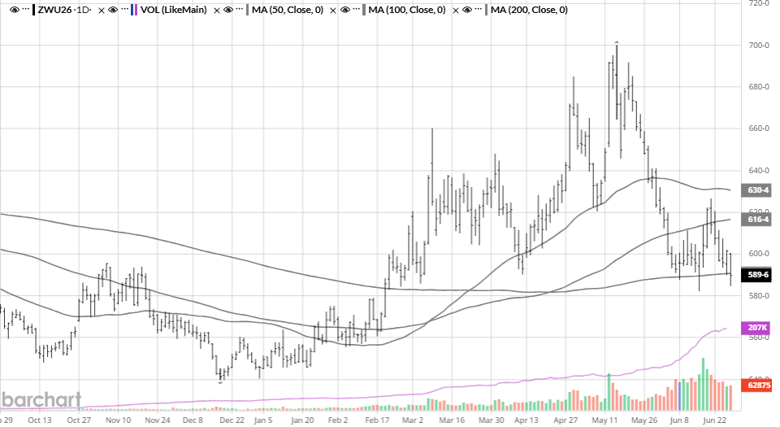
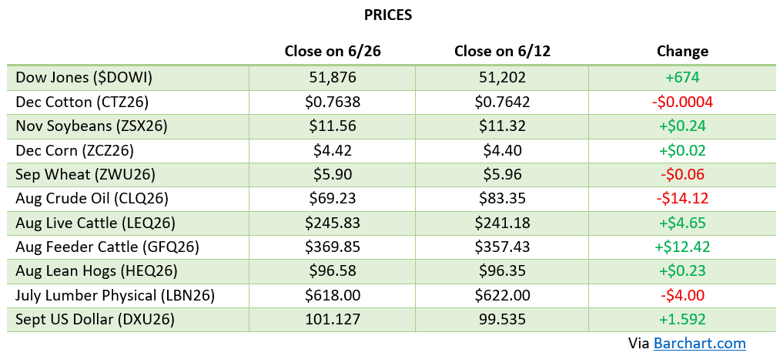
Corn spent the last two weeks trying to carve out a bottom after the brutal three-week stretch of fund liquidation that ran from Memorial Day into mid-month. Managed Money had been selling aggressively, and while that pace finally cooled, the selling pressure left December corn defending the $4.40 area with the season-average farm price forecast sitting right on top of the market. The catalysts that drove the spring rally have all moved the wrong way: planting weather has been close to ideal, crop establishment across the Corn Belt has been excellent, and crude oil has continued to leak lower as the Iran peace framework has firmed up. With old-crop ending stocks comfortable at 2.145 billion bushels and the new-crop balance sheet described by USDA as essentially unchanged, there has simply been no fresh bullish fuel to pull the funds back to the buy side.
From here, the entire complex is positioning ahead of the June 30th Planted Acreage and Grain Stocks reports, which is far and away the next major scheduled event. Any meaningful deviation from the March Prospective Plantings number, especially given how much chatter there has been about corn acres slipping on elevated fertilizer costs, has the potential to move this market hard in either direction. The other watch item is the calendar itself: as we push toward pollination in July, the weather forecast carries more and more weight, and a hot, dry ridge building over the Corn Belt is the kind of thing that could put a weather premium back into a market that has very little of one priced in right now.
Soybeans have once again been the more resilient half of the row-crop trade, holding up better than corn even as the same fund liquidation wave washed through the complex. July beans have been hovering in the $11.15 to $11.30 neighborhood, leaning on the tighter fundamental backdrop the May WASDE established, namely that 2026/27 ending stocks projection of just 310 million bushels and the booming crush demand story behind it. Board crush margins north of $3 per bushel remain historically strong and continue to do the heavy lifting on the demand side, with the RFS volumes finalized at record highs providing a structural floor under soybean oil. The drag remains the supply side: planting is all but wrapped up at well over 90% complete, Brazil is sitting on another enormous crop, and U.S. export shipments are still running behind last year’s pace. The long-delayed Trump-Xi meeting remains the wildcard that could flip the demand narrative overnight if a framework actually materializes, but the market has been burned enough times waiting on that headline that it is no longer paying up for it. Like corn, beans are squarely focused on what the June 30th acreage figure does to the new-crop picture.
Wheat has continued the slide that began once it touched multi-year highs back in mid-May on the historically small U.S. winter wheat crop. The pullback has been driven by harvest pressure now that combines are rolling across the Southern Plains, timely late-May and early-June rains that pulled crop conditions up off the worst-case scenario, and funds booking profits after an extended run. July Chicago SRW has worked down into the high $5.80s and July KC HRW has slid into the low $6.30s. The important thing to remember is that nothing about the supply story has actually changed, this is still projected to be the smallest domestic wheat harvest since 1965, so the question is whether harvest lows are in or whether the seasonal pressure has more to run. Watch the pace of harvest results, spring wheat conditions in the Northern Plains, and whether the recent rains were enough to truly stabilize the HRW crop or just a temporary reprieve.
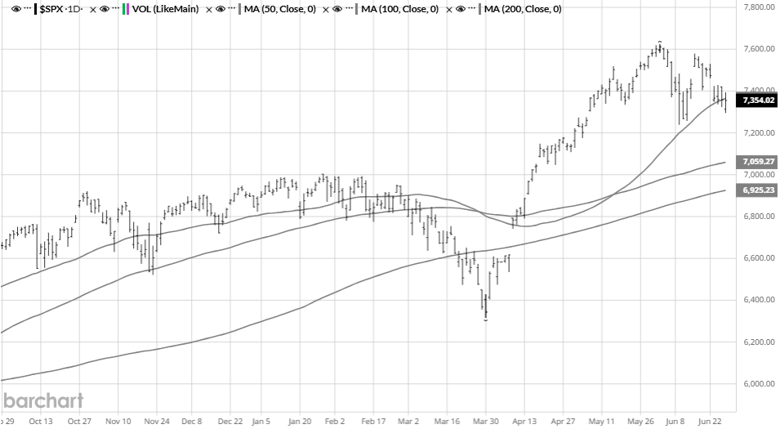
Equity markets have extended their remarkable run, with the major indexes pushing to fresh records even as volatility has picked up and some of the high-flying AI names have seen sharp, fast bouts of profit-taking. The dominant tension remains inflation: with price data still running hot, a growing share of investors now believes the Fed’s next move could be a rate hike before year-end rather than another cut, a notable shift in expectations. For now, the AI trade and strong earnings tone have been enough to keep dip-buyers in control, but the market feels increasingly two-sided after such a long stretch of one-way gains.
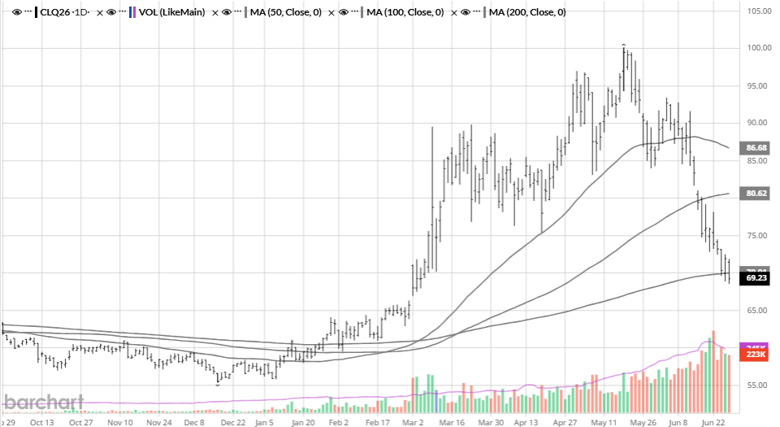
Crude oil has remained the single most important variable for the entire ag complex, and the direction has been lower. WTI has continued to retreat from its spring highs above $110 per barrel as the Iran peace negotiations have progressed, with the apparent Memorandum of Understanding to wind down the Middle East conflict taking crude back below $85 to close out the prior period and keeping pressure on prices since. The reopening of the Strait of Hormuz to international shipping is reportedly part of the framework, and if that holds, the war premium that propped up the grain complex this spring continues to bleed out. The practical takeaway for producers is that fertilizer cost relief is finally becoming more than partial, nitrogen and diesel have eased off their wartime peaks, though prices are not yet all the way back to pre-conflict norms.
– The June 30th USDA Planted Acreage and Grain Stocks reports are the dominant near-term event for the entire complex. With so much debate over whether high fertilizer costs trimmed corn acres from the March intentions, and whether beans picked up the difference, any surprise in the final acreage figures will be a significant market mover heading into July.
– The New World screwworm situation in Texas continues to be monitored after its first mention in the WASDE narrative last month, a reminder that animal agriculture is carrying its own emerging risks alongside the geopolitical backdrop.
– Cotton has continued to drift with the broader commodity complex as crude has retreated, peeling away some of the energy-driven premium that had made natural fiber more attractive versus petroleum-based synthetics. Producers who can lock in profitable margins at current levels while keeping upside participation should continue to evaluate their hedging options.
– Any concrete movement on a Trump-Xi meeting remains the most important demand-side wildcard for soybeans. A genuine resumption of Chinese buying would change the bean story quickly, but the market has stopped pricing it in until it actually happens.
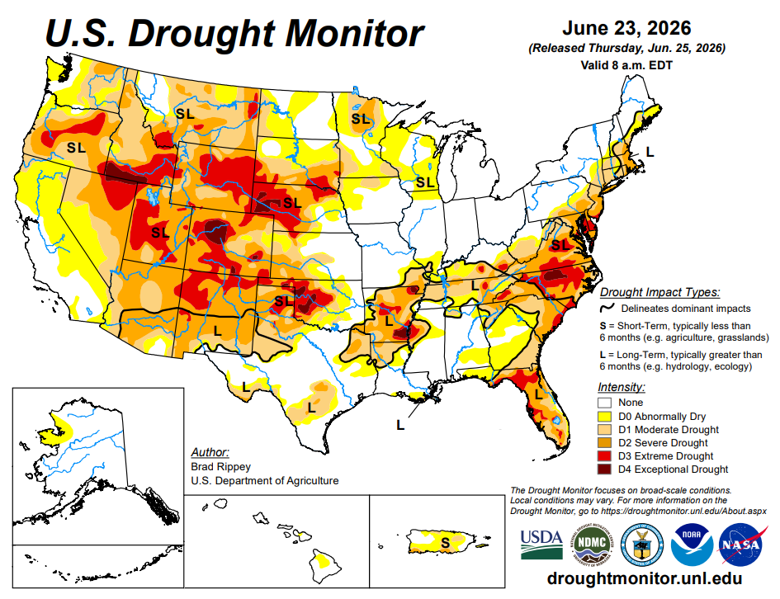
Drought Monitor
Here is the most recent drought monitor.
Contact an Ag Specialist Today
Whether you’re a producer, end-user, commercial operator, RCM AG Services helps protect revenues and control costs through its suite of hedging tools and network of buyers/sellers.
Contact Ag Specialist Brady Lawrence today at 312-858-4049 or blawrence@rcmam.com.
Corn has been under persistent pressure since Memorial Day weekend, with funds aggressively liquidating long positions built up over the spring. Managed Money has sold hard across the corn market going on the last 3 weeks, while the pace has slowed, they could continue selling if they want. The primary catalyst has been a combination of favorable planting weather, excellent crop establishment across the corn belt, and a crude oil market that has been retreating as Iran peace talks progressed. The June WASDE brought few surprises on corn. USDA described the 2026/27 corn outlook as “virtually unchanged” from May, with ending stocks coming in at 1.942 billion bushels and the season-average farm price forecast held at $4.40 per bushel. Old-crop 2025/26 ending stocks ticked up slightly to 2.145 billion bushels on a modest increase in imports, keeping carry extremely comfortable. The one positive was exports, but it was not enough to keep corn up close to $5. 96% of corn has been planted with a 67% good/excellent rating to start the week.
Soybeans have been caught in the same fund liquidation wave as corn, though they’ve shown more resilience given the tighter fundamental backdrop established in the May WASDE Report. July beans settled near $11.15 heading into the June 11th report. The soybean complex did find a brief bounce mid-period on continued strong crush margins and some renewed optimism around a potential Trump-Xi bilateral trade framework, but it didn’t hold. Planting pace has been exceptional, with 92% of beans in the ground and South American supply estimates remain large, with USDA maintaining Brazil’s 2025/26 crop and making only minor tweaks globally.
Wheat has been the most volatile market of the period, but not in the direction bulls had hoped. After touching multi-year highs in mid-May on the back of the historically small U.S. winter wheat crop, both Chicago SRW and KC HRW futures have been in a steady slide. July SRW dropped from around $6.36 to the $5.86 area during the period before attempting a bounce, while July KC HRW fell from the mid-$6.70s to the low $6.30s. The catalyst for the pullback was a combination of timely rains arriving in Kansas and Nebraska late in May, some improvement in crop conditions relative to the worst-case scenarios, and funds taking profits after an extended rally.
Equity markets have continued an impressive run with volatility recently and profit taking in some of the high flyers leading to a few heavily lower days. With inflation still a worry many investors believe that we are likely to see a rate HIKE before the end of the year rather than another cut.
Crude oil has been the dominant macro variable across all markets and the primary driver of the grain complex selloff over the past two weeks. WTI has fallen sharply from its spring highs above $110 per barrel as Iran peace negotiations have progressed, at times with apparent momentum, though the path has remained anything but straight. The headline to end the week that there is an apparent Memorandum of Understanding to end the conflict in the Middle East took crude back below $85 to end the week.
The June 30th USDA Planted Acreage and Grain Stocks reports are the next major scheduled market events. Any meaningful deviation in final corn or soybean planted acres from the March Prospective Plantings survey will be a significant market mover across the complex.
The New World screwworm situation in Texas received its first mention in the WASDE narrative this month, a reminder that animal agriculture has its own emerging risks to monitor alongside the geopolitical backdrop.
Cotton has pulled back with the broader commodity complex as crude oil retreated, removing some of the energy-driven premium that had made natural fiber more attractive relative to synthetics. Producers should continue to evaluate hedging strategies to protect margins at still-profitable price levels.
Drought Monitor
Here is the most recent drought monitor.
Contact an Ag Specialist Today
Whether you’re a producer, end-user, commercial operator, RCM AG Services helps protect revenues and control costs through its suite of hedging tools and network of buyers/sellers — Contact Ag Specialist Brady Lawrence today at 312-858-4049 or blawrence@rcmam.com.
Join Jeff Eizenberg and Ben Hetzel as they dive deep into the complex world of agricultural markets, consumer spending, and the surprising economics of convenience. In this eye-opening episode, they challenge the narrative of high food prices by exploring the booming delivery service industry and questioning whether consumers are truly feeling the pinch. From DoorDash delivery fees to wheat market strategies, the hosts break down the nuances of agricultural economics with their signature blend of humor and expertise. Learn why “hope is not a strategy” and discover insights into market risk management, harvest expectations, and the evolving landscape of food production and consumption. Whether you’re a farmer, agribusiness professional, or simply curious about the economics of food, this episode offers valuable perspectives that will change how you think about pricing, convenience, and market dynamics.
Check out the complete Transcript from our latest podcast below:
Convenience vs. Cost: Navigating Agricultural Markets, Convenience, and Consumer Spending
Jeff Eizenberg 00:58
Welcome back to the hedged edge. I’m your host, Jeff Eisenberg, with my co host here. Ben Hetzel, it’s week three, Ben, and it’s Friday afternoon. You’ve got a football game to go to. What’s been going on?
Ben Hetzel 01:12
Yeah, thanks, Jeff. Glad to be here today. Got a lot of exciting things to talk about, and that the markets they just they never cease to stop. Amazing me how far down we can go. It’s all red again today, pretty much. But speaking of football, super excited. I’m a sports guy. You’re a sports guy. Little different sports the way we use a ball, but we’re still sports guys. We got the big homecoming this week in lemon, where, where I live, and taking on a neighboring rival team, which is actually a closer here at work to that town than I am my where I live, so a neighboring rival in Buffalo, South Dakota. So it’s been a it’s been a really good rivalry over the years.
Jeff Eizenberg 01:58
There we go. Well, could call FanDuel and see if they can put you guys on there for tonight’s game.
Ben Hetzel 02:03
Hope he has a great game, and battling some injuries mid season here for some of our guys, but it’s fun. And over here in Scranton, they get the football game in Richardson tonight. So the heading or Scranton Nighthawk boys are headed over to Richardson, North Dakota, to take the Raiders on. So good games should be games that the teams that I’m cheering for can win, but hopefully it’s just a good night of football and everybody goes home safe.
Jeff Eizenberg 02:35
Yeah, that’s good. Well, we’ll check in next week and find out the score here and see if you guys came out on top getting into the show. This is week three. It’s taking a life of its own. You know, we’ve had on some great guests so far, and as we talk more, and it’s just spurring all sorts of conversations and discussion and really new ideas for the farmers, the farming community and everyone in the local area to want to tune in and share ideas with themselves as well. Today’s topic, I think everyone’s going to think we’re probably crazy as we start to think about how this this plays out. But what we’re going to be talking about is how expensive is our food and the reality that people are paying 10, $12 delivery fees for a $10 cheese burger, and that they’re still complaining that the cost of food is too high. So let’s call this what this is. I’m going to call it out. This is going to be our dash barometer discussion, and I’m excited to hear what you think about it. I’m excited to hear what others have. What others have to say. You can check in with us by tweeting us at AG underscore, RCM, or you can find us on Facebook or YouTube by searching RCM, ag services. I want to find out what people are paying for their Door Dash, how much they’re paying, and in the end, how is it effective price? So we’ll talk more on that. But before we do let’s do a couple of things. First, let’s check in on this week’s market. It was, it was what it was post week report, pretty quiet. Expectations were that we were going to have this big meeting today with President Xi from China, and it was going to be a scenario where the markets were going to rally, because if Trump is going to cut the best deal ever, where are we been? We’re 12 hours after the meeting.
Ben Hetzel 04:34
Yeah, great meeting on both sides is what we’re hearing based on what I see, but nothing for egg, nothing
Jeff Eizenberg 04:44
tricketts, nothing for AG, you know, there is a little bit out there, some thought that. Well, yeah, we’ve got this 20% tariff on fentanyl, which is raising 80, 90 billion of dollars worth of income and rent. Revenue, and that they’re going to take that money and pick it right back into the farmers. We’ve been hearing 10, 11 billion and Farm Aid, if that’s what they have to do, that’s what they have to do. But I don’t know about you, I just much rather see us selling our grain.
Ben Hetzel 05:17
Yeah, absolutely. That’s the best thing that we can have going on. Is is just fair trade. And you know, there’s a lot of talk that if the Supreme Court rules it’s unconstitutional what Trump’s done with tariffs that could have a devastating impact on these markets. And I think farmers and ranchers just need to be prudent with marketing decisions and mitigate risk where they can and in hopes that all that’s just hooey and goes away. But the risk is there. You know, however they plan to utilize money to rob Peter, to pay Paul, so to speak, is just nonsense. We need fair markets, and we need a market that’s profitable for our producers, and I don’t think any government form of bailout has ever been good for the ag sector long term, right?
Jeff Eizenberg 06:11
You’re right, and it might be a short term band aid. And you know, there’s talk and hope that ultimately we get a deal done. Doesn’t seem like this crop year, but let’s say for next and maybe that’s the reality, and we were facing these current prices, or possibly lower, because everyone’s got a great crop coming, and we’ll have to take in the aid, do what we have to do to get on to next year. And then, you know, hope that we have a new strategy. And you and I have talked about the word hope, and that’s one thing that I’ve been training my entire career, 25 years. And whether it’s a hedge fund or agriculture side of the business, that I’ve been on, hope is not a strategy. And that’s one thing that I feel like this show, is we’ve pulled it together and talked and communicated that our goal is to help people understand that there are opportunities in the marketplace. It doesn’t have to be because you love the price. It doesn’t have to be because you have to sell. It has to be because you have a plan and a strategy.
Ben Hetzel 07:19
Well, that’s a great topic, because, you know, the last two years, at least, even longer now, but the last two years, particularly, we’re in wheat country, so that that’s a huge concern for all the producers that I talked to. Hopefully they’ve got other grains as well, because it’s, it seems, or, you know, hopefully they like to grow other grains, because it seems like we’re moving away from wheat or trying to. But as you look at the wheat market, the last two years, there’s been 20 cent carries between the contract months, pretty steadily. You know, there’s some that come in tighter, you know, 1315, cents. But you know, by expiration, a lot of times they widen back out to 20 plus cents. We’ve seen them as wide as 30 at expiration. But you know, at one point in time, there was 60 cent carry out through three months. And that’s given you a great opportunity, even if you don’t like to your point the price up front, you can maybe look out there and find a spot where it works logistically to market some grain that traditionally would have a good basis, you know, a traditionally good basis. And I’ve been talking to growers lately about that very, very topic, you know, we need to be calling into the elevator merchandisers and saying, Hey, if I deliver in Jan, Feb, March, what kind of basis could I lock in today against this carry, you know, and they can go to work on that, you know, you make, make those offers, put that drain out there for them to Go, try to market. Because by time we get there, oftentimes, Jeff, you’ve been in the market a long time, these carries converge to the front end, and we just see this same flat price all the way through the marketing year, or a range of that. You know, last year, at harvest, we on 14 pro spring wheat particularly, just as an example, we dipped down into the high $4 range, which everybody was just their minds were blown that we’d have a four in front of the price of wheat locally. But it happened. And then we got back to five and a quarter. And I’m like, Guys, we might have to be happy with this price. You know, not saying this is it, but it’s going to take something non traditional to break out of this. While we didn’t get it on the futures, we got that steady yo yo effect. But as it went, it went out, the only reason we seen $6 cash or high $5 cash was all basis. You. And in a lot of ways, it was non traditional situations that don’t always present themselves. It wasn’t seasonal demand that created that opportunity. It was a shortened market somebody needed to cover and advantages for the farmers that are near that you can’t count on that hope that that’s going to happen again. To your point, hope is not a strategy. So you got to look out there and say, Okay, what can I get for a basis to take the carry out of the market, whether it’s corn, corn got nice carries out into the new crop, wheat, wheat has a nice carry there’s, there’s usually an opportunity out there, if, if you’re looking for it, and you know, if you, if your facility that you’re marketing with, or your your buyer is willing to to roll positions, you can take some risk off that way as well. And I don’t want to get too far in the weeds on some of that, but you know, as you know, I do a lot of stuff with over the counter, using swaps. Do a lot of non traditional contracts for growers, where they’re making offers, getting premiums, and maybe the market spikes. And being an independent Co Op is Scranton equity is in the way I operate it, which is kind of nice that I’m the guy that’s choosing how much risk we take. Because I, you know, I’m reporting to a board, and they’re all in the loop of what I’m doing. You know, if you’re a bigger company, maybe you don’t have the flexibility to do some of this stuff. But you know, if, if that market were to rally and you want to blow out all that offering, we can potentially roll that into a new crop position if it were to hit. And if you’re offering grain, it’s usually above the market on those deals, so it’s a premium to where we’re at today. And if that hits, that means the market did, did respond. It did what we were hoping it would do we wanted it to do, and we’re being rewarded. And, okay, we got rid of all our grains, so now we gotta roll that position to a new crop. That means that new crop values better than it was when you put this position on. Also, I don’t find a hole in that strategy.
Jeff Eizenberg 12:18
Yeah, you’re right in thinking along those lines. And sometimes people think about price and all they see is the flat price. And the difference between a flat price and the pricing you’re talking about is that you need to break it apart into two. And so we’re taking a little bit of time here in this episode to speak about the difference between futures and basis and challenge people to think a little bit more outside the box and having those types of conversations with their buyers. Right now, we are seeing offers on the future side, with some of the cash contracts that you’re talking about that include OTC and others that could be as over $5 in 2026 for the futures portion now, basis is the other side. Are you as an elevator going to put out basis offers for 2026 crop? Probably not right now, but coming up into the middle of next year, you will so people will have the opportunity today to think about pricing a portion of their grain for next year, even though they don’t love the price of this year’s grain. And I do want to make make a note here we’ve talked and you’ve said, well, people traditionally don’t like to do that, because they don’t know if they’re going to actually grow the crop. Have you ever gotten to a point talking with guys that they don’t have anything to sell?
Ben Hetzel 13:50
Good point, you know, generally, there’s something left year to year. You know, most farmers that I’ve ever worked with, there’s a few that’ll sell out of certain drops, but generally, there’s one or or maybe two that gets stashed away and kept as a reserve, you know. And the old, the old mentality that I heard a lot of times growing up from my dad was, well, that’s my bank account. If I don’t raise a crop, I got something to sell. I don’t know that. He was always thinking that that would mean the market would rally and he could sell it for more other than it’s just he had it to sell. And I’m not going to speak for him, obviously, but as I’ve been around and heard those conversations, that’s what it appears in it, for certain people, is it’s, it’s kind of a little nest egg, but generally producers will have, especially in wheat country, it seems like we always carry about 25% or more. Seems like the reporting coming out always around 30% stocks on farm. So that means we’re carrying a chunk of grain all the time. Yeah. And I would challenge growers, why is that not forward contracted in a carry market all the time? Why are you not taking premiums out of this market all the time? You don’t have to get way out into the future with that. You can be three, four contract months out, and all six, nine months if you want to get aggressive and and take that carry out. You know you have the grain. There’s virtually no risk to you if you weren’t going to market it anyway, other than you might actually market it. And if that’s a crime at that price, then don’t do it. Please don’t do it. But if it’s a good price, it’s way above the market, and you’re going to be disappointed in that. That’d be the only reason not to do it.
Speaker 1 15:47
If you want to listen back to this episode or find past episodes of The hedged edge, visit kbjm.com or kndc radio.com under Listen Live and podcast options, or either stations, free mobile app under podcasts,
Jeff Eizenberg 16:04
shifting gears a little bit to harvest, since we’re heading into that timeframe, it’s almost fall. Next week be the first week of fall, and probably by time this show airs, it will be the numbers are big. We’re looking at a huge crop nationwide. You’ve shared with me that you’ve got some great crop coming in, maybe some quality concerns about the freeze that you had last week. Love to kind of hear from you where you are there. It’s grant equity and talking to the farmers in that area. How’s the quality look? How does the how’s the crop look? And more importantly, where are you going to put all the grain?
Ben Hetzel 16:47
A few challenges there in that statement, the quality from what I’m seeing and talking to people, we’re optimistic is the word to use there. Don’t really know how it’s going to pan out, but I was in some fields with some guys and pick some ears. I got to get them checked. Still what we’re dealing with there, but it was really encouraged by what I was seeing, been hearing it. So I had to see it for myself, to believe it, so to speak, because it’s just a kind of unchartered territory. And to be honest, the last experience I had was not good. We ended up with super light corn that stayed at, you know, close to 20 moisture and there’s limited places to go with stuff like that. So really encouraged. I think our overall quality is going to be better than what a lot of us anticipated in in most of the areas, obviously, there’s going to be the entire spectrum of really bad stuff to stuff that wasn’t even hurt. I talked to a farmer near the rain country this morning, and he got up in the middle of the night to check the weather, and his son’s got a field that, for whatever reason, when he checked the weather, there was a cloud on the radar right over that spot where his son’s field is, his corn field, and he refreshed it because he couldn’t believe there’d even be a cloud in the sky, but he refreshed it, and I’ll be darn that was the only place in the southwest corner in North Dakota that had a cloud, and that field did not freeze. The only thing he could attribute it to is his son’s been going to church a lot.
Jeff Eizenberg 18:20
Hey, sometimes it pays.
Ben Hetzel 18:22
So, yeah, it’s better than we thought. And and we’re cautiously optimistic that it’s going to be it’s going to be okay. We’re going to have something to market. I don’t know where we’re going to put it. I think the baggers will be working overtime to put it in the big white peg zone in the field. You know, if it’s, if it’s quality, that can be exported or blended, we’ll find some homes. There’s a good export program for corn, and on the P and W, there’s, there’s other homes as well. And this grain will those grain will navigate through the pipe, and, you know, you get quality issues. Basically, the best thing you can do is stash it away and get through harvest, and then bring those samples, bag samples, Bin samples, whatever it is, bring them in, get them checked, figure out what, what grade flow it needs to go through and and get it, get steel wheels rolling.
Jeff Eizenberg 19:19
Sounds a good plan. Well, let’s take a minute here. Ben, since we’re staying on topic of quality and bagging and bringing in samples, would you mind give us a quick update on what’s going on with the co op? I know you’ve had a huge project you’ve been working on and some new storage facilities, as well as a revamped track rail line. Tell us what’s been going on out there, what’s the status of the project, and when can people start to expect to start bringing hauling in more grain?
Ben Hetzel 19:49
Yeah, so we started this project, ultimately, over a year ago, we changed the traffic flow and put up a new scale and grading house. And. Main Office got the trucks navigating through the facility a little bit cleaner and smoother. It’s been well received. It’s not ideal, because the way the the community is laid out here with the railroad track, and there’s a creek that runs through so kind of limited, or what, what options we really had there to fix the traffic flow with all the infrastructure that’s already in place, but we think we got a pretty good plan going forward. That was phase one, and now phase two is well underway. As you referenced, we’re putting up another slip elevator. It’s a big investment for the Co Op, big investment into the community. It’s going to have far reaching effects. I’m anticipating with speed at which we can dump today, we have two, basically two concrete work houses that we use to handle the multiple commodities that we’re doing, and each one of them has a dump pit inside those work houses. So it’s, basically two, two dump pits, and it’s going to be going to four. And the two new ones are high speed. Each one of those dump pits is faster than the two pits we have today. Quite an increase in velocity of receiving. And you know, as we looked at it, the age of the workhouse and the load out facility for the amount of grain that the equity is has handled over the years, it was time to really look at investing in another load out. It’s high speed, so we don’t have to spend 1215, hours loading these trains. We can get them loaded in six, seven hours because of the track layout, it just makes it kind of a non event, if you will. But that’s the idea. Is there’s less and less people in the rural communities that they’re wanting to live here, and we got to speed this stuff up and take care of our people that do work for us, and it’s going to be a huge advantage. And with the changes the railroads made to their policies on how they handle these big timed out trains. It’s, it’s going to be a really nice addition. So if it comes in the middle of the night, I don’t, don’t necessarily have to get up super early and and go get that train loaded. We can kind of pick our time slot, get it loaded and move on about the day. So huge, huge advantage for the producers in this area. It’s going to be a facility, a legacy facility, as you know, these concrete houses stand for many, many years, and super excited about that, but we are back out of the ground. Yes, we’re on the surface of the ground and getting ready to go up in the air. So the crew is working diligently to pour the last slab before they build the form. And once that forms built, we’ll be we’ll be slipping. Wow. So super fun
Jeff Eizenberg 22:55
next year, next year’s the next year’s crap. We up and going, hopefully,
Ben Hetzel 23:01
if they the weather holds and they get the slip done here late October, which is kind of the anticipated, optimistic timeline, maybe early November, and then all winter and next spring they’ll spend putting the equipment in place, and hopefully we’ll be able to fill it harvest The next year. But it could be September,
Jeff Eizenberg 23:21
September, right? Well, if we get another crop like this one, you’re gonna be pretty busy out there.
Ben Hetzel 23:28
Yeah, lots of bushels. And takes a lot, a lot of effort on our people. And I’m super excited to see see this change for not only our producers, but our employees and and it’ll it’s going to be fun. Just need the bushels next year as well.
Jeff Eizenberg 23:48
Hey, from your mouth to God’s ears, right? That’s right. Well, good luck, and yeah, keep us posted. We’ll be checking in with you on that as we talk more.
Speaker 1 23:58
Want more agricultural market expertise. Listen to full episodes of the hedge edge podcast wherever you get your podcasts, or visit RCM, ag services.com, get the complete market analysis and strategies you need to succeed. All right,
Jeff Eizenberg 24:15
we’re going to shift over to this week’s main topic, which not that we didn’t already cover a lot, but we we’ve been talking over the last couple of weeks to different people. We’ve talked to the banks, we’ve talked to Dwayne over at Dakota western bank. We’ve we talked with David Munoz, with Bartlett, and the same topic keeps coming up. We’ve got higher priced beef, we’ve got higher priced cattle, and we got the fact that people are spending more and more at the grocery store, they’re spending more and more for a normal meal. And there’s a consensus out there that the consumer is feeling pressure in a pinch. So I really want to throw it out today that I don’t really think that the consumer is in that much a pain, if you think about it, Dwayne brought this up to us the other. Day that people are buying their fast food or their convenience food, let’s call it that they’re buying it on a credit card, and they’re buying it through DoorDash. They’re buying it through, you know, some of these convenient solutions. Well, if they’re doing that, how much are they actually paying for the food versus how much they’re spending, and it’s actually impacting their pocketbook, that’s the question. And then we can ask, Is food really that much more expensive, or can people afford even higher prices?
Ben Hetzel 25:35
I don’t know if I even want to touch that topic, because, you know, to each his own. But no, I think, I think it’s an interesting scenario that’s unfolding. You know, we’re not, I don’t think any of us are naive to the credit card game. You know, if you don’t pay that credit card off every month, then you are financing whatever it is you’re putting on there. And if that’s fast food or whatever it is, I would just about bet there’s a whole lot of convenience purchasing in there, where we’ve become a convenience and instant gratification society. Take care of what I want right now. And I mean, I’m a victim. I’m I’m in it, and so, you know it. I don’t think people in general. Now, of course, we live in rural America. You’re, you’re in closer to Big City Life. I mean, you live it. So it’s, it’s hard for me to even comprehend what’s going on in that realm. But out here, I don’t see a lot of adjustments being made. I still drive by a few C stores in the mornings, and people are in there getting their breakfast or their coffees, or maybe they’re packing a lunch for the day, whatever it is that’s the most expensive place to buy that. And I don’t see a change in the flow of traffic in and out of those places so and I haven’t changed my habits, but I know that when you go buy a steak, it’s, it’s 20 bucks, you know, expensive, some dollar steak, and fortunately for myself and my family, we raise our own. But there that’s opportunity cost too. You know, I could sell that and not not eat that steak, but, you know. So the prices have gone up. I don’t think it’s hit the retail stores, you know, the big bot stores, like it’s going to that. We’ll see that starting to develop here in the fall months, probably more and more as these prices, you know, there was a stockpile of product in the system that maybe didn’t have prices ratcheted up on yet, but it’s coming, you know. And so what does it take to start breaking that habit? I honestly think that, you know, I think my dad might have said this years ago to me, or a few years back, that the only time you’ll really change people’s habits is, it is when they get hungry.
Jeff Eizenberg 28:04
Literally, we don’t see that in our country right now. I mean, to be honest, I I was like, you don’t change the habits too much. But I the other day, I was last weekend, went to Ohio State football game, and we just tailgated. So we were down. We’re waiting. And we got late to the tailgate, so we missed all the good food. And I said to my wife, let’s order Chipotle. I bet you I can get it delivered to me standing here on the corner. And she said, No way. I don’t know what you’re talking about. I go, No, watch this. Pulled up my Chipotle app, hit the num, hit the button, ordered three different Chipotle burritos for us, for her and I, and in a friend. And all I had to do was type in my location, and next thing you know, 30 minutes later, I was standing at a corner waving down a guy in a in a in a yellow minivan, and he dropped off my food. Now I cost me $10 but that was the best $10 ever spent. I almost even bought the steak Chipotle to spend a few more dollars just, just so I could feel like I got it
Ben Hetzel 29:08
all. Oh, man, that’s that’s an amazing story, because if you’d have bought a nacho in the store or in the stadium, it cost you what that whole meal cost you guys. Yes, exactly, right.
Jeff Eizenberg 29:21
So I think the point in all this is that employment is strong. There’s people utilizing these middlemen services and these tools that are have been created. And I looked up the data, and in a five year span, Door Dash and these different types of companies have increased their revenue from about a billion dollars to 12 billion. So 12 times the amount of money is being spent on these services again, post covid. Covid accelerated this middleman business, and now you think about people, Instacart shopping, having people go shopping. Before that, what are they paying? Three. I have 10 more dollars on top of their grocery bill. People are complaining about the fact that prices are too high, but the reality is, they’re spending more on these service conveniences that they don’t need to spend. So to your dad’s point, to your point that you made that your dad said, I don’t think that there’s actually a problem with the cost of food. It’s likely that people have become a little bit lazy.
Ben Hetzel 30:24
Yeah, hard to believe that, like Walmart delivers groceries, or, you know, you can send it, call your order in, and they’ll deliver it like DoorDash out here in rural America, they’ll drive 25 miles. I I’m not even making that up. I didn’t know that was a thing. It’ll literally deliver it to a neighboring town 25 miles away, if you’re willing to pay for it. I have no idea. I I have no idea, but that just blows my mind. For then the gas to go home and go to Walmart and pick that up and spend the extra 1520 minutes other than the drive time, just because you’re driving through town and traffic and go in the store, out of the store, I mean, they I don’t know if you could charge enough for that.
Jeff Eizenberg 31:12
I think you should at the game tonight. You should try the chipotle game that I just played. I don’t know how close the closest one is to you in lemon, but put it in if you can, and text me how much it would the delivery fee is, if it’s not Chipotle, I’m sure Chick fil A or something else around you has it. Text me the picture. I have to know the listeners. Oh, my God. I have to know. I should
Ben Hetzel 31:37
try to do that. I’ll try to remember. You might have to text me later to remind me my mind might not be on Chick fil A or Chipotle. I don’t even know where there’s a Chipotle. I I’m guessing Bismarck two hours
Jeff Eizenberg 31:49
might be a little cold by the time it gets
Ben Hetzel 31:52
to you. I hear you though, you know it’s I don’t think the price of that stuff has gone up to a point where people are going to change their habits. And, you know, it’s too easy to get get extended credit on your credit cards or whatever it is. And you know, we’ve seen an increase in pay scale in rural America. I’m sure it’s happening everywhere. So as people have earned more, even though their dollar doesn’t go as far. You know, this perceived idea that I’ve got, oh, I’ve got three 5% more to spend on convenience or or entertainment or whatever it is, and beyond the food, and we won’t even touch this, because this would be a whole nother rabbit hole. But how many apps and TV channels subscriptions do Americans have that are just hitting their credit cards and they don’t even know anymore? I look at mine, and I’m just like, my dumb kids, every time I turn around, there’s something on there. I’m like, Stop doing that. We’re not doing this, you know. And so if you don’t monitor that, pretty soon, you’re just getting gobbled up with these $10 $2 whatever they are, fees for these subscriptions. It’s crazy. Now there’s service companies out there, these middlemen, as you call them. They’re they’re out there helping you figure out how to manage that, right? So making a business off of your bad decision making, you know, I blows my mind.
Jeff Eizenberg 33:21
Yeah, well, we’re gonna keep track of that. We’re gonna call that the dash barometer. I think we keep track of it. I think we put a challenge out to listeners to text us or send us a picture of cost of a convenient drop off at your home. I’d love to see that. I’d love to hear from people, if they can do it, it’s just, you’re going to need to take a picture and drop it in on Facebook or the YouTube channel, or even even email it into us, if you like. But I’m going to, we’re going to report on this one. So more to come. On that front,
Speaker 1 33:57
if you’re enjoying today’s show, check us out on Facebook. Just search RCM, ag services for market updates and tips. Find us on Facebook.
Ben Hetzel 34:05
Today, you talked about the cattle prices being high, and we’ve talked off, off there, and conversations and whatnot about the government. You know, I’ve seen the video, and I don’t know if you’ve seen it, I’ve talked about it with people that Trump stood in front of an audio a group on at a podium and said, we got the price of eggs down. We’re going to get the price of beef down. You know, for the ag community, that’s that should infuriate us, but yet, you know, the American people are concerned about it. We don’t want the price of beef to go down because we raise it. You don’t raise beef, so you want the price to beef to go down. So when you order that Chipotle steak sand steak burrito, it doesn’t cost you 30 bucks next time, right? And so there’s, there’s conflicting opinions on what’s in the best interest, but it comes down. Each individual, just like the rest of this stuff. But again, mitigating risk is so important for the Ag producer on that front and hope is not a strategy. You said it, and I think that we should stand on the hill with the flag all day long, preaching that. But one thing that every producer is realizing, and I think our next episode down the road, should we should bring in a guy, and I’ve got an idea for an agronomy input speaker. He would shed some light on what’s going on in the input world. But what we’re seeing is, after an adjustment for inflation, some of the highest price inputs compared to the lowest price for production, that disparity has gotten so wide our producers are are really in a pickle. And so I think to call out one of our goals with this podcast is to help navigate that that space and educate producers on opportunities in the market and tools that are out there. And I encourage growers that are listening and people that know producers that are listening that might hear this point I’m at this, and tell them, hey, there’s there’s somebody out there that might be able to help you, and I think the partnership that we have, Scranton equity, RCM egg services yourself, me and the team that we have around us can do a phenomenal job to lead people to the right solutions for their challenges. And I just want to call that out.
Jeff Eizenberg 36:41
That’s right, and it’s a great way to wrap up today’s episode and segment is to repeat the theme, the team is everything. It’s it’s what we all need in order to be successful. Not one of us knows everything, but not one of us is going to have the right answer every time. But if you share your ideas and you’re willing to talk about the good and the bad, not just the wins, but also the losses and the risk that you face day to day, there’s going to be a solution for you. And unfortunately, it can’t come at the end, when you’re faced with harvest and you haven’t made a sale, it has to be along the way, throughout the year in advance, like we talked about earlier in this episode, even as far as six, nine, even 12, months in advance. So definitely plan on checking in with Ben, getting involved with with your local buyer on a more intimate basis, your bankers, your agronomists and your brokerage firms, and talk with them about how they can help give you some good ideas. Share with them your ideas as well. And what we hope in the end is that these episodes, these shows, yes, we’re having a lot of fun today talking football and DoorDash, but we’re hoping that in the end, people are taking a minute to reflect and think about how their farm and their operation is managing and mitigating risk
38:13
absolutely well. Thank
Jeff Eizenberg 38:14
you again for the great week on this show. We’ll be back back on the mic next week and next few weeks after that. So good luck in football this weekend. We’ll talk early next week.
Ben Hetzel 38:27
Yeah, enjoy your weekend. Can’t wait to catch up next week. Thanks, Jeff,
Cattle markets are at multi-decade highs, and producers are facing both incredible opportunities and serious risks. In this first radio edition of The Hedged Edge, hosts Jeff Eizenberg and Ben Hetzel dig into the realities of managing cattle risk when prices are running hot.
Joining the conversation are Dwayne Bowman, President of Dakota Western Bank, and Joe McKitrick, a North Dakota rancher, who share their perspectives on:
Why tight cattle supplies are driving record highs.
The risks of inflation, feed costs, and consumer “trade-down.”
How bankers and ranchers view tools like LRP, futures, options, and forward contracts.
Opportunities in feed, grain, and basis markets across the Northern Plains.
Why communication and discipline are critical in today’s cattle market.
Whether you’re a rancher, banker, or market watcher, this episode will give you a practical look at how to navigate risk — and why now may be the most important time to have a marketing plan in place.
____________________________________
____________________________________
Check out the complete Transcript from our latest podcast below:
Bulls, Bears, and Beef: Risk Management When Prices Run Hot
Jeff Eizenberg 00:51
Welcome to the first ever radio version of the hedge edge podcast. I’m your host, Jeff Eisenberg, and I’m here, joined with my co host, Ben Hetzel. Ben, we made it big. We’re on the radio.
Ben Hetzel 01:02
Yeah, buddy, it’s fantastic to be here with you today, and I can’t wait to get into this, and I gotta thank you for all the work you’ve done to get this up and running gov of the inaugural show.
Jeff Eizenberg 01:14
Absolutely no thank thank you as well. Couldn’t have done it without you. And you know a lot of our listeners are going to recognize your voice straight away. You know you’re from the local lemon community. You’re the CEO and general manager of Scranton equity co op for myself, for everybody who’s listening, I’m a bit of a newer voice to the area, and the managing director of the host of the show, RCM, ag services. I thought it’d be a good idea just to give a little bit of background, Ben you and I, we teamed up about a year ago. Really, the idea that we had when we first got together was to support the local Co Op and the community around with additional education and information about risk management and hedging services that we’ve been providing in and around the Dakotas and throughout the I states and other parts of the country. But really, you know, the more we talked and the more we got talking about education, the idea of the show kind of came alive. And since this is the first episode, I thought no better person than you to give us a quick recap and give the listeners an idea of why, why we’re going to do this show. Why should they listen? So if you don’t mind, yeah,
Ben Hetzel 02:26
sure. You know, the landscape changes pretty drastically year to year, it seems like. And the way production, AG, is it has changed over my career. Anyway, one thing that hasn’t changed is the risk. I mean, there’s, there’s a ton of risk in production. Ag and and so our mission with this podcast is, as you said, that this inaugural start to what you used to do on the hedged edge, first you want to provide the farmers and ranchers, AG, producers, end users, any professional with tools and resources that they need to navigate the markets today and maximize margins, reducing risk in their business. Secondly, you know, I want to highlight the importance of building that right team. We’ve talked about our conversations. You know, that’s the banker, the insurance agent, suppliers, whether it’s agronomics or other, having that agronomist close to your business, your broker, grain buyer, metal buyer, and all also your people that are on the operation every day with you and, and it’s just, it’s all about bringing that team closer and and and minimizing risk In your operation.
Jeff Eizenberg 03:40
Yeah, no, that’s, that’s right, and it’s, it’s been kind of the heart and soul for you and for me our entire careers, and as you get talking to more and more people, least as I have and you’ve, you’ve shared with me, it’s also about longevity and legacy. For a lot of people, the ability to not just turn a profit this year, but set up their operations, their farm, their ranch, to pass on to the next generation. Pay back their banker today, you’ll find we’ve got a guest banker on the on the line, so he’ll be happy to hear that. And with all of this said, we’re excited to be able to share this platform with you. Each week. We’re excited to bring new guests and new new team members from around the local community together to have these discussions. So again, thank you for taking the time to put this one together. All right, now that we’ve walked through why we’re here, let’s jump into today’s episode, bulls, bears and beef. All right, joining us today. We’ve got Dwayne Bowman. Dwayne’s the president of Dakota western bank, and Joe mckich. Joe joins us from Bowman, North Dakota, where he’s actively ranching, and it has been his entire career in production agriculture. So gentlemen, Dwayne Joe, are you there? Able to able to hear us? I’m here.
Joe McKitrick 04:59
Do. Yes, Jeff, All
Jeff Eizenberg 05:02
right, thanks for jumping on and joining us. We actually Dwayne is in studio with with Ben, so we’ve got the two of them together, which is great. And Joe’s off in Montana today. So again, thank you both for jumping in you know today and where we where we’re going here with this first episode is, let’s just jump in and talk about cattle why not? Right? It’s the hottest market. There is grain markets. Well, we’ll save that for the end. But with cattle prices are at all time highs. Wanted to kind of start out with a couple quick stats, and then have you guys really share what’s going on, boots on the ground style. You know, I think many people have heard, if they didn’t already know, this is the smallest us cattle herd in 70 years, 70 years since 1951 there’s 86 point 7 million head out there on feed that is highly un contrast to the 2019 peak pre covid numbers, 94 point 7 million. So we’re way down. Number one, number two. This one’s pretty interesting. I think we all know it, because if any of you are like me, my wife goes to the store or Costco, they’re paying up big time for beef. The Department of Labor Statistics noted that the average retail ground beef price is over $6 a pound. That’s up over $2 or 50% from five years ago. So prices are through the roof and hitting our pocketbooks, but yet, still, the price keeps going higher. And we’ll get to some questions at the end as how do we cure this? But before we get there, I kind of want to hear straight away from Joe what’s going on out there in the field. You know that we talked last week, before we did this call about the cattle on feed report and cattle on feed had been pointing to lower placements nationally, and particularly in the south. But up by you in your area, it’s a little bit different. What’s going on?
Joe McKitrick 06:53
Joe, well, thanks for having me on Jeff. As far as placements go the North looks so much better than the South because of the screw worm issue we have and but one thing that you know is an interesting take on the placements is Texas. The Texas feeders are competing for feeders up north and feeders in Oklahoma because they can’t get the feeders, their feeder cattle out of Mexico right now. So it’s creating a demand up here that’s that’s higher than normal on a seasonal basis, and also making it so that the Oklahoma feeders are the same basis as we are dealing with here. So it’s kind of a unique situation to add on to, as you said, already a very large shortage of feeders in general. Yeah.
Jeff Eizenberg 07:48
And the the other part is that you’ve got some quality ground. Obviously, had good condition and good grass, so people are bringing it your way. Is that been something you’ve seen as well? A trend in your direction?
Joe McKitrick 08:00
Yeah, there was a lot of yearlings contracted early. People were, you know, excited about the price we saw in June with yearlings, so they went ahead and contracted them. You know, fear of the unknowns of the marketplace, as we saw now. You know, the market has fully gotten better and better, and there’s a lot of yearlings starting to show up last week, this weekend, next week. The, you know, in the three, four state area, sale barns are starting to receive a lot of yearlings, and receiving them on a very high demand. I mean, the prices just keep going up every day. The Northern index is, you know, some version of 375, 380, on an index sphere. So the prices we’re seeing are just phenomenal. But again, there is a, you know, there, there’s a visible shortage as far as what’s available up here.
Jeff Eizenberg 08:50
Yeah, that makes, makes good sense. And that’s the kind of the gets to the crux of the problem, right? It’s that we’re, we’re trending higher. There’s a lot coming in, and people are looking to sell, taking, taking profits effectively out of the market. How are people feeling about these high prices?
Joe McKitrick 09:07
Well, so 2025, brought in a, a whole new market for us. And like I say, in June, you know, we thought that as producers, they, you know, that was already record prices. And so everybody the video sales saw that to where the volume in June was almost a flip flop of a normal July, meaning the volume of July went to the June sales. And so it’s, it’s just a function of, you know, 2014 and 2015 isn’t a far distance in most people’s memories. And so they That was a short lived bull market. And so people just want to make sure they capitalize on what is in front of them. So, you know, we saw a lot of activity early. There’s still calves for sale, no doubt, but there is a lot of contractor calves already.
Jeff Eizenberg 09:52
And then Dwayne, from your perspective, people are selling. They’re taking profits. They’ve locked in. Some of the opportunity to market. Question starts coming back is, what’s next? Are they thinking about replacing this herd, and in what way are they able to leverage the banks to come in and support buying new calves at this at these heightened prices? Is it even feasible? What do you think?
Dwayne Bowman 10:17
Well, good question. You know, it wasn’t that many years ago, I remember sitting down with one of my producers, you know, it’s probably six, seven years ago, and you know, when we were doing projections on there, and we figured, you know, we needed to get to about $1.70 on a cap to break even for him. And you know that time abs are probably worth about $1.45 and needed to see $1.70 so here we are. Fast Forward, you know, to 2025 and we saw $3 and then we saw $4 and now I’ve even seen some five point cans at about five bucks. So it’s gone up so fast that, you know, I think, if anything, there’s some fear now in the market, as Joe referenced, you know, it’s 1014 2015 that was very short lived. So everybody’s still got that fresh in their mind. But yet, you know, right now, this is it’s going to be, it’s going to be awfully fun. When it comes to the end of this year, these guys are going to have the most money they’ve ever had in their pocket. Last year was a really good year for us in the ranching country here, but we were dry, you know. So yes, you were getting record calves at record cap prices, but they weren’t hanging on to a lot of extra heifers. You know, they were selling down, still on numbers, just because we were so dry, they didn’t have hay in their hay yards. The pastures look pretty bleak. And now this year we’ve received, you know, tremendous rainfall along with these record prices. So there’s a lot of optimism. You know, your question as far as, are they going to replace right now? You know, I would say on the cow calf site, you know, really, that we’re not seeing a lot of demand to increase their numbers. You know, they still remember when they paid 2800 bucks for a red heifer 10 years ago, and never really did pay for that red heifer. So paying 4500 now, there’s not a lot of guys doing that. They’re, they’re holding their numbers. So they might buy a few back, but they’ve also, they’re selling that call Cal for 2300 bucks so they can afford to buy back. You know, $1,000 more, $2,000 more on the feeder side, I think we will see the guys. You know, they’re going to continue to to buy, you know, whether it’s yearlings or whether it’s feeder calves, because they’re coming off of, you know, probably the most money they’ve ever made. So they have to put that money back somewhere. You know, they’re, they’re either, they’re either going to be paying income taxes, which both of them like to do, they’re going to have to put it back into cattle. So it’s, it’s going to be a little more challenging on the on the hedging side, when it looks, when you look on the board and and you’re looking at, you know, a $300 loss at this point, but yet, they know they’re going to have to put it back into cattle.
Ben Hetzel 12:18
Yeah, it’s going to be really interesting. Jeff, too, you talk about what happened the last time we seen prices spike, and this one being such an extreme, comparatively value wise, as a producer myself, small scale, you try to try to remember those things and do things different this time. So whether using futures and options or an LRP product to mitigate some of that risk. You might find yourself looking back on this last summer, earlier spring, and I wish I wouldn’t have bought that insurance or put that position on as a cow calf guy. Now, feedlot guys that are buying numbers and doing that, you know they got to be prudent and hedge their risk diligently. But you know, as a cow calf guy that maybe 10 years ago, never even thought about hedging those calves this year might have been looking, and maybe even in the last few years, looking at hedging them. They’re born or unborn, possibly, you know, and as that product’s changed, it’s it’s made it a little bit different this year. It seems like it’s a little more expensive early on, but the value is much higher too. So value of using that tool, but, you know, we’ll get into that a little later. I think Jeff too that, you know, it’s, it’s still not a, it wasn’t a mistake to to buy that insurance. And some people, probably, I’ve heard it from others that they probably think, man, you know, I wish I would have done that. It’s, it’s kind of a trap that I think producers can get in, and hopefully we can shed some light on why that’s that’s a good thing to be doing anyway. But going forward, it’s going to be interesting to see what the trend is. Continue to edge these calves right after they’re born on an LRP, or start getting into futures and options and understanding those tools that are available to them. I think the trends will definitely depict a new direction based on what’s going on this year.
Speaker 1 14:17
If you want to listen back to this episode or find past episodes of The hedged edge visit kbjm.com or kndc radio.com under Listen Live and podcast options, or either stations free mobile app under podcasts.
Jeff Eizenberg 14:32
Ben, you mentioned something when we spoke the other day about the kind of misconception in the country that the banks are actually forcing people to put on these hedges and lock in losses. And you know, when you’re talking about losing on the calf rate as you buy it, what are your What are you guys thoughts in general, about this?
Dwayne Bowman 14:51
Yeah, like speak a little bit on the bank side, you know, I mean, no, I mean, we’re not forcing guys to lock in, you know, to put on losses. Obviously, the guys that are buying feeder cattle. Buying yearlings. We want them to be prudent and be doing some hedging, and just they’re putting so much money on the table right now, so they know they have to have some type of protection on there. But I don’t think anybody’s going to force anybody into taking a losses. We’re hoping you know that they’re going to be able to when they’re buying. Hopefully that that it looks like a break even at at worst, but definitely be doing need to be doing some type of protecting on, on their end, on the cow calf side, you know, as Ben talked about, you’re seeing more and more guys that are getting comfortable using LRP, a great tool to help kind of take, you know, to lock in some prices for them. And then we’re seeing a lot more guys that are just forward contracting, you know, a lot more hitting the video sales early. And they they understand that so much better. You know, hedging is a is a scary word for a lot of lot of producers, still. But when they forward contract and just know, hey, October delivery, I got 398, that 650, pounds, they know exactly where they’re so they like, they like that part of it. But the hedging is, is definitely going to be, definitely going to be a big piece going going forward, on the on the feeder side, on the fat site, just because there’s so much money at play this year.
Ben Hetzel 16:02
Yeah, that brings up an interesting point the way in that, when we talk about grains, and just for a moment, even though we’re not going to spend a lot of time on today, but oftentimes, in this geography, forward contract, particularly the because you could lose it, you could get hail, you could get lots around different things that happen to lose the job or lose the quality that you’ve guaranteed to the market. So that’s where the futures and options piece or or a product like LRP would would really kind of protect you. But we were pretty comfortable selling cash. And, you know, generally, if they’re on the ground and they’re healthy today, you’re going to be able to be able to sell them. And you know, you it wasn’t that long ago we had a storm called Atlas. If your cattle are contracted in November and we’re in a wet cycle right here, as you mentioned, and it’s you wonder if that’s crossed some producers minds, like, what happens if we get a bad one, you know, maybe they aren’t selling 100% likely not. But if they’re selling a high percentage, and the risk is there that something could happen, it’s usually doesn’t devastating level, but there’s some risk there.
Joe McKitrick 17:15
Going to your comment Ben, about, you know, hedging and doing something with the cow calf side. And we’re, I’m hearing it a lot in our travels that, you know, that was just a waste of money, or the put option, they bought more so the lrps, but they were a waste of money. And, you know, all too much marketing and egg is done on a recency bias. So you know, now that we got 2025 the big run of 25 under our belt, and the recency bias says that was a waste of money. You know, that’s one thing that I’d encourage, is that, you know, don’t give up on adding some protection, because the time that you don’t need it is right around the corner is the time you do need it. And obviously 2025 if you did nothing, that was the best case. But typically somewhere right around the corners when, when you do need your hedging program. So I think that’s an important piece of that conversation.
Ben Hetzel 18:10
Yeah, and I’m glad you went there, because I, I’ve felt like we, we had to touch on that, because, again, you know, personal experience, and obviously you live it every day. Dwayne sees it every day, Jeff, he’s he’s in the trade every day. It’s so important to protect yourself against the risk. And if you’re making money, when you put that edge on, it wasn’t a waste, waste of time or effort or money, because your point is market turn at any given moment, and you’re going to need it, because it may fall faster than it came up, and it catches you by surprise and but yeah, and that was part of that misunderstanding too. Is, you know, a lot of people get in that trap. Well, yeah, I wasted that $60 a head on my LRP, which, when I bought LRP, I said to my agent the day I did it, I said, Well, tomorrow, this might be a mistake, which it was, because it rallied big time. The next day, they said, This may look like, not be a mistake. It may look like a mistake. And I hope I’m wrong in doing this, because that’s a unique tool, just like an option, that it’s a fixed cost, and if the market keeps running, you’re going to capture some of that gain. It’s really unique. And I think producers need to know that, you know, just because you buy that product doesn’t mean you out of the market. You still have opportunity.
Dwayne Bowman 19:29
No, you’re right there. You know, Ben, that’s exactly what we’re hoping for. You know that you never have to use that tool. You know, as Joe said, the best thing the person could have done this year was nothing. Well, that’s we’re right around the corner from where you you know, things could turn the other way, really, really fast. And it’s, it’s the insurance, you know, it’s just the insurance that you’re going to be able to sleep at night having that protection on. Obviously, the bankers, we want to have that as well. We want to have that risk covered. The producers need to have that same thing. And it’s, you know, that’s why we put crop insurance on, you know, that’s why they put hail insurance on, so they can sleep better at night. They hope they never have
Jeff Eizenberg 19:58
to collect on it. Yeah, we’re talking. Working with Dwayne Bowman here, the president of Dakota, western bank. So Dwayne, when we talk about that right there, the relationship with the banker, I think that’s so important. You know, we have a lot of people that you know doing futures and options and other transactions that require the bank to be aware and communicative about where they stand with their potential gains, losses and margin calls. And, you know, we’re on the radio waves, and we use the word margin call, somebody might turn us off straight away. But the reality is that that can happen, and having that open line of communication with the bank in advance is paramount. And so, yeah, I just give you this chance to speak to that. And you know, the way that your bank handles, kind of working with their, their ag loans, whether it’s cattle, grains, whatever it might
Dwayne Bowman 20:47
be, yeah, I mean, the biggest thing when we’re putting their, their operating note together, or putting their note together to purchase the feeder cattle, obviously, a big part of that, a piece of that, is the risk protection, and it’s going to come at a cost, you know, whether it’s going to be put options, you know, and we’re going to build that in, or whether it’s going to be crop insurance. Going to be crop insurance, you know, we’re going to build that into the into the note, we have to manage our risk, and they’ve got to manage their risk. So it’s just, it’s a cost of doing business, but it’s, it’s no different than, than any other business out there. Like you said, it’s, uh, I think if anything, it’s just a lot of lot of producers still are just scared, you know, they don’t know enough about the marketing. They don’t know enough about risk protection, futures contracts, things like that. They’re they don’t have enough knowledge on it yet, but it’s a necessary piece to continue to get educated on. And that’s where I think this, this show is going to be kind of exciting, because hopefully it’s going to provide some opportunities for producers to get educated.
Jeff Eizenberg 21:38
Yeah, thanks, Dwayne, that’s that’s the goal. And really appreciate your feedback and being there to answer those questions in office, and you know they’re there locally. So that’s that’s great. Switch it over to Joe again, where Joe mckich from Bowman? Joe one kind of old trading fallacy out there. Maybe it’s the truth. Maybe it’s not. Is that higher prices cure higher prices. And so here we are. We’re higher prices. What’s it going to take the cure? Cure these higher prices. For the consumer, really? I mean, the the rancher, hey, keep on going. But for the for the consumer, we’re feeling the pinch we’ve got. The other day, I actually, I got a text message from friend up there and in Bismarck, and it was a picture of McDonald’s, and below the drive thru window, it said, financing available. So we all know beef is expensive. What’s it going to take?
Joe McKitrick 22:33
Well, I think you know, going to the McDonald’s conversation, the CEO was on again, and he talked about, it’s his lower to middle income consumers that they’re having a hard time getting them to come in the door. They’re skipping breakfast and eating at home, and he’s assuming that they’re skipping a meal altogether. So any of the consumers that have a household income, I think he used of 100,000 or less, they’re seeing a decrease in traffic. And so, you know, that’s always the fear. You know, the Packers, the funds, their job is to, you know, get prices as high as they can. They’re not really in it for that longevity of as much as today’s price. And what can they make a profit out of it today and and, you know, so that just say, what is going to limit demand? That’s to be seen. But obviously, if McDonald’s is saying that we’re limiting some demand today, the concern is permanent demand loss, since beef high and the wife goes home and makes a different meal, and then the family is okay with that meal, you know, based on pork or chicken, five years down the road when beef not as high, obviously, chicken still going to be cheaper, pork still going to be cheaper than beef at that time. Are they going to stick with that and not, you know? So we have more permanent demand law. There’s already conversation with a few fast foods are mixing pork with their beef for for ground beef. So concern of permanent demand laws is what is on every producers radar, that that the ones that we sustain the industry over a 20 year span, and we’re not just in it for the short term gain, like a fund is or, you know, packer is for the day. So I think that’s the real conversation is, how high do we have to go? We went to 475, and made during covid, and there’s a lot of forecasts that will get there fairly easy again that’s to be seen.
Jeff Eizenberg 24:28
Yeah, you know, from from where I sit, I’m feeling more and more as I talk with gentlemen like yourselves, then it’s really going to take the rebuilding of the herd and the numbers getting higher to drive that pricing back down. What are your thoughts? How long is it going to take to really, truly rebuild a herd?
Joe McKitrick 24:47
Well, so there’s two packers that have came out recently and said that, you know, we’re dealing with anywhere from three to six more quarters of really tight supply. And then, you know, getting to more normalization. What? How? However they define it. They did not define it in their in their notes. But you know 2027 being closer to more normalization. So assumably, we’re going to see some herd expansion somewhere along the journey that provides that
Speaker 1 25:15
want more agricultural market expertise. Listen to full episodes of the hedge edge podcast, wherever you get your podcasts, or visit RCM, ag services.com, get the complete market analysis and strategies you need to succeed.
Jeff Eizenberg 25:29
The other question that’s going to come into play here Dwayne is interest rates. You know, we know President Trump’s been pushing for lower rates. What are your thoughts? How is interest rate play going to either support or impact the the herd expansion on the cattle side,
Dwayne Bowman 25:47
yeah, you know, really what I’ve seen the last few years with rates going up, it hasn’t had nearly as much impact on the Ag side as you’d expect. You know, land prices have been strong as ever. Have continued to go up. So in a producer actually said this to me the other day. He said, you know, interest rates, to me don’t mean, don’t, don’t mean nearly as much as as commodity prices. And he’s right. You know, commodity prices and weather are a much bigger factor and impact than interest rates. So I think we’re going to see interest rates go down. I don’t think that’s going to have a big impact on what cattle prices do, you know, like you were talking what kills, you know, high prices. You know, it’s high prices. And I think what, what we’re finally going to see at some point right now, the consumption, beef consumption in the US has been very stable. The last three years, it’s been right around 58 pounds per capita. So that isn’t changing. So at what point, you know, does the price cause them to go elsewhere? Chicken is still, you know, twice the consumption that beef is, but you talked about, you know, the $2 difference there is, I don’t think it’s enough difference right now that the consumer still knows that they enjoy, that their lifestyle, they know what they like. And we are, we’re definitely in a in a lifestyle to where we know what, what we appreciate, what we like, and as long as we can afford it, we’re going to continue to stay that way, like you talked about financing, you know, I thought this was kind of interesting. I heard this the other day about, you know, people love convenience, so DoorDash, you know, they love that. And you know, they’re gonna order that cheese burger from McDonald’s, and they’re gonna get fries and they’re gonna get their frosty. And next, you know, they’ve got a $17 meal, and they’re paying five bucks data delivered. So they’ve got 22 bucks, and they’re putting it on a credit card that they’re not paying off at the end of the month. Jeff, so you’re right, yeah, and that’s the lifestyle. So it’s going to come a point when they can’t, you know, make those payments, when they really are feeling the pinch. That’s where there’s going to be some lifestyle changes. And then we may see some adjustments on beef.
Joe McKitrick 27:36
I think Dwayne brings up a good point there too. That’s worth noting. Is the even though beef high, it’s not like chicken and pork are dirt cheap. Those competing meats have done a good job of trying to follow beef up, yet stay a little bit cheaper so that they maintain their demand. But if you notice that, you know that those meats are that’s just kind of in a silent move. So it’s not as big a disparity as one would say.
Ben Hetzel 28:07
The interesting thing would be the margins at the production level, you know, is, is the producer that’s raising, you know? And I know it’s all pretty well confinement related production, but where’s the margin, and all that landing. Jeff, you and I had a conversation the other day about what some of these fast food chains might be doing to encourage that middle class, lower class consumer to come into the store or the restaurant and and buy some, buy the meals, or whatever fast food. And it’s really interesting, they’re, they’re focusing a lot. If there’s traditionally a burger joint, you know, say, McDonald’s or or one like that, that, you know, first thing a lot of us think of is the Big Mac or some kind of a quarter pounder type thing. They really focus in there. They’re happy their daily specials, or whatever the meal deals around chicken.
Jeff Eizenberg 29:05
Yeah, I think we, think we saw, we looked it up. McDonald’s CEO came out and said, Oh yeah, we’re gonna bring back the value meal. And they have six new value meals. Well, five out of six are chicken, chicken related. So there, there you go. They’re trying to drive towards profitability. Shifting course here to the last question. Ben, I think this one is really slated for you, if you think about it, you know you got your finger on the pulse of the grain market, there at Scranton, at the at the elevator and the Co Op. Where are you feeling like the opportunities are in thinking about from the feed side and from the ranching side, is there really, is this a level that people should be coming in and thinking, Okay, how should I lock in and forward price some of my my feed?
Ben Hetzel 29:51
Yeah, we’re seeing some increased interest in locking in grain longer, earlier, longer, you know, whether or not you. Seasonally, this is traditionally. Maybe we’re coming into that, that lower price point where nervous ramps up the volume hitting the facilities and basis widens out. But I think some of them are trying to get ahead of it, even trying to figure out, how can we get some corn or maybe a different sheet stuff laid in earlier and have more of it on hand. I’ve actually heard of some feed lots building bins because they want to store more supply, which, you know, there’s all kinds of arguments around whether that’s a good idea or bad idea. It depends on your operation, probably as much as anything of what, what’s prudent there. But, you know, we got a big drop, especially geographically for us, we’ve got some pretty big drops staring us in the face, and it’s going to be tough to keep all of it moving at once. You know, locally, we’ve got as good a wheat drop as we’ve had. And it may not be a record, but it’s, it’s not gonna be too terrible, far off. And for some producers, and you know that’s, that’s just one of the crops they’re raising at extremely high levels of production this year, sharing a lot of good yields on other other crops, whether it’s keys, canola, flax, all of them are really good this year. And then we got probably what looks to be one of the the best corn crops I’ve ever seen. And I know Dwayne and and Joe. You guys travel this area a lot, too, and it kind of looks like Minnesota around here. You know this corn you drive down the road, you can’t see over the fields, and a lot of times the corn doesn’t get that Paul and and the height of corn isn’t always the the whole story, obviously. But when you talk to growers, it’s they’re just talking about how phenomenal is. So there’s opportunities coming for these guys buying feed. I guess to me, anyway, it feels like basis should widen out, you know, a little bit anyway, from where we’re at. And the big question will be how much export business that we pick up because of the lack of the soybean export program. You know, the facilities on the coast, the P and W, the Gulf, they’re going to have to elevate grain to keep the facilities buzzing. So they’re going to be looking to fill it with corn or wheat, you know, here in this this next quarter. So, you know, it looks like, even if China were to come in and be interested in some beans, it’d be tough for the US to execute on the P and W a bean program with what’s been put on the books for corn. So as long as demand stays high, maybe we, maybe we slot no here, you know, protect your risk on the board, you know, and, and the basis risk based on seasonality,
Jeff Eizenberg 32:44
makes sense, and Joe as your what’s your sense on that bin building at the on the feed lots, something you see as you travel?
Joe McKitrick 32:53
Well, there’s a lot of conversation about how to take advantage of it. You know, for the first time in probably two decades, you know, like southwest Kansas has a negative corn basis in areas and there’s just a loop. There’s a massive amount of corn growing this year, and like Ben saying, it looks like Minnesota in areas that are fringe acres, and maybe they’re normally 60 to 85 bushel or 100 and 100 plus.
Ben Hetzel 33:21
So yeah, say it 150 plus.
Joe McKitrick 33:25
Oh, yeah. I mean, I never thought we’d have a hot, you know, a 2023, corn crop, again, in the fringe acres, but it looks like we’re going to, and, you know, you get into western Kansas from north to south is there is a mountain of corn this year western South Dakota, same thing. So, yeah, there’s conversation of how to, you know, there’s a lot of places that are going to make a wet corn pile that would maybe normally make a small one, that are going to make, you know, one day last three quarters of the winter or something. And so, yeah, there’s a lot of conversation how to take advantage of this, you know, the large crop and and really large basis at harvest too.
Jeff Eizenberg 34:05
Looking ahead into 2020 end of 25 and end of 26 What are your thoughts, Joe,
Joe McKitrick 34:12
so 25 was a a demand driven market, and as we go into 26 we’re getting into a supply driven market, where the shortages of supply or the constraint is becoming the larger, and so the structure of the market changes. The safety of a demand driven market is greater this you know, the clarity of that it’s going to go higher is greater than a supply driven because there’s so many outside forces that could affect supply exports the Mexican import. So I think the you know, the conversation leads to what could potentially put a final top in this market, and and one of them is the NCBA is putting a lot of pressure on the USDA to do something about this Mexican feeder cat. Import situation, the Texas yards, you know, there’s a lot of Texas yards that make a living off of feeding Mexican feeder cattle. And in fact, the largest feed yard conglomerate in the US is only at 40% capacity, and not totally because of no imports of Mexican feeder cattle. But there’s a, you know, that’s a part of the situation. So, you know, what could put the final top in is, you know, the opening of the border. The other thing that’s, you know, transpired since last week is the Trump’s tariffs are now under pressure, judicially, yes, and if something like that changed to where Brazil could ship directly to the US. And so when you add in that, we’re increasing Australian imports as fast as as they can do it. And then you add in the Brazilian side, and then you put this, you know, the screw worm situation, in the rear view mirror. That’s a lot of headwinds for the market to keep going higher. And so then the supply driven side of it in 26 becomes a question mark of how, how is that going to affect supply? Obviously, demand is not going to fall out of bed, so we still have demand, but we don’t have demand as a driver. That takes us to a whole nother level from here, where, whereas supply of supply stay tight, we could go quite a bit higher. But given the factors at bay that are being held at bay, if any of them come alive again, there is serious risk to the market. And as we talked last week, there’s a lot of air gap to the market too. We came a long ways, really fast in 2025 and markets like to take it away as quick as they put it on too.
Jeff Eizenberg 36:42
So that’s the old other trader story. Yeah, take it away as fast as it came. Yep, exactly.
Speaker 1 36:48
If you’re enjoying today’s show, check us out on Facebook. Just search RCM, ag services for market updates and tips. Find us on Facebook today.
Jeff Eizenberg 36:57
Dwayne Ben, any
Dwayne Bowman 36:58
final thoughts? Well, I think, just to piggyback a little bit on what Joe said, you know, I think he’s exactly right. You know, the, I would say the imports is going to have even a could have a potential bigger impact than, than we keep talking about. You know, our US, cattle being down. I think we’re down 500,000 but we’re, what do you say? Jeff, 86 point 7 million cattle in the in the US. But I think globally, it’s 1.5 7 billion, you know. So the US is really a small piece of this. So the imports could have a have a huge impact. Tariffs could have a big impact, compared to the demand side, as Joe talked about, I think that’s going to stay pretty
Ben Hetzel 37:32
stable, yeah. And I think one, one last comment I have in regard to the beef talk, what a scenario to be in, though, good demand, as good as it’s ever been, not only domestically, but good demand for us, beef globally. And now you’ve got some supply constraints that can fuel the fire. So from a commodity standpoint, it really doesn’t get any better than that, you know. And so one without the other can be fun, but if you have them both, and you’re on the right side of it, it can be really exciting. But again, you know, where does that end? Where’s the party shut down? And so that’s, that’s really what we’re here talking about. And navigate markets and situations that whether it’s good or bad, like you said, Jeff, so happens the cattle market is fun to talk about today. Wheat markets, so, you know, we’ll get into that. But regardless, if you’re at the top, there’s tools out there, you know, RCM, egg services, whether it’s Jeff out in Ohio, some of the other brokers around the mid states here, or myself in Scranton, North Dakota, Scranton, equity. The tools are there. We’re more than happy to help people understand them, and that’s why we’re talking about it.
Jeff Eizenberg 38:50
That’s good. Well, you know, again, today’s been a great day. It’s been great to kind of talk with all of you guys. Obviously, Dwayne and Joe for joining the show and Ben shared at the beginning is that this is the most important part, is that you’ve got a team around you. There’s people in and around the area that are knowledgeable about different parts of the business, that have had different types of experiences. Come if you’re on the on the grain side and the you’re talking to a rancher, ranchers talking to a corn or wheat farmer, it’s just a different conversation. And you can learn something you pick something up, obviously, having great quality relationships with your bank, your co ops, your brokerage firms, again, be super important, particularly in these difficult times, whether the top or bottom of a market, the emotional cycle that We’re in is real. And again, our goal, and having having this show on the radio is is to be able to share experiences like Joe’s and Dwayne’s events in my my own through throughout the radio waves, and get some feedback from you all, and hoping that you stop into the co op or give Ben a call, or just check in on. The podcast and catch up with us next week.
Disclaimer
RCM Ag Services is a registered DBA of Reliance Capital Markets II LLC. Trading futures, options on futures, and retail off-exchange foreign currency transactions are complex and involve substantial risk of loss and are not suitable for all investors. Loss-limiting strategies such as stop loss orders may not be effective because market conditions or technological issues may make it impossible to execute such orders. Likewise, strategies using combinations of options and/or futures positions such as “spread” or “straddle” trades may be just as risky as simple long and short positions. There are no guarantees of profit. You should carefully consider whether trading is suitable for you in light of your circumstances, knowledge and financial resources. You may lose all or more than your initial investment. You should not rely on any of the information herein as a substitute for the exercise of your own skill and judgment in making such a decision on the appropriateness of such investments. Opinions, market data and recommendations are subject to change without notice. Reliance Capital Markets II LLC shall not be held responsible for any actions taken based on this website or attached links. Parties acting on this electronic communication are responsible for their own actions. Past performance is not necessarily indicative of future results.

 Corn spent the last two weeks trying to carve out a bottom after the brutal three-week stretch of fund liquidation that ran from Memorial Day into mid-month. Managed Money had been selling aggressively, and while that pace finally cooled, the selling pressure left December corn defending the $4.40 area with the season-average farm price forecast sitting right on top of the market. The catalysts that drove the spring rally have all moved the wrong way: planting weather has been close to ideal, crop establishment across the Corn Belt has been excellent, and crude oil has continued to leak lower as the Iran peace framework has firmed up. With old-crop ending stocks comfortable at 2.145 billion bushels and the new-crop balance sheet described by USDA as essentially unchanged, there has simply been no fresh bullish fuel to pull the funds back to the buy side.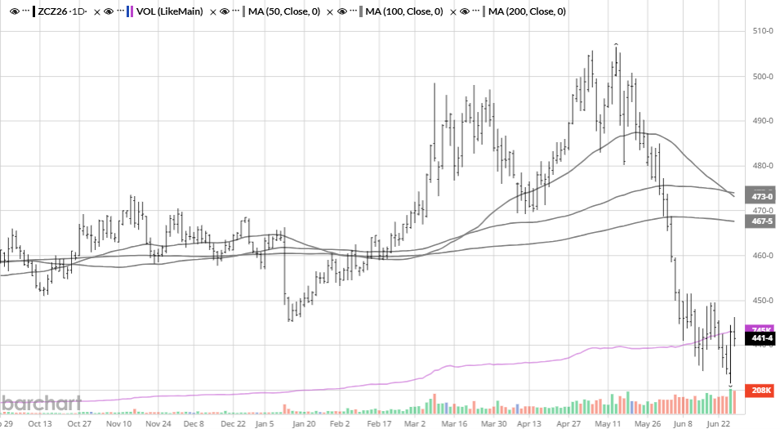
 Soybeans have once again been the more resilient half of the row-crop trade, holding up better than corn even as the same fund liquidation wave washed through the complex. July beans have been hovering in the $11.15 to $11.30 neighborhood, leaning on the tighter fundamental backdrop the May WASDE established, namely that 2026/27 ending stocks projection of just 310 million bushels and the booming crush demand story behind it. Board crush margins north of $3 per bushel remain historically strong and continue to do the heavy lifting on the demand side, with the RFS volumes finalized at record highs providing a structural floor under soybean oil. The drag remains the supply side: planting is all but wrapped up at well over 90% complete, Brazil is sitting on another enormous crop, and U.S. export shipments are still running behind last year’s pace. The long-delayed Trump-Xi meeting remains the wildcard that could flip the demand narrative overnight if a framework actually materializes, but the market has been burned enough times waiting on that headline that it is no longer paying up for it. Like corn, beans are squarely focused on what the June 30th acreage figure does to the new-crop picture.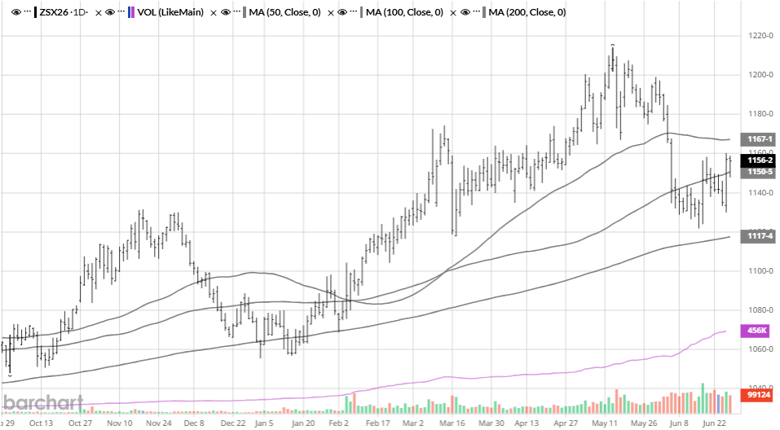
 Wheat has continued the slide that began once it touched multi-year highs back in mid-May on the historically small U.S. winter wheat crop. The pullback has been driven by harvest pressure now that combines are rolling across the Southern Plains, timely late-May and early-June rains that pulled crop conditions up off the worst-case scenario, and funds booking profits after an extended run. July Chicago SRW has worked down into the high $5.80s and July KC HRW has slid into the low $6.30s. The important thing to remember is that nothing about the supply story has actually changed, this is still projected to be the smallest domestic wheat harvest since 1965, so the question is whether harvest lows are in or whether the seasonal pressure has more to run. Watch the pace of harvest results, spring wheat conditions in the Northern Plains, and whether the recent rains were enough to truly stabilize the HRW crop or just a temporary reprieve.