Tag: market updates

23 Oct 2025

Harvest, Hedging, and History: Navigating Agricultural Markets from Grain Elevators to Futures Contracts

In this episode of The Hedged Edge, hosts Jeff Eizenberg and Ben Hetzel dive deep into the heart of agricultural markets with special guest Fred Seamon from CME Group. As harvest challenges mount with record-breaking rainfall across the Midwest, the conversation spans centuries of market innovation—from the early days of Chicago’s grain trade to cutting-edge futures contracts. Fred shares fascinating insights into the historical development of commodity exchanges, explaining how farmers went from local merchants to global market participants.

The discussion explores critical topics including harvest logistics, railroad transportation, the evolving role of the USDA, and emerging market tools like the new fertilizer futures contract. Listeners will gain a rich understanding of how technological advances and market innovations continue to transform risk management for producers. Whether you’re a farmer, trader, or agricultural enthusiast, this episode offers a comprehensive look at the complex ecosystem of agricultural markets, blending historical perspective with forward-looking analysis.

Packed with expert commentary, practical insights, and a touch of humor, this episode is a must-listen for anyone interested in understanding the intricate world of commodity trading and agricultural economics.

_____________________________________

_____________________________________

Listen on the radio at KNDC Radio https://www.kndcradio.com/

and KBJM Radio https://kbjm.com/


Check out the complete Transcript from our latest podcast below:

Harvest, Hedging, and History: Navigating Agricultural Markets from Grain Elevators to Futures Contracts

Jeff Eizenberg  00:57

Welcome to the next episode of The hedged edge. I’m your host, Jeff Eisenberg, and I’m here with my co host, Ben Hetzel. Ben, it’s almost big game season, and we’re talking waterfowl. What’s been going on? You get out any hunting yet?


Ben Hetzel  01:12

No, I haven’t. My my boys like to shoot some birds. I don’t mind going out a little bit. I much prefer to shoot the clay version, because I don’t know, I just, for some reason, I’ve always kind of grown up with the idea that if you’re gonna hunt


Speaker 1  01:28

wildlife, you have to be willing to eat the wild game that you hunt.


Ben Hetzel  01:33

And I’ve never been a real big fan of game bird, so I didn’t, we didn’t shoot a lot of them when I was a kid. So, but my boys like to hunt, and it’s a lot of our family hunts, so it’s, it’s just good to get out. But yeah, we’re coming up on, there’s, there’s tons of people out there along the roads, and sometimes not the safest practices going on with vehicles on these country roads. But definitely got bird season going on and and big games coming right around the corner, and that’s kind of what we do. We we enjoy that a little more, I’d say. So we’re excited.


Jeff Eizenberg  02:12

That’s good. Now, with all the weather we’ve had all the wet, rain and whatnot, that’s good for birds. Yeah,


Ben Hetzel  02:19

I mean, it’s, probably all right. In general, it’s good to have moisture versus drought, obviously, and it’s been crazy. I’d say this year has got to be right up there with a record for a lot of places. I hear producers talk across the trade area that they are at record levels. And when you have thunderstorms, they vary and that sort of thing. But it’s been an unbelievably wet year for this trade area, Southwest, North Dakota, Northwest South Dakota. I seen a visual on kind of the percentile, and we’re at like 150% to normal, is what our little area of the world showed, particularly right around where I live, near London, and so yeah, it’s, it’s good, but yet challenging at times. Harvest is slow to come off. These row crops are ready in a lot of areas, and harvest is definitely moving forward, but we see fields that are ready to be cut, fields that are cut. So it’s, we’re in the midst, and I know a lot of guys are anxious to get get everything out of those fields, especially when you got you know, we’ve had some high winds, 60 mile an hour us, and so guys are nervous about some of these row crops starting fall down or whatever it is. But again, the wildlife sure enjoy that cover. So more harvest that gets done makes it easier on the deer and antelope hunters, but it’s that season. Yep.


Jeff Eizenberg  03:52

And speaking of harvest, where, where are we in the process now, from the elevators perspective, you guys filling up, starting to put up any grain piles? What’s it look like as you’re driving around?


Ben Hetzel  04:04

I don’t see too many piles. You know, out here, we do a lot of grain bagging, past how that’s managed. Wildlife can be a challenge, especially in a wet year. No, you were curious of how that all kind of works. But for the most part, the bags are fine, unless wildlife get on them and start popping holes in them and then have some serious problems. But a lot of people manage them real close. Now, you know, there’s been some train wrecks on bags, but, yeah, it’s, there’s a there’s a fair amount of bags around, and guys were moving a little bit of small grain. A lot of canola has been moved. So I think there’s places to go with some of this row crop harvest, but we’re getting pressure all the time to continue to make space, pretty hard to keep the flax and the peas and the canola and the wheat, all that stuff moving because they want to try to market their corn and. And some fires as well. And so it’s been a real battle. Railroads kind of slipped a little bit. It’s gotten a little bit late on placements, so that’s a challenge as well. But it hadn’t been too bad, and I wouldn’t say we’re way behind. You know, seasonally, it’s not uncommon to expect some delays, but it’s it’s starting to show up a little bit more now, as corn harvest is ramping up in the east and and on the railroads defense, this soybean crop didn’t move like normal it was a non traditional flow for them, and so that they actually, I think, adjusted about as well as you could ever expect a large organization to shift their assets, and fortunately, it’s a smooth move to the Gulf. It’s not quite as smooth for us up here as going to the P and W, but that flow isn’t a bad flow, and so the railroad can do it fairly efficiently. And so that’s a positive. Unlike the Mexico market, where we can bottleneck the border and some of that stuff, and there is, there’s some congestion going on there. We’re hearing trains are getting held up across the border, slow to come back out, and so that is affecting some of this. But that’s just a volume issue, which is good. I mean, Mexico has been a great trade partner. We’ve talked about it on our podcast. People that tuned in to one of our earlier shows learned a lot about what’s going on with US and Mexico, and I think that’s key going forward still. But, you know, maybe we’ll get into a little bit of it today, on the rest of the world and what’s going on. There’s lots of news this last week that kind of rocked the market. China’s still obviously a big topic. So if


Speaker 2  06:52

you want to listen back to this episode or find past episodes of The hedged edge, visit kbjm.com or kndc radio.com under Listen Live and podcast options, or either station’s free mobile app under podcasts.


Jeff Eizenberg  07:08

Yeah, that’s a great segue. And yeah, I’m excited here today, we’re going to bring on a special guest that’s got a ton of history and experience in the markets, and take a look back in memory lane and understand what the importance is of the exchange, is how the exchange ultimately helps us to manage risk, and a lot of that comes down to understanding the history and how things flow, how trade flows, and how traders are able to manage some of the things you just talked about, people Bringing more crop to town than possibly in years past. How the rail systems could potentially slow down movement of grain from Southwest North Dakota down through to the Gulf, etc. So with that, we’ll take a minute here and introduce our guests. We have Fred Seaman joining us from the CME Group. Fred is with us, right out of Chicago, been part of the exchange for the last nearly 25 years. So welcome Fred.


Fred Seamon  08:08

Thank you, Jeff. Much appreciated. Really glad to be here.


Jeff Eizenberg  08:13

No thanks for jumping on this exciting for me, you and I basically have been involved in Chicago markets about the same amount of time you’re saying 2001 for you, I started out working at the Board of Trade, and in 2000 you know, our paths have kind of meandered, but we’ve never crossed until today. So this is exciting.


Fred Seamon  08:35

It’s amazing that we haven’t, but I did. I started in late 2001 and had been teaching at the University of Wyoming, so it was quite a change for me and my wife, but definitely haven’t looked back. It’s been the best job I’ve ever had by far.


Jeff Eizenberg  08:53

Yeah, you can’t beat the exchanges. The history goes back over. I think, I believe, 150 years, you know, the way in which they started out being Chicago, the center of the agricultural world, and the river and the rail all coming in, and now, now today, to be the place where innovation is happening, left and right. You know, the the thing that stands out to me, I think people miss and I always ask farmers that I meet, I ask elevator operators that I meet. Have you been to Chicago and have you seen the exchanges? And unfortunately, they transitioned away in our career, time from the pit traded. But I would love for you to help everyone remember the the training coats, the greens, the yellows, the blues, kind of the vibe that Chicago used to have.


Fred Seamon  09:46

I’m so glad that I got to witness peak four before, you know, it started to decline. And you know that did occur during my my tenure at the exchange. I. And, you know, it’s, it’s, it’s all electronic now, but you know that was, we got into a commodity boom in the, you know, early and mid, 2000s and you know, you would get really, really busy days. And I would hear from merchandisers, you know that, you know, they would, it would take some period of time before they would get confirmation on fills. So as efficient as the floor was, and it was extremely efficient, there’s a lot of things the floor did really, really well, but the markets had just grown to a point where, you know, the electronic screen just became, you know, the choice when, when we did start having daytime, electronic trade, the choice of most agricultural traders, and it started to to evolve away from the floor. But, you know, a lot of what happened on that floor is still relevant today. It’s just how we manage, you know, and how people enter and execute trades has changed. That’s all. But the underlying reason for them, the markets are still the same.


Jeff Eizenberg  11:10

Yeah, that’s That’s right. It’s a place to discover price and also manage risk. And the reality that the hedging community is what the exchanges were built for. Is so important for people understand it was built for hedgers, the speculators came in to provide liquidity. And today it’s a global marketplace that trades 24, six, effective, yeah. Well,


Fred Seamon  11:37

you know, it started as a spot market. If you go back into the 1840s you know what happened is, you know, everyone knows the US started 13 original colonies on the east coast. But as it started to expand westward, it didn’t take farmers long to recognize that they would rather farm ground in places like Ohio and Indiana and Illinois than they would Massachusetts and New York. So agricultural production moved westward, but most of the people were still in the east. So at harvest, you know, you’d have all these farmers bringing all of this grain into the major cities, Chicago, being one of them. And you know, they would try to find a merchant who was willing to buy their grain to, you know, arrange for it to be shipped back to the east where it would be consumed. And you know, some of those merchants were legitimate, some probably not. And you know, the the idea, did all producers get equal treatment? Well, probably not. So the exchange actually started. Well, there’s a few things. You know, the Board of Trade was a an organization that was started to promote commerce in the city of Chicago, and grain trade was one of those things. So, you know, their their first idea was just, let’s have merchant members, and let’s have them congregate in one place, and then, you know, a farmer can come to that one place, the members have been vetted, so, you know, hopefully they’re all legitimate, and something that we take for granted, but was real powerful at the time, was every time there was a transaction, they would post the price, so that the next farmer that came along probably wouldn’t receive the Same price, but would get an idea of the value of what they were, you know, selling, and that was the start of the exchange. It was just a spot market. Need to fall from there, eventually becoming forward contracts, and ultimately futures contracts in the 1860s that didn’t ultimately succeed, but corn, wheat and oak futures all launched on January 2. 1877 have existed continually since. It’s


Jeff Eizenberg  14:17

quite the history it is.


Ben Hetzel  14:19

It’s really kind of wild when you think about farmers and ranchers moving their goods far as they did. You know, I’ve got my aunt was going through the attic of the farmhouse where my grandparents lived for all my life anyway, and most of my mom and her siblings, but they found boxes of old receipts or tickets from when they would haul calves down to Sioux Falls, South Dakota. And mean to drive that today is a trek. I mean, it’s a six and a half hour drive. And to think back then they loaded their calves up and. The wagons and shipped them down there, or they took them in when the railroad came through, they took them in and put them on the rail and down there and sold them. And it’s just crazy to think of the dollars that they were transacting compared to what we’re transacting today. And of course, was cattle at all time highs. It’s just unbelievable. That journey that them, people went on to move that grain or those cattle was remarkable,


Fred Seamon  15:28

absolutely remarkable. And one of the things, Jeff, I think you, you mentioned, was about innovation and the farmers, indeed, the effort that they took to bring grain into the city, and then, you know, you got the railroads and so forth. And that certainly evolved. But, you know, transportation into the major merchandising points. But a couple of the innovations that occurred at the exchange early that we again take for granted, but it just completely revolutionized how grain was traded. Two of them were a system of grades and sampling. There wasn’t a USDA then, so a way to be able to differentiate grain so that it could be commingled in a grain elevator. And the first grain elevator in Chicago was was built in the late 1830s so the ability to commingle grain, and then the idea of receding grain within a facility, so that you could trade grain among multiple parties without it having to move to the multiple parties. It could just sit in one location, and you could just trade ownership of it. And that really revolutionized grain trade. And actually the center of grain trade in the Midwest. US moved from St Louis to Chicago because of those, those innovations, I


Jeff Eizenberg  17:08

think that’s really important for people to understand, is that the exchange has continued to evolve to support the farming community. It’s something that has been exciting the whole way through that, the point then became the delivery mechanism, right? Because that, I also believe is important to have multiple delivery points, of which the grade and quality is standardized. Was that the exchange that drove that? Or how did that come about?


Fred Seamon  17:35

They did and of course, there’s some great stories of shenanigans that went on along with that. But, yeah, a system of grades and a system of grading as well. But as you can imagine, when you know the Registrar of the exchange, the person that’s signing their checks, is a member of the change that also runs a grain elevator at the same time. There could be, from time to time, pressure on that exchange staff member to, you know, look one way or another when it came to grading grain. So at some point, the state of Illinois stepped in and said, enough of the shenanigans. We’re taking over. And those processes have existed at the government level, rather than the exchange level, for most of our existence. But did start at the exchange that’s


Ben Hetzel  18:39

kind of wild, because you’re talking like 1830 in the USDA started 1860 or Yeah?


Fred Seamon  18:47

Is that? Yeah? I think, I think that’s right. And it’s interesting. It was the 1860s when the state of Illinois took over inspection. So that was part of the learning process as things move from exchange regulated to state regulation and making it sound like the board was the Wild West. In some ways it was. But what they did and how, you know, they brought about organized trade. It definitely was a positive. You just anytime you have human beings and trade, there’s always going to be those few that are going to be looking for ways to benefit. So there definitely were some shenanigans.


Speaker 2  19:40

Want more agricultural market expertise. Listen to full episodes of the hedge edge podcast wherever you get your podcasts, or visit RCM, ag services.com get the complete market analysis and strategies you need to succeed.


Ben Hetzel  19:57

You can a wild west. Jeff, you’re I know you’re. Dying to jump on this. We have no government. USDA is not giving out reports.


Jeff Eizenberg  20:05

That’s right, that’s right. Ben, and that’s the part that he’s mentioned, the USDA didn’t exist back when the exchange started. The USDA effectively doesn’t exist today, because we don’t have a government operationally. And so you start to ask yourselves, the question is, how are we going to advance the needs that we have today for information without the USDA? And I’m going to go ahead and pose the question, do we even need the USDA anymore? After you know the innovation that could potentially happen as a


Fred Seamon  20:39

result. As of right now, we do, especially on the livestock side, feeder cattle is settled to our feeder cattle index, which is all based on USDA reported feeder cattle sales in the country and direct reports. We also use USDA reports for doing differentials in live cattle deliveries and lean hogs and pork cut out is all under mandatory price reporting. So one of the big things when you see a government shutdown coming, you know we always want to know is, is AMS market reporting going to be affected or not? And some of this, the shutdowns, they’ve been considered non essential, and those reports didn’t come out, and the exchange had nothing to to settle against. And other times they were deemed essential, and the reports continued to flow. Luckily, this time, the reports continued to flow at this point, so we haven’t had an adverse effect. And then on the grain side, you know, just having USDA price reporting adds additional trans transparency in the countryside relative to Chicago. So I think, you know, that’s a benefit to all. But, yeah, I mean that it’s we still rely pretty heavily on USDA, whether it’s for livestock settlements or for transparency when it comes to grains and oil seeds, and I should mention dairy too, that all is USDA based reporting as well. So we’d hate to see USDA go


Jeff Eizenberg  22:37

anywhere. Okay, so we’ll give them a break. They need to exist. Let’s get this government shut down, taken care of, and get these people back to work. Shifting gears a little bit, though, but similar topic, I do want to ask the question is from a research perspective, and as you start to think forward about news and information, you know, we’re having so many new private companies that have entered the market. We have private companies like stone X and many others that have existed over the years, and new ones are entering the marketplace for research yield updates, and we’re getting information from China and from Brazil, and you get all these questions of, How reliable is that data? How reliable is our own data? Are we going to eventually transition to a spot, kind of like when you and I were at the exchanges and the pit trade had existed, it was kind of slow. You mentioned it. People didn’t always get reported their trades in a timely manner to now it’s microseconds. Do you feel that perhaps, maybe even this government shutdown accelerates this but that we get to a point where the information is more real time and we rely on, call it an exchange of information, to truly understand where we are with yields and stocks and other things like that. Oh, I


Fred Seamon  24:04

feel for certain that we’re going to see incredible amounts of change going forward. The technology is just improving every day, right? And satellites, cameras, the I’m not one of these people that, oh my god, AI is going to replace people. I don’t believe that, but I think AI is going to be a good kind of first step for analyzing all of these data, and then people will ultimately, but it’ll be a massive amount of data that will come in, and the AI will make it manageable for a person to evaluate. So I think, yes, we will continue to see evolution, both in private companies, but also, I think at the USDA as well. We were just at an event at West Texas and a live cattle event. And, you know, some of the interesting things that they’re working on from that front. So I think there will be that, that evolution, and you will see a lot more data available in more real time or near real time, as we go forward. And that’s important. You know, one of my jobs at the exchange is new agricultural products. You know, me and my team are responsible for designing new agricultural futures contracts. And, you know, back in the floor days, and historically, that always meant physically delivered, right, you know, and that’s still the gold standard, don’t get me wrong. But bringing a physically delivered contract to market, you know, designing a delivery mechanism, getting firm signed up for, you know, participating in that. And, you know, it takes a lot of time and a lot of effort to do that, so the cost to bring a physically delivered contract to market is pretty high. So, you know, you’ve got to have, and again, it’s the gold standard. You would still do those, but you’ve got to have a lot of really strong supporting economics for the exchange to make that investment. But you have a lot of these, you know, firms, USDA data, but also, you know, price reporting agencies that are assessing, not just reporting markets, but assessing markets. And one of the areas that you know, we’ve had growth is the ability to bring cash settled contracts, based on these assessments, to market, and they’re a lot cheaper to bring to market. So things that historically probably would have never seen the light of day of a futures contract. The calculus is different just because the cost and the effort to bringing it is is there. So you know, that’s another area where we see a lot of evolution.


Speaker 2  27:10

If you’re enjoying today’s show, check us out on Facebook. Just search RCM, ag services for market updates and tips. Find us on Facebook today.


Ben Hetzel  27:22

Yeah, and I think one, one to call out that I recently learned about is the new fertilizer contract, the 10 ton, yeah, you know, I think that could be valuable. And there’s tons of arguments about size and and what the perfect fit would be, and is it more of a producer contract, or can commercials utilize it effectively and but I think it speaks to the innovation and some of what you’ve you’ve touched on today, and I think part of the challenges is promoting it and getting it utilized so that there’s plenty of liquidity and and and again, being cash settled makes that a more appealing situation.


Fred Seamon  28:05

Yeah, that’s been, you know, we’ve had fertilizer contracts for a long period of time, but they’re more wholesale directed contracts. And the idea was, hey, you know, could we package one of these and aim it more at the producer level. And that’s where the 10 ton came from. You know, the 10 ton urea. Let’s get some market makers involved. So there’s a good two sided market. And, you know, let’s put it out there. You know, that’s a major cost point for so many producers. And you know, a real inability to, you know, other than forward contracting. And then, you know, the elevators being able to have a tool to use. What could make better forward contracts to producers as well. But why can’t we do something at the producer level with respect to fertilizer, and this has been our first test case, and, you know, we’ve seen some uptake to it, so we’re still optimistic about it, but, you know, an idea that can certainly expand, you know, as we go kind of down from the wholesale level To the actual producer level with respect to fertilizer,


Ben Hetzel  29:22

I think every producer that that I deal with out here really recognizes the benefit of having a futures backed commodity with, you know, contract, because you take sunflowers and peas and and some of those type of products. A lot of the pulses are all the pulses, basically. And, you know, sunflowers can be really challenging to market, because there’s really no that gold standard you talked about having that backed by those contracts and and so thin markets. Obviously, the volumes dictate what, what? Makes sense to bring to market, but I think we all can really step back and realize that there’s a ton of value in and what’s what your company, the CME Group, and others, are doing, to bring these contracts to to the producers, or to the commercial side, or investors. And so I really, I think that’s a take home for people listening. Is this, this is a valid tool, and it’s been around a long, long time. It’s, it’s battle tested, it’s, it’s evolving still, and, and those are all great things, but really appreciate your insights. That’s that’s been fun to listen to that history, too.


Fred Seamon  30:40

Oh yeah, no, glad to share those things. And you know, that’s, that’s why we’re here. And, you know, I spend I’ve been here, you know, coming up on 24 years, and one of the big things for me is, you know, just because something didn’t work in the past does not mean that it won’t work in the future. So, you know, at least I, and I encourage my team to also not put on blinders. And, you know, it’s okay to evaluate something that maybe we tried, you know, a decade ago, 15 years ago, maybe the timings right now. So we work really hard to be non biased, and we are definitely customer driven, that’s for sure.


Jeff Eizenberg  31:29

Yeah, and we appreciate that tremendously, Fred. And you know the people that are listening here today, you recall the reason we brought this podcast on the radio and into the community and are taking taking your time and creating your time to listen is we want to focus on the importance of risk management and around producing crops, whether it’s corn, soybeans, wheat, you name it, trying to focus on helping people make the right decisions, forward thinking on how they actually are planning to sell and market their grain. And none of that exists without the exchange. And the exchange, again, the word innovation and willingness to continue to support the local communities. So for those that are that are listening, if you, if you have ideas of products that you’d love to hear or see. You can call us, you can text us, you can email us, and we’ll we’ll send it right out to chain to Fred. So the other way is obviously check in with Ben over at Scranton equity Co Op, and you know he’ll be able to explain all the different products that they use today, futures, options, some of the OTC solutions. And again, reminder, as we wrap up harvest and head out into the cold months that none of us want to talk about, that you still have grain in the bins, and we need to figure out the best timing to sell that, of course, but always think there’s opportunities to hedge manage risk and just put an offer out there to see if you can get something done. So thanks again to everyone who’s been listening and sharing their inputs, and thanks to Fred and Ben dear for all your time. It’s been a great it’s been a great week.


Ben Hetzel  33:19

Yeah, thanks Jeff, and thanks again, Fred, for bringing those insights. Good visit.


Fred Seamon  33:24

Yeah, thanks guys. Appreciate you having me.
25 Sep 2025

Convenience vs. Cost: Navigating Agricultural Markets, Convenience, and Consumer Spending

Join Jeff Eizenberg and Ben Hetzel as they dive deep into the complex world of agricultural markets, consumer spending, and the surprising economics of convenience. In this eye-opening episode, they challenge the narrative of high food prices by exploring the booming delivery service industry and questioning whether consumers are truly feeling the pinch. From DoorDash delivery fees to wheat market strategies, the hosts break down the nuances of agricultural economics with their signature blend of humor and expertise. Learn why “hope is not a strategy” and discover insights into market risk management, harvest expectations, and the evolving landscape of food production and consumption. Whether you’re a farmer, agribusiness professional, or simply curious about the economics of food, this episode offers valuable perspectives that will change how you think about pricing, convenience, and market dynamics.

___________________________________________________________

___________________________________________________________

Check out the complete Transcript from our latest podcast below:

Convenience vs. Cost: Navigating Agricultural Markets, Convenience, and Consumer Spending

Jeff Eizenberg  00:58

Welcome back to the hedged edge. I’m your host, Jeff Eisenberg, with my co host here. Ben Hetzel, it’s week three, Ben, and it’s Friday afternoon. You’ve got a football game to go to. What’s been going on?


Ben Hetzel  01:12

Yeah, thanks, Jeff. Glad to be here today. Got a lot of exciting things to talk about, and that the markets they just they never cease to stop. Amazing me how far down we can go. It’s all red again today, pretty much. But speaking of football, super excited. I’m a sports guy. You’re a sports guy. Little different sports the way we use a ball, but we’re still sports guys. We got the big homecoming this week in lemon, where, where I live, and taking on a neighboring rival team, which is actually a closer here at work to that town than I am my where I live, so a neighboring rival in Buffalo, South Dakota. So it’s been a it’s been a really good rivalry over the years.


Jeff Eizenberg  01:58

There we go. Well, could call FanDuel and see if they can put you guys on there for tonight’s game.


Ben Hetzel  02:03

Hope he has a great game, and battling some injuries mid season here for some of our guys, but it’s fun. And over here in Scranton, they get the football game in Richardson tonight. So the heading or Scranton Nighthawk boys are headed over to Richardson, North Dakota, to take the Raiders on. So good games should be games that the teams that I’m cheering for can win, but hopefully it’s just a good night of football and everybody goes home safe.


Jeff Eizenberg  02:35

Yeah, that’s good. Well, we’ll check in next week and find out the score here and see if you guys came out on top getting into the show. This is week three. It’s taking a life of its own. You know, we’ve had on some great guests so far, and as we talk more, and it’s just spurring all sorts of conversations and discussion and really new ideas for the farmers, the farming community and everyone in the local area to want to tune in and share ideas with themselves as well. Today’s topic, I think everyone’s going to think we’re probably crazy as we start to think about how this this plays out. But what we’re going to be talking about is how expensive is our food and the reality that people are paying 10, $12 delivery fees for a $10 cheese burger, and that they’re still complaining that the cost of food is too high. So let’s call this what this is. I’m going to call it out. This is going to be our dash barometer discussion, and I’m excited to hear what you think about it. I’m excited to hear what others have. What others have to say. You can check in with us by tweeting us at AG underscore, RCM, or you can find us on Facebook or YouTube by searching RCM, ag services. I want to find out what people are paying for their Door Dash, how much they’re paying, and in the end, how is it effective price? So we’ll talk more on that. But before we do let’s do a couple of things. First, let’s check in on this week’s market. It was, it was what it was post week report, pretty quiet. Expectations were that we were going to have this big meeting today with President Xi from China, and it was going to be a scenario where the markets were going to rally, because if Trump is going to cut the best deal ever, where are we been? We’re 12 hours after the meeting.


Ben Hetzel  04:34

Yeah, great meeting on both sides is what we’re hearing based on what I see, but nothing for egg, nothing


Jeff Eizenberg  04:44

tricketts, nothing for AG, you know, there is a little bit out there, some thought that. Well, yeah, we’ve got this 20% tariff on fentanyl, which is raising 80, 90 billion of dollars worth of income and rent. Revenue, and that they’re going to take that money and pick it right back into the farmers. We’ve been hearing 10, 11 billion and Farm Aid, if that’s what they have to do, that’s what they have to do. But I don’t know about you, I just much rather see us selling our grain.


Ben Hetzel  05:17

Yeah, absolutely. That’s the best thing that we can have going on. Is is just fair trade. And you know, there’s a lot of talk that if the Supreme Court rules it’s unconstitutional what Trump’s done with tariffs that could have a devastating impact on these markets. And I think farmers and ranchers just need to be prudent with marketing decisions and mitigate risk where they can and in hopes that all that’s just hooey and goes away. But the risk is there. You know, however they plan to utilize money to rob Peter, to pay Paul, so to speak, is just nonsense. We need fair markets, and we need a market that’s profitable for our producers, and I don’t think any government form of bailout has ever been good for the ag sector long term, right?


Jeff Eizenberg  06:11

You’re right, and it might be a short term band aid. And you know, there’s talk and hope that ultimately we get a deal done. Doesn’t seem like this crop year, but let’s say for next and maybe that’s the reality, and we were facing these current prices, or possibly lower, because everyone’s got a great crop coming, and we’ll have to take in the aid, do what we have to do to get on to next year. And then, you know, hope that we have a new strategy. And you and I have talked about the word hope, and that’s one thing that I’ve been training my entire career, 25 years. And whether it’s a hedge fund or agriculture side of the business, that I’ve been on, hope is not a strategy. And that’s one thing that I feel like this show, is we’ve pulled it together and talked and communicated that our goal is to help people understand that there are opportunities in the marketplace. It doesn’t have to be because you love the price. It doesn’t have to be because you have to sell. It has to be because you have a plan and a strategy.


Ben Hetzel  07:19

Well, that’s a great topic, because, you know, the last two years, at least, even longer now, but the last two years, particularly, we’re in wheat country, so that that’s a huge concern for all the producers that I talked to. Hopefully they’ve got other grains as well, because it’s, it seems, or, you know, hopefully they like to grow other grains, because it seems like we’re moving away from wheat or trying to. But as you look at the wheat market, the last two years, there’s been 20 cent carries between the contract months, pretty steadily. You know, there’s some that come in tighter, you know, 1315, cents. But you know, by expiration, a lot of times they widen back out to 20 plus cents. We’ve seen them as wide as 30 at expiration. But you know, at one point in time, there was 60 cent carry out through three months. And that’s given you a great opportunity, even if you don’t like to your point the price up front, you can maybe look out there and find a spot where it works logistically to market some grain that traditionally would have a good basis, you know, a traditionally good basis. And I’ve been talking to growers lately about that very, very topic, you know, we need to be calling into the elevator merchandisers and saying, Hey, if I deliver in Jan, Feb, March, what kind of basis could I lock in today against this carry, you know, and they can go to work on that, you know, you make, make those offers, put that drain out there for them to Go, try to market. Because by time we get there, oftentimes, Jeff, you’ve been in the market a long time, these carries converge to the front end, and we just see this same flat price all the way through the marketing year, or a range of that. You know, last year, at harvest, we on 14 pro spring wheat particularly, just as an example, we dipped down into the high $4 range, which everybody was just their minds were blown that we’d have a four in front of the price of wheat locally. But it happened. And then we got back to five and a quarter. And I’m like, Guys, we might have to be happy with this price. You know, not saying this is it, but it’s going to take something non traditional to break out of this. While we didn’t get it on the futures, we got that steady yo yo effect. But as it went, it went out, the only reason we seen $6 cash or high $5 cash was all basis. You. And in a lot of ways, it was non traditional situations that don’t always present themselves. It wasn’t seasonal demand that created that opportunity. It was a shortened market somebody needed to cover and advantages for the farmers that are near that you can’t count on that hope that that’s going to happen again. To your point, hope is not a strategy. So you got to look out there and say, Okay, what can I get for a basis to take the carry out of the market, whether it’s corn, corn got nice carries out into the new crop, wheat, wheat has a nice carry there’s, there’s usually an opportunity out there, if, if you’re looking for it, and you know, if you, if your facility that you’re marketing with, or your your buyer is willing to to roll positions, you can take some risk off that way as well. And I don’t want to get too far in the weeds on some of that, but you know, as you know, I do a lot of stuff with over the counter, using swaps. Do a lot of non traditional contracts for growers, where they’re making offers, getting premiums, and maybe the market spikes. And being an independent Co Op is Scranton equity is in the way I operate it, which is kind of nice that I’m the guy that’s choosing how much risk we take. Because I, you know, I’m reporting to a board, and they’re all in the loop of what I’m doing. You know, if you’re a bigger company, maybe you don’t have the flexibility to do some of this stuff. But you know, if, if that market were to rally and you want to blow out all that offering, we can potentially roll that into a new crop position if it were to hit. And if you’re offering grain, it’s usually above the market on those deals, so it’s a premium to where we’re at today. And if that hits, that means the market did, did respond. It did what we were hoping it would do we wanted it to do, and we’re being rewarded. And, okay, we got rid of all our grains, so now we gotta roll that position to a new crop. That means that new crop values better than it was when you put this position on. Also, I don’t find a hole in that strategy.


Jeff Eizenberg  12:18

Yeah, you’re right in thinking along those lines. And sometimes people think about price and all they see is the flat price. And the difference between a flat price and the pricing you’re talking about is that you need to break it apart into two. And so we’re taking a little bit of time here in this episode to speak about the difference between futures and basis and challenge people to think a little bit more outside the box and having those types of conversations with their buyers. Right now, we are seeing offers on the future side, with some of the cash contracts that you’re talking about that include OTC and others that could be as over $5 in 2026 for the futures portion now, basis is the other side. Are you as an elevator going to put out basis offers for 2026 crop? Probably not right now, but coming up into the middle of next year, you will so people will have the opportunity today to think about pricing a portion of their grain for next year, even though they don’t love the price of this year’s grain. And I do want to make make a note here we’ve talked and you’ve said, well, people traditionally don’t like to do that, because they don’t know if they’re going to actually grow the crop. Have you ever gotten to a point talking with guys that they don’t have anything to sell?


Ben Hetzel  13:50

Good point, you know, generally, there’s something left year to year. You know, most farmers that I’ve ever worked with, there’s a few that’ll sell out of certain drops, but generally, there’s one or or maybe two that gets stashed away and kept as a reserve, you know. And the old, the old mentality that I heard a lot of times growing up from my dad was, well, that’s my bank account. If I don’t raise a crop, I got something to sell. I don’t know that. He was always thinking that that would mean the market would rally and he could sell it for more other than it’s just he had it to sell. And I’m not going to speak for him, obviously, but as I’ve been around and heard those conversations, that’s what it appears in it, for certain people, is it’s, it’s kind of a little nest egg, but generally producers will have, especially in wheat country, it seems like we always carry about 25% or more. Seems like the reporting coming out always around 30% stocks on farm. So that means we’re carrying a chunk of grain all the time. Yeah. And I would challenge growers, why is that not forward contracted in a carry market all the time? Why are you not taking premiums out of this market all the time? You don’t have to get way out into the future with that. You can be three, four contract months out, and all six, nine months if you want to get aggressive and and take that carry out. You know you have the grain. There’s virtually no risk to you if you weren’t going to market it anyway, other than you might actually market it. And if that’s a crime at that price, then don’t do it. Please don’t do it. But if it’s a good price, it’s way above the market, and you’re going to be disappointed in that. That’d be the only reason not to do it.


Speaker 1  15:47

If you want to listen back to this episode or find past episodes of The hedged edge, visit kbjm.com or kndc radio.com under Listen Live and podcast options, or either stations, free mobile app under podcasts,


Jeff Eizenberg  16:04

shifting gears a little bit to harvest, since we’re heading into that timeframe, it’s almost fall. Next week be the first week of fall, and probably by time this show airs, it will be the numbers are big. We’re looking at a huge crop nationwide. You’ve shared with me that you’ve got some great crop coming in, maybe some quality concerns about the freeze that you had last week. Love to kind of hear from you where you are there. It’s grant equity and talking to the farmers in that area. How’s the quality look? How does the how’s the crop look? And more importantly, where are you going to put all the grain?


Ben Hetzel  16:47

A few challenges there in that statement, the quality from what I’m seeing and talking to people, we’re optimistic is the word to use there. Don’t really know how it’s going to pan out, but I was in some fields with some guys and pick some ears. I got to get them checked. Still what we’re dealing with there, but it was really encouraged by what I was seeing, been hearing it. So I had to see it for myself, to believe it, so to speak, because it’s just a kind of unchartered territory. And to be honest, the last experience I had was not good. We ended up with super light corn that stayed at, you know, close to 20 moisture and there’s limited places to go with stuff like that. So really encouraged. I think our overall quality is going to be better than what a lot of us anticipated in in most of the areas, obviously, there’s going to be the entire spectrum of really bad stuff to stuff that wasn’t even hurt. I talked to a farmer near the rain country this morning, and he got up in the middle of the night to check the weather, and his son’s got a field that, for whatever reason, when he checked the weather, there was a cloud on the radar right over that spot where his son’s field is, his corn field, and he refreshed it because he couldn’t believe there’d even be a cloud in the sky, but he refreshed it, and I’ll be darn that was the only place in the southwest corner in North Dakota that had a cloud, and that field did not freeze. The only thing he could attribute it to is his son’s been going to church a lot.


Jeff Eizenberg  18:20

Hey, sometimes it pays.


Ben Hetzel  18:22

So, yeah, it’s better than we thought. And and we’re cautiously optimistic that it’s going to be it’s going to be okay. We’re going to have something to market. I don’t know where we’re going to put it. I think the baggers will be working overtime to put it in the big white peg zone in the field. You know, if it’s, if it’s quality, that can be exported or blended, we’ll find some homes. There’s a good export program for corn, and on the P and W, there’s, there’s other homes as well. And this grain will those grain will navigate through the pipe, and, you know, you get quality issues. Basically, the best thing you can do is stash it away and get through harvest, and then bring those samples, bag samples, Bin samples, whatever it is, bring them in, get them checked, figure out what, what grade flow it needs to go through and and get it, get steel wheels rolling.


Jeff Eizenberg  19:19

Sounds a good plan. Well, let’s take a minute here. Ben, since we’re staying on topic of quality and bagging and bringing in samples, would you mind give us a quick update on what’s going on with the co op? I know you’ve had a huge project you’ve been working on and some new storage facilities, as well as a revamped track rail line. Tell us what’s been going on out there, what’s the status of the project, and when can people start to expect to start bringing hauling in more grain?


Ben Hetzel  19:49

Yeah, so we started this project, ultimately, over a year ago, we changed the traffic flow and put up a new scale and grading house. And. Main Office got the trucks navigating through the facility a little bit cleaner and smoother. It’s been well received. It’s not ideal, because the way the the community is laid out here with the railroad track, and there’s a creek that runs through so kind of limited, or what, what options we really had there to fix the traffic flow with all the infrastructure that’s already in place, but we think we got a pretty good plan going forward. That was phase one, and now phase two is well underway. As you referenced, we’re putting up another slip elevator. It’s a big investment for the Co Op, big investment into the community. It’s going to have far reaching effects. I’m anticipating with speed at which we can dump today, we have two, basically two concrete work houses that we use to handle the multiple commodities that we’re doing, and each one of them has a dump pit inside those work houses. So it’s, basically two, two dump pits, and it’s going to be going to four. And the two new ones are high speed. Each one of those dump pits is faster than the two pits we have today. Quite an increase in velocity of receiving. And you know, as we looked at it, the age of the workhouse and the load out facility for the amount of grain that the equity is has handled over the years, it was time to really look at investing in another load out. It’s high speed, so we don’t have to spend 1215, hours loading these trains. We can get them loaded in six, seven hours because of the track layout, it just makes it kind of a non event, if you will. But that’s the idea. Is there’s less and less people in the rural communities that they’re wanting to live here, and we got to speed this stuff up and take care of our people that do work for us, and it’s going to be a huge advantage. And with the changes the railroads made to their policies on how they handle these big timed out trains. It’s, it’s going to be a really nice addition. So if it comes in the middle of the night, I don’t, don’t necessarily have to get up super early and and go get that train loaded. We can kind of pick our time slot, get it loaded and move on about the day. So huge, huge advantage for the producers in this area. It’s going to be a facility, a legacy facility, as you know, these concrete houses stand for many, many years, and super excited about that, but we are back out of the ground. Yes, we’re on the surface of the ground and getting ready to go up in the air. So the crew is working diligently to pour the last slab before they build the form. And once that forms built, we’ll be we’ll be slipping. Wow. So super fun


Jeff Eizenberg  22:55

next year, next year’s the next year’s crap. We up and going, hopefully,


Ben Hetzel  23:01

if they the weather holds and they get the slip done here late October, which is kind of the anticipated, optimistic timeline, maybe early November, and then all winter and next spring they’ll spend putting the equipment in place, and hopefully we’ll be able to fill it harvest The next year. But it could be September,


Jeff Eizenberg  23:21

September, right? Well, if we get another crop like this one, you’re gonna be pretty busy out there.


Ben Hetzel  23:28

Yeah, lots of bushels. And takes a lot, a lot of effort on our people. And I’m super excited to see see this change for not only our producers, but our employees and and it’ll it’s going to be fun. Just need the bushels next year as well.


Jeff Eizenberg  23:48

Hey, from your mouth to God’s ears, right? That’s right. Well, good luck, and yeah, keep us posted. We’ll be checking in with you on that as we talk more.


Speaker 1  23:58

Want more agricultural market expertise. Listen to full episodes of the hedge edge podcast wherever you get your podcasts, or visit RCM, ag services.com, get the complete market analysis and strategies you need to succeed. All right,


Jeff Eizenberg  24:15

we’re going to shift over to this week’s main topic, which not that we didn’t already cover a lot, but we we’ve been talking over the last couple of weeks to different people. We’ve talked to the banks, we’ve talked to Dwayne over at Dakota western bank. We’ve we talked with David Munoz, with Bartlett, and the same topic keeps coming up. We’ve got higher priced beef, we’ve got higher priced cattle, and we got the fact that people are spending more and more at the grocery store, they’re spending more and more for a normal meal. And there’s a consensus out there that the consumer is feeling pressure in a pinch. So I really want to throw it out today that I don’t really think that the consumer is in that much a pain, if you think about it, Dwayne brought this up to us the other. Day that people are buying their fast food or their convenience food, let’s call it that they’re buying it on a credit card, and they’re buying it through DoorDash. They’re buying it through, you know, some of these convenient solutions. Well, if they’re doing that, how much are they actually paying for the food versus how much they’re spending, and it’s actually impacting their pocketbook, that’s the question. And then we can ask, Is food really that much more expensive, or can people afford even higher prices?


Ben Hetzel  25:35

I don’t know if I even want to touch that topic, because, you know, to each his own. But no, I think, I think it’s an interesting scenario that’s unfolding. You know, we’re not, I don’t think any of us are naive to the credit card game. You know, if you don’t pay that credit card off every month, then you are financing whatever it is you’re putting on there. And if that’s fast food or whatever it is, I would just about bet there’s a whole lot of convenience purchasing in there, where we’ve become a convenience and instant gratification society. Take care of what I want right now. And I mean, I’m a victim. I’m I’m in it, and so, you know it. I don’t think people in general. Now, of course, we live in rural America. You’re, you’re in closer to Big City Life. I mean, you live it. So it’s, it’s hard for me to even comprehend what’s going on in that realm. But out here, I don’t see a lot of adjustments being made. I still drive by a few C stores in the mornings, and people are in there getting their breakfast or their coffees, or maybe they’re packing a lunch for the day, whatever it is that’s the most expensive place to buy that. And I don’t see a change in the flow of traffic in and out of those places so and I haven’t changed my habits, but I know that when you go buy a steak, it’s, it’s 20 bucks, you know, expensive, some dollar steak, and fortunately for myself and my family, we raise our own. But there that’s opportunity cost too. You know, I could sell that and not not eat that steak, but, you know. So the prices have gone up. I don’t think it’s hit the retail stores, you know, the big bot stores, like it’s going to that. We’ll see that starting to develop here in the fall months, probably more and more as these prices, you know, there was a stockpile of product in the system that maybe didn’t have prices ratcheted up on yet, but it’s coming, you know. And so what does it take to start breaking that habit? I honestly think that, you know, I think my dad might have said this years ago to me, or a few years back, that the only time you’ll really change people’s habits is, it is when they get hungry.


Jeff Eizenberg  28:04

Literally, we don’t see that in our country right now. I mean, to be honest, I I was like, you don’t change the habits too much. But I the other day, I was last weekend, went to Ohio State football game, and we just tailgated. So we were down. We’re waiting. And we got late to the tailgate, so we missed all the good food. And I said to my wife, let’s order Chipotle. I bet you I can get it delivered to me standing here on the corner. And she said, No way. I don’t know what you’re talking about. I go, No, watch this. Pulled up my Chipotle app, hit the num, hit the button, ordered three different Chipotle burritos for us, for her and I, and in a friend. And all I had to do was type in my location, and next thing you know, 30 minutes later, I was standing at a corner waving down a guy in a in a in a yellow minivan, and he dropped off my food. Now I cost me $10 but that was the best $10 ever spent. I almost even bought the steak Chipotle to spend a few more dollars just, just so I could feel like I got it


Ben Hetzel  29:08

all. Oh, man, that’s that’s an amazing story, because if you’d have bought a nacho in the store or in the stadium, it cost you what that whole meal cost you guys. Yes, exactly, right.


Jeff Eizenberg  29:21

So I think the point in all this is that employment is strong. There’s people utilizing these middlemen services and these tools that are have been created. And I looked up the data, and in a five year span, Door Dash and these different types of companies have increased their revenue from about a billion dollars to 12 billion. So 12 times the amount of money is being spent on these services again, post covid. Covid accelerated this middleman business, and now you think about people, Instacart shopping, having people go shopping. Before that, what are they paying? Three. I have 10 more dollars on top of their grocery bill. People are complaining about the fact that prices are too high, but the reality is, they’re spending more on these service conveniences that they don’t need to spend. So to your dad’s point, to your point that you made that your dad said, I don’t think that there’s actually a problem with the cost of food. It’s likely that people have become a little bit lazy.


Ben Hetzel  30:24

Yeah, hard to believe that, like Walmart delivers groceries, or, you know, you can send it, call your order in, and they’ll deliver it like DoorDash out here in rural America, they’ll drive 25 miles. I I’m not even making that up. I didn’t know that was a thing. It’ll literally deliver it to a neighboring town 25 miles away, if you’re willing to pay for it. I have no idea. I I have no idea, but that just blows my mind. For then the gas to go home and go to Walmart and pick that up and spend the extra 1520 minutes other than the drive time, just because you’re driving through town and traffic and go in the store, out of the store, I mean, they I don’t know if you could charge enough for that.


Jeff Eizenberg  31:12

I think you should at the game tonight. You should try the chipotle game that I just played. I don’t know how close the closest one is to you in lemon, but put it in if you can, and text me how much it would the delivery fee is, if it’s not Chipotle, I’m sure Chick fil A or something else around you has it. Text me the picture. I have to know the listeners. Oh, my God. I have to know. I should


Ben Hetzel  31:37

try to do that. I’ll try to remember. You might have to text me later to remind me my mind might not be on Chick fil A or Chipotle. I don’t even know where there’s a Chipotle. I I’m guessing Bismarck two hours


Jeff Eizenberg  31:49

might be a little cold by the time it gets


Ben Hetzel  31:52

to you. I hear you though, you know it’s I don’t think the price of that stuff has gone up to a point where people are going to change their habits. And, you know, it’s too easy to get get extended credit on your credit cards or whatever it is. And you know, we’ve seen an increase in pay scale in rural America. I’m sure it’s happening everywhere. So as people have earned more, even though their dollar doesn’t go as far. You know, this perceived idea that I’ve got, oh, I’ve got three 5% more to spend on convenience or or entertainment or whatever it is, and beyond the food, and we won’t even touch this, because this would be a whole nother rabbit hole. But how many apps and TV channels subscriptions do Americans have that are just hitting their credit cards and they don’t even know anymore? I look at mine, and I’m just like, my dumb kids, every time I turn around, there’s something on there. I’m like, Stop doing that. We’re not doing this, you know. And so if you don’t monitor that, pretty soon, you’re just getting gobbled up with these $10 $2 whatever they are, fees for these subscriptions. It’s crazy. Now there’s service companies out there, these middlemen, as you call them. They’re they’re out there helping you figure out how to manage that, right? So making a business off of your bad decision making, you know, I blows my mind.


Jeff Eizenberg  33:21

Yeah, well, we’re gonna keep track of that. We’re gonna call that the dash barometer. I think we keep track of it. I think we put a challenge out to listeners to text us or send us a picture of cost of a convenient drop off at your home. I’d love to see that. I’d love to hear from people, if they can do it, it’s just, you’re going to need to take a picture and drop it in on Facebook or the YouTube channel, or even even email it into us, if you like. But I’m going to, we’re going to report on this one. So more to come. On that front,


Speaker 1  33:57

if you’re enjoying today’s show, check us out on Facebook. Just search RCM, ag services for market updates and tips. Find us on Facebook.


Ben Hetzel  34:05

Today, you talked about the cattle prices being high, and we’ve talked off, off there, and conversations and whatnot about the government. You know, I’ve seen the video, and I don’t know if you’ve seen it, I’ve talked about it with people that Trump stood in front of an audio a group on at a podium and said, we got the price of eggs down. We’re going to get the price of beef down. You know, for the ag community, that’s that should infuriate us, but yet, you know, the American people are concerned about it. We don’t want the price of beef to go down because we raise it. You don’t raise beef, so you want the price to beef to go down. So when you order that Chipotle steak sand steak burrito, it doesn’t cost you 30 bucks next time, right? And so there’s, there’s conflicting opinions on what’s in the best interest, but it comes down. Each individual, just like the rest of this stuff. But again, mitigating risk is so important for the Ag producer on that front and hope is not a strategy. You said it, and I think that we should stand on the hill with the flag all day long, preaching that. But one thing that every producer is realizing, and I think our next episode down the road, should we should bring in a guy, and I’ve got an idea for an agronomy input speaker. He would shed some light on what’s going on in the input world. But what we’re seeing is, after an adjustment for inflation, some of the highest price inputs compared to the lowest price for production, that disparity has gotten so wide our producers are are really in a pickle. And so I think to call out one of our goals with this podcast is to help navigate that that space and educate producers on opportunities in the market and tools that are out there. And I encourage growers that are listening and people that know producers that are listening that might hear this point I’m at this, and tell them, hey, there’s there’s somebody out there that might be able to help you, and I think the partnership that we have, Scranton equity, RCM egg services yourself, me and the team that we have around us can do a phenomenal job to lead people to the right solutions for their challenges. And I just want to call that out.


Jeff Eizenberg  36:41

That’s right, and it’s a great way to wrap up today’s episode and segment is to repeat the theme, the team is everything. It’s it’s what we all need in order to be successful. Not one of us knows everything, but not one of us is going to have the right answer every time. But if you share your ideas and you’re willing to talk about the good and the bad, not just the wins, but also the losses and the risk that you face day to day, there’s going to be a solution for you. And unfortunately, it can’t come at the end, when you’re faced with harvest and you haven’t made a sale, it has to be along the way, throughout the year in advance, like we talked about earlier in this episode, even as far as six, nine, even 12, months in advance. So definitely plan on checking in with Ben, getting involved with with your local buyer on a more intimate basis, your bankers, your agronomists and your brokerage firms, and talk with them about how they can help give you some good ideas. Share with them your ideas as well. And what we hope in the end is that these episodes, these shows, yes, we’re having a lot of fun today talking football and DoorDash, but we’re hoping that in the end, people are taking a minute to reflect and think about how their farm and their operation is managing and mitigating risk


38:13

absolutely well. Thank


Jeff Eizenberg  38:14

you again for the great week on this show. We’ll be back back on the mic next week and next few weeks after that. So good luck in football this weekend. We’ll talk early next week.


Ben Hetzel  38:27

Yeah, enjoy your weekend. Can’t wait to catch up next week. Thanks, Jeff,

04 Dec 2020

Harvest Market Updates: Parts 1 & 2 – TN, KS, SD, MS, & TX

In Part 1:
We’re doing a virtual road trip around the U.S. in today’s podcast visiting some of our favorite ag persons for harvest market updates. We’ll be travelling from Tennessee to Kansas to get you updates on market conditions, harvest crop updates, 2020-2021 predictions and more. To give us more detail about the regional nuances on these topics, we’re joined by some of the best guys in the business to give you their take on their home state:

Chapters:

00:00 Intro

01:01 Jody Lawrence – TN/Central Region – Director of Research with RCM Ag Services

39:41 Jake Moss – KS – Branch Manager, Hoxie, KS with RCM Ag Services

Find the full episode links below:


& In Part 2:
We’re making our way to South Dakota, Mississippi, and Texas. We’ll be covering updates on market conditions, harvest crop updates, 2020-2021 predictions and more in these three states. To give us more detail about the regional nuances on these topics, we’re joined by three of the best guys in the business to give you their take on their home state:

Chapters:

00:00 Intro

01:04 Brad Berven – SD – JES Farms in Pierre

14:05 Reed Trusty – MS – VP of Sales at Local Seed Co.

35:37 Jason Swann – TX – Ag Loan Officer at Aim Bank in TX

Find the full episode links below:

10 Jul 2020

Ag Markets Update: July 4 – 10


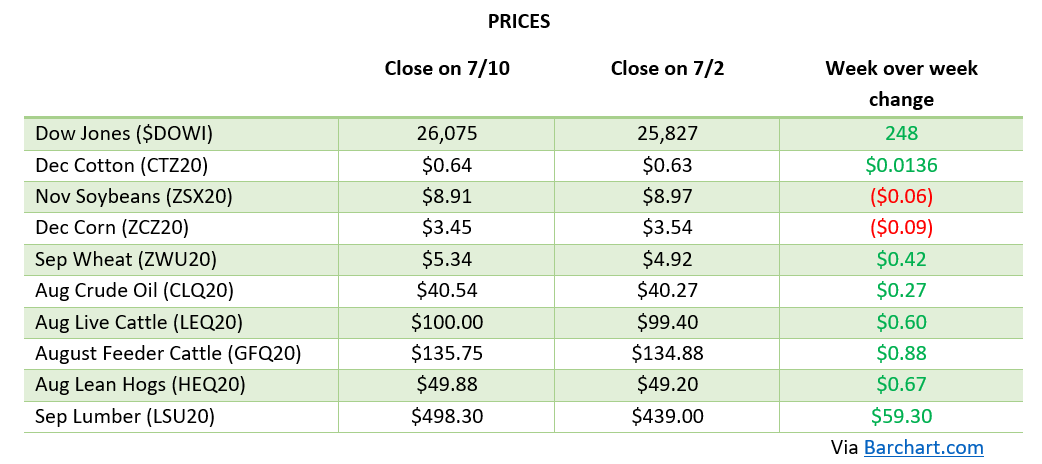
Corn had a choppy week only to end $0.09 lower after last week’s shockingly bullish USDA report. The main price mover this week was the uncertainty in the weather outlook. The weather post July 15th has been in limbo of hot and dry or cooler with some rain. Hot and dry would hurt the crop for the long run lowering yield, which is when we saw the prices rise on certain days. The post July 15th to August 1st period is very important to keep an eye on moving forward as the weather will be the key mover and the August 10th USDA report is worth keeping an eye on. The eastern corn belt looks to have extreme heat and dryness over the next week after a round of rain earlier this week…but let’s be honest, the weather man is only right 10% of the time = changes to the forecast are expected and prices will react.

“Supply side for corn ad beans adjusted due to the changes in planted area, so nothing too exciting there. But corn demand got cut quite a bit. Even so, the ending stocks are below trade expectations,” Scoville says (agriculture.com)


Soybeans had a similar week to corn with some up and down price movement after the rally last week. The hotter and drier outlook in parts of the Midwest will have an adverse effect on the crop like it will for corn. The lack of sales to China is are still holding back the market as Phase 1 continues to trail behind trade goals. Like corn, keep an eye on weather moving forward but as mentioned before. And big purchases from China would be a promising sign, but it doesn’t seem like that’s bound to happen any time soon:

Meanwhile, trade relations between the U.S. and China remain relatively frosty. President Donald Trump noted earlier today that relations are “severely damaged” after each has accused the other of mishandling the coronavirus pandemic. Trump indicated a planned phase-two trade agreement is still on the table but is not a priority right now. (farmprogress.com)


Wheat got a boost this week (+$0.42) as Russia and Europe’s wheat crops look to come in well below pre-harvest estimates. Low harvest numbers from the rest of the world is bullish for U.S. wheat prices as our growing season continues. This boost is very welcome following the last few months of declining prices. The markets will keep an eye on Russia and Europe as they progress through harvest.


Via Barchart


Dow Jones
The Dow continues to move on any news related to COVID-19. A lot of uncertainty hangs over the U.S. and the markets as spikes in cases continues around the country. An important thing to keep an eye on for the markets will be what schools decide to do in the fall, as going back to school is being used as a tool to also try and continue to reopen the economy.

Lumber
September lumber futures reached a multi-year high this week and are now up +82% from their April multi-year low. The best way to sum up the market place is by watching it print. It was up $48 – $498 since Wednesday. There isn’t enough wood to supply the needs, and mills are raising prices at will. It is a market squeeze that only ends once the pipeline is filling or prices shut down purchase order books.