Category: Market Updates

12 Jun 2026

AG MARKET UPDATE: MAY 29 – JUNE 12

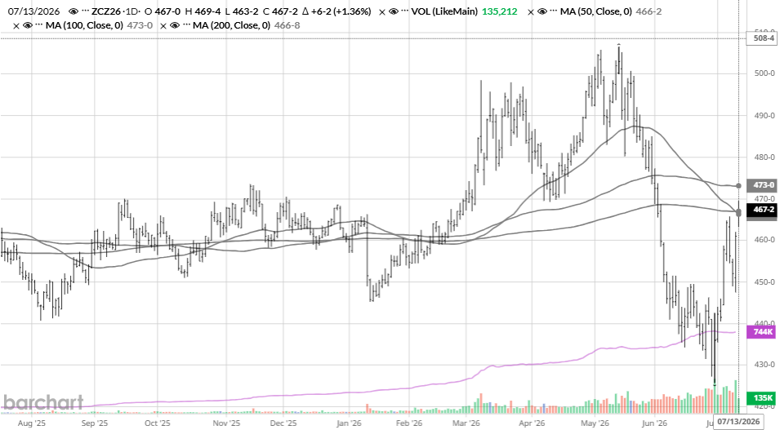
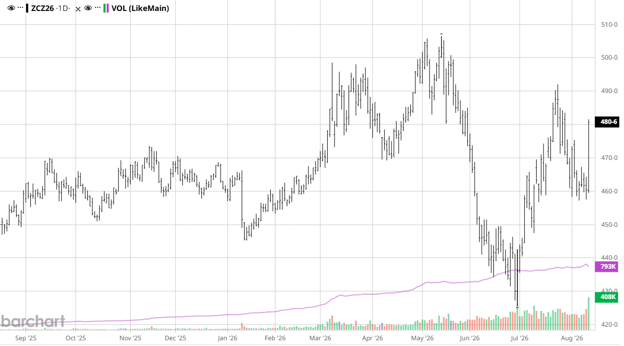
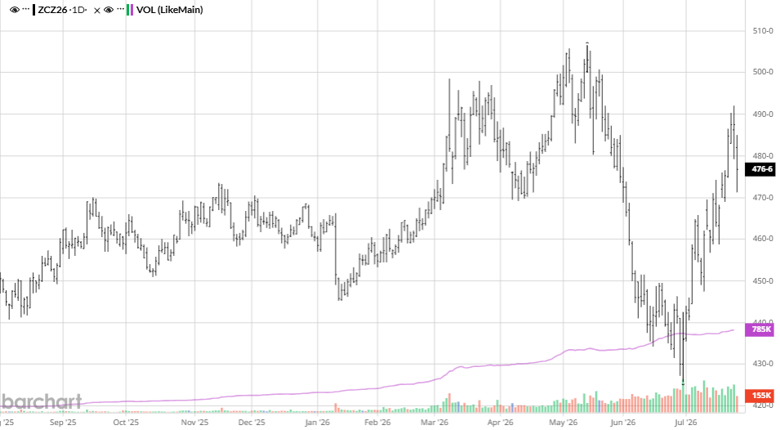
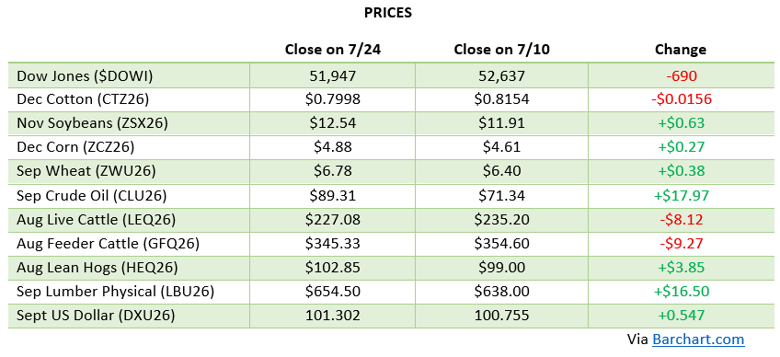
Corn has been under persistent pressure since Memorial Day weekend, with funds aggressively liquidating long positions built up over the spring. Managed Money has sold hard across the corn market going on the last 3 weeks, while the pace has slowed, they could continue selling if they want. The primary catalyst has been a combination of favorable planting weather, excellent crop establishment across the corn belt, and a crude oil market that has been retreating as Iran peace talks progressed. The June WASDE brought few surprises on corn. USDA described the 2026/27 corn outlook as “virtually unchanged” from May, with ending stocks coming in at 1.942 billion bushels and the season-average farm price forecast held at $4.40 per bushel. Old-crop 2025/26 ending stocks ticked up slightly to 2.145 billion bushels on a modest increase in imports, keeping carry extremely comfortable. The one positive was exports, but it was not enough to keep corn up close to $5. 96% of corn has been planted with a 67% good/excellent rating to start the week.

Via Barchart

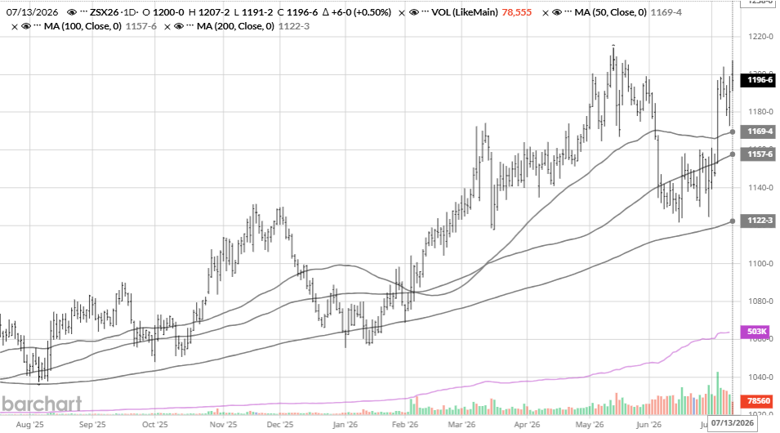
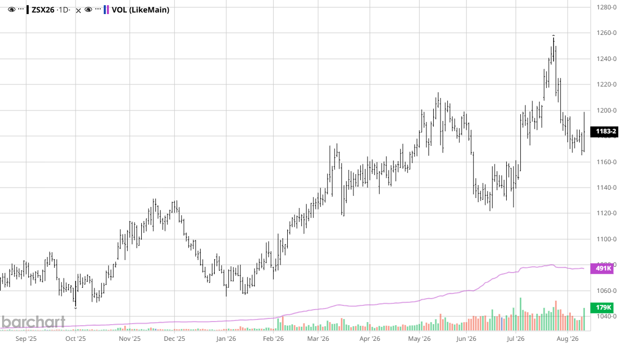
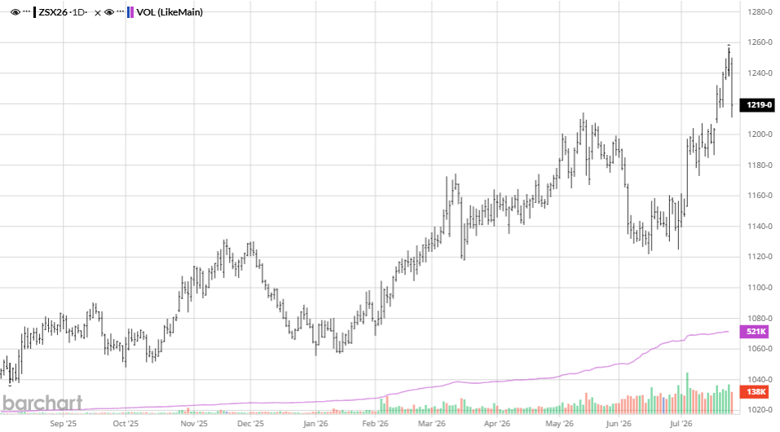
Soybeans have been caught in the same fund liquidation wave as corn, though they’ve shown more resilience given the tighter fundamental backdrop established in the May WASDE Report. July beans settled near $11.15 heading into the June 11th report. The soybean complex did find a brief bounce mid-period on continued strong crush margins and some renewed optimism around a potential Trump-Xi bilateral trade framework, but it didn’t hold. Planting pace has been exceptional, with 92% of beans in the ground and South American supply estimates remain large, with USDA maintaining Brazil’s 2025/26 crop and making only minor tweaks globally.

Via Barchart

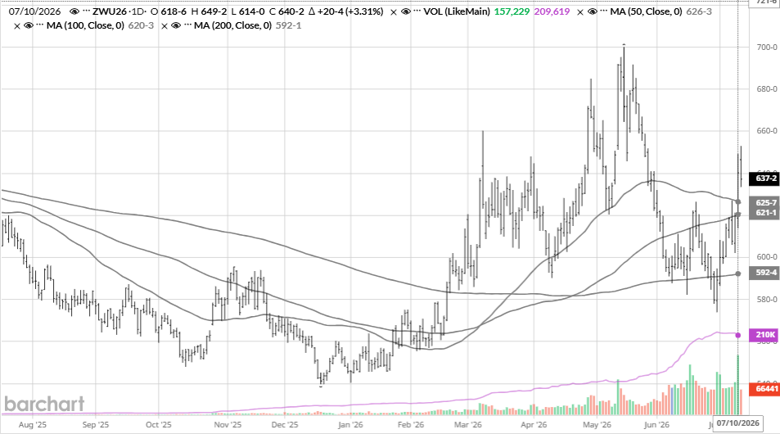
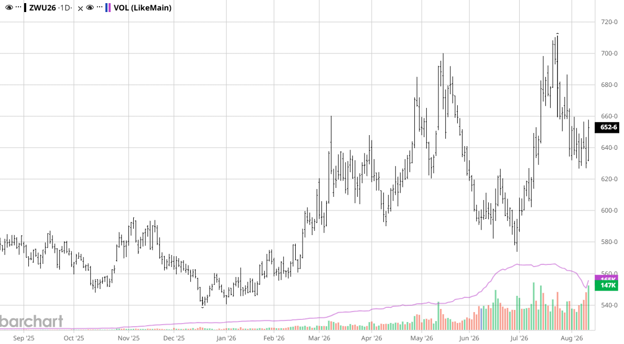
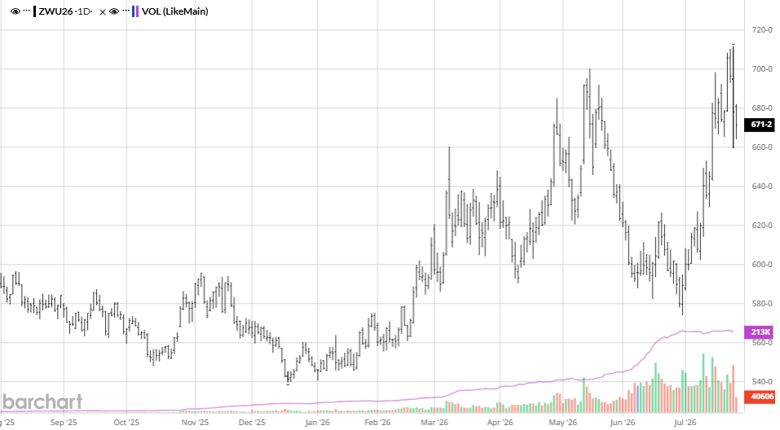
Wheat has been the most volatile market of the period, but not in the direction bulls had hoped. After touching multi-year highs in mid-May on the back of the historically small U.S. winter wheat crop, both Chicago SRW and KC HRW futures have been in a steady slide. July SRW dropped from around $6.36 to the $5.86 area during the period before attempting a bounce, while July KC HRW fell from the mid-$6.70s to the low $6.30s. The catalyst for the pullback was a combination of timely rains arriving in Kansas and Nebraska late in May, some improvement in crop conditions relative to the worst-case scenarios, and funds taking profits after an extended rally.

Via Barchart

Equity Markets

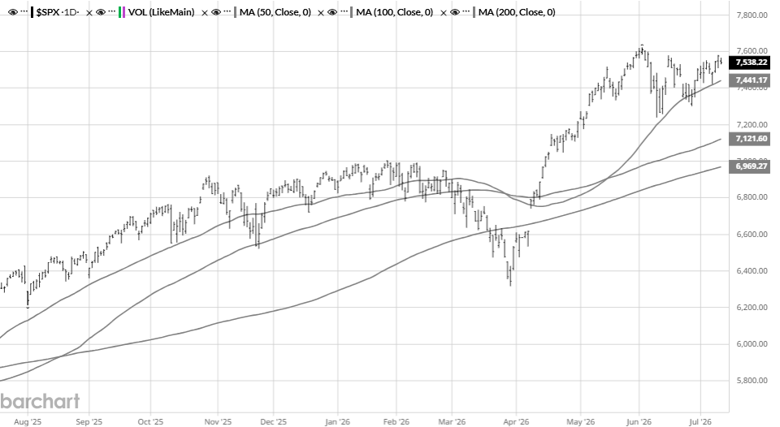
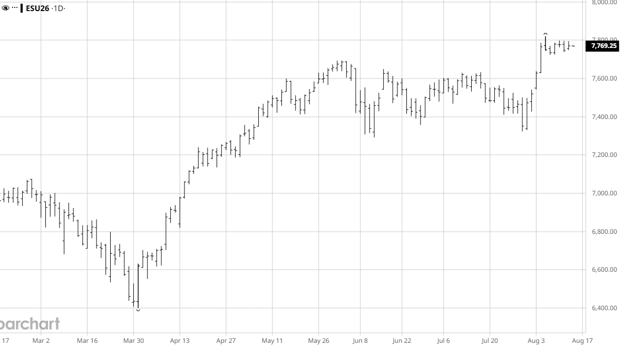
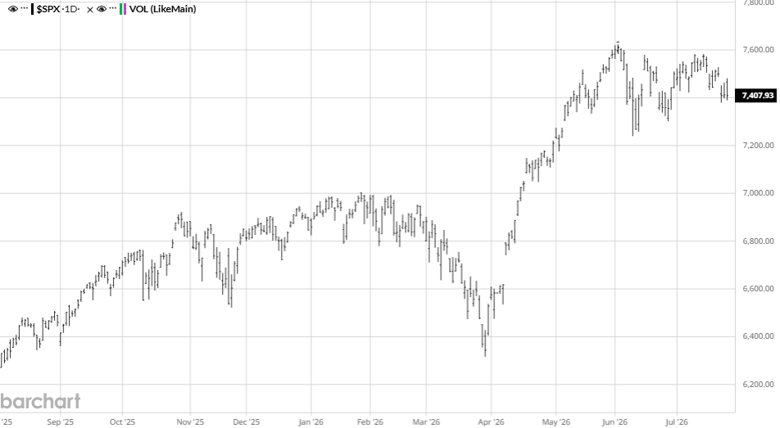
Equity markets have continued an impressive run with volatility recently and profit taking in some of the high flyers leading to a few heavily lower days. With inflation still a worry many investors believe that we are likely to see a rate HIKE before the end of the year rather than another cut.

Via Barchart

Energy Markets

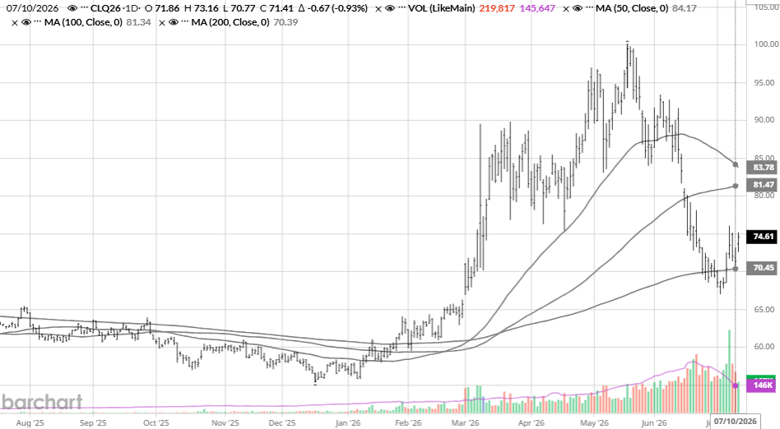
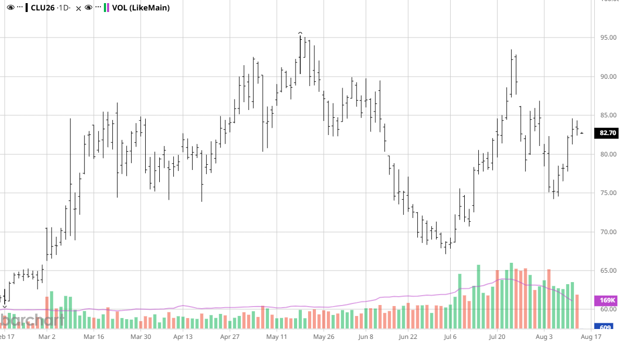
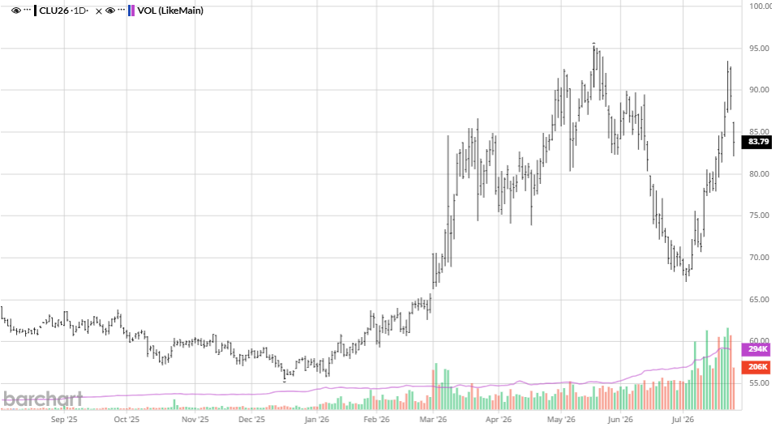
Crude oil has been the dominant macro variable across all markets and the primary driver of the grain complex selloff over the past two weeks. WTI has fallen sharply from its spring highs above $110 per barrel as Iran peace negotiations have progressed, at times with apparent momentum, though the path has remained anything but straight. The headline to end the week that there is an apparent Memorandum of Understanding to end the conflict in the Middle East took crude back below $85 to end the week.

Via Barchart

Other News

  • The June 30th USDA Planted Acreage and Grain Stocks reports are the next major scheduled market events. Any meaningful deviation in final corn or soybean planted acres from the March Prospective Plantings survey will be a significant market mover across the complex.
  • The New World screwworm situation in Texas received its first mention in the WASDE narrative this month, a reminder that animal agriculture has its own emerging risks to monitor alongside the geopolitical backdrop.
  • Cotton has pulled back with the broader commodity complex as crude oil retreated, removing some of the energy-driven premium that had made natural fiber more attractive relative to synthetics. Producers should continue to evaluate hedging strategies to protect margins at still-profitable price levels.


Drought Monitor

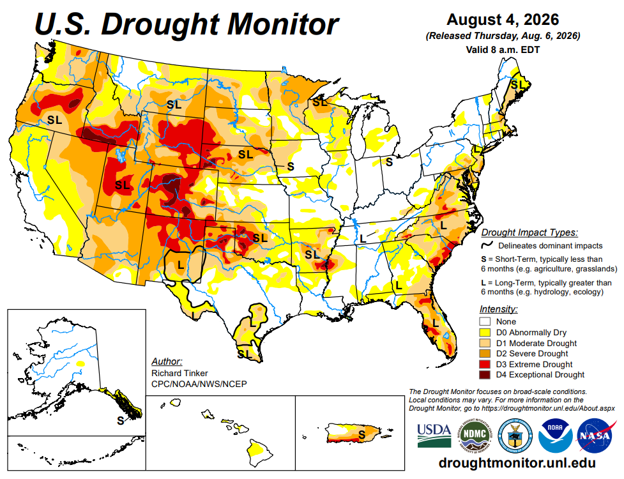
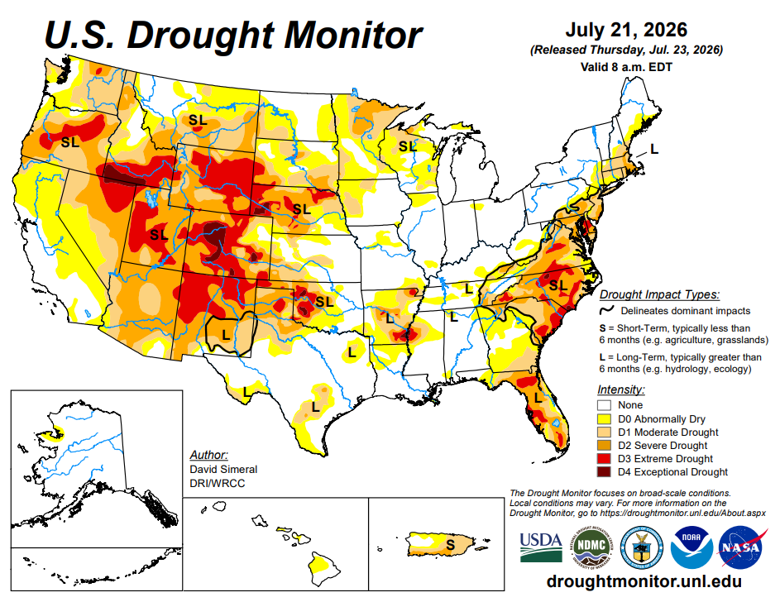
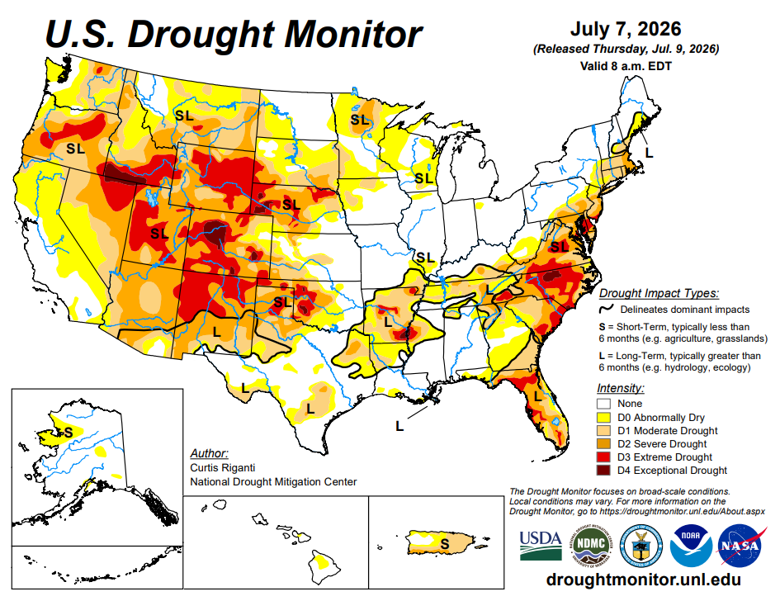
Here is the most recent drought monitor.
Contact an Ag Specialist Today

Whether you’re a producer, end-user, commercial operator, RCM AG Services helps protect revenues and control costs through its suite of hedging tools and network of buyers/sellers — Contact Ag Specialist Brady Lawrence today at 312-858-4049 or blawrence@rcmam.com.


10 Jun 2026

Leonard Lumber Report: After five weeks of chop, futures finally broke out

Summary:


After five weeks of chop, futures finally broke out. The $20 move was a welcome sight and pulled cash along with it. Mills did their part keeping a lid on things—trying to build files rather than chase. Classic lumber pop. No one’s shocked that it is happening.

The question is what comes next.

Normally, this is where a market starts to build a run. But recent history says these moves have been one-and-done. So, at 608, I’m not ready to assume we’re headed for 618, then 628. This market still has to prove itself—and that likely means specs stepping in and buying strength, not just watching it.

There are a few things working in favor of this move:

– We haven’t had a real “fear buy” all year. It’s been fill-ins the whole way. Even with tight items, the trade has stayed patient. That leaves the door open—if demand picks up even marginally, this thing can go.

– Logistically, trucking remains a mess. The spread-out supply chain is limiting the typical fill-in business. That can flip the script quickly and turn into a short-term chase if availability tightens in the wrong spots.

Bottom line: the breakout matters—but the market lacks any conviction . If the specs show up, we can extend. If not, we will be talking about the next “big one to come again.”

Technical:

On the technical side, it helps explain why these rallies struggle to stick.

An RSI pushing 78% on just a $20 move isn’t normal. You took a five-week dead market and drove it straight into overbought territory in a handful of sessions. That kind of compression + quick release tends to exhaust itself early—not build into a sustained leg higher.

That said, it’s been so long since we’ve had any real follow-through that fading this outright feels premature. That said, the Sept premium starting to widen should be at least looked at. 

This market needs to keep rallying.

Let’s start with a close above 610 in July. Hold that, and you can begin talking about extension. Fail there, and this risks being another quick pop that runs out of gas just like the others.

Daily Bulletin:

https://www.cmegroup.com/daily_bulletin/current/Section23_Lumber_Options.pdf

Southern Yellow Pine:

https://www.cmegroup.com/markets/agriculture/lumber-and-softs/southern-yellow-pine.volume.html

The Commitment of Traders:

https://www.cftc.gov/dea/futures/other_lf.htm


About the Leonard Report:

The Leonard Lumber Report is a column that focuses on the lumber futures market’s highs and lows and everything else in between. Our very own, Brian Leonard, risk analyst, will provide weekly commentary on the industry’s wood product sectors.


Brian Leonard

bleonard@rcmam.com

312-761-263

29 May 2026

AG MARKET UPDATE: MAY 8 – 29

Corn has been a market defined by a tug-of-war between a bearish domestic supply picture and a geopolitical premium that refuses to fully disappear. Coming off the May 8th close, December corn had briefly flirted with the $5 level before pulling back as Iran peace talk optimism ebbed and flowed. The May 12th WASDE report, the first to include 2026/27 new-crop estimates, was the dominant event of the period. USDA pegged 2026/27 corn ending stocks at 1.957 billion bushels, down from 2.142 billion for 2025/26, a modest tightening but still well above comfortable levels. The initial reaction was muted, with the market already priced for a heavy supply picture. July corn futures settled in the $4.55 neighborhood in the days following the report, well off recent highs.

The real story in corn continues to be the fertilizer situation. Nitrogen prices, which spiked sharply when the Strait of Hormuz conflict erupted in late February, have only partially retreated from their peaks. Farmers across the country are scrambling for alternatives, manure, biofertilizers, and bio stimulants, but the economics remain challenged. This cost pressure has some analysts believing final planted corn acres could come in below USDA’s March intentions survey. Planting progress has been strong, with the week of May 24th showing approximately 89% of the crop in the ground, well ahead of the five-year average. Export inspections continue to run well ahead of last year’s pace, providing a supportive underpinning, and a flash sale of nearly 19.4 million bushels to Mexico was announced mid-month. If you can sell corn at profitable levels above your cost of production, it remains a reasonable conversation to have with your merchandiser given the uncertainty that still lies ahead.

Via Barchart

Soybeans were the standout performer of the period, posting their most significant rally in months following the May 12th WASDE. USDA surprised the trade by projecting 2026/27 soybean ending stocks at just 310 million bushels, a full 30 million below the 2025/26 figure and roughly 45 million below analyst expectations. The primary driver was a massive projected increase in crush demand, with USDA forecasting 2.750 billion bushels of crush for 2026/27, up 120 million from the current year, on the back of exceptional crush margins and booming soybean oil demand as a biofuel feedstock. Board crush margins holding well above $3 per bushel remain historically exceptional and are lending strong support to nearby contracts. July soybean futures spiked to two-year highs in the wake of the report.

The rally has since come under some pressure, with planting progress running exceptionally fast, 79% of intended soybean acres were in the ground as of May 25th, ahead of the 68% five-year average and significantly above last year’s pace. Brazil’s Conab and USDA left South American production estimates largely unchanged, with Brazil expected to produce another enormous crop in 2026/27. Year-to-date U.S. soybean export shipments trail last year’s pace by about 21%, which remains an overhang on any sustained rally. Still, with domestic crush demand as strong as it has been in years, beans have a fundamental story to tell that corn simply does not right now. The long-awaited Trump-Xi meeting, which had been delayed repeatedly, amid the Iran conflict negotiations, remains a potential catalyst for a fresh round of Chinese buying that could push beans meaningfully higher.

Via Barchart

Wheat has been the most compelling story in the grain complex over the past three weeks, and for good reason. The May 12th WASDE delivered a shocking number: USDA projected 2026/27 U.S. winter wheat production at just 1.048 billion bushels, down 25% from 2025/26 and the smallest domestic wheat harvest since 1965. Severe, persistent drought across the Southern Plains, particularly in Kansas, Colorado, and Nebraska, has devastated crop conditions. At last check, only about 30% of the winter wheat crop was rated good or excellent, with maturity running well ahead of schedule due to extreme dryness. The recent volatility off contract highs took a big chunk out of the market but still holding over $6 in July wheat.

Via Barchart

Equity Markets

Equity markets have continued their remarkable run, with the S&P 500 and Nasdaq posting new all-time highs during the period. The AI trade remains the dominant factor with AI being the dominant story during earnings. While PCE inflation came in at 3.8% for April the markets shrugged it off mostly. Some AI related names have gone parabolic in the last month creating a tough environment if you want to own those names.

Via Barchart

Energy Markets

Crude oil remains the macro wildcard for the entire ag complex. WTI has been in a volatile, two-directional range throughout the period, with prices whipsawing on every Iran headline. Peace talk optimism has pushed oil down meaningfully from its April peaks above $110 per barrel, with analysts at UBS noting that crude has fallen roughly 20% from its 2026 highs on ceasefire negotiations. However, Iran crude loadings in May have run below 0.3 million barrels per day, a dramatic collapse from March’s 1.7 million barrels per day, meaning actual physical supply has not improved despite the diplomatic noise.

Via Barchart

Other News

  • Wheat’s surge to two-year highs has been the headline, but cotton has continued its own quiet rally. Hedge funds turned net bullish on cotton for the first time in two years this month as the war-driven surge in oil prices increased the appeal of natural fiber over synthetic alternatives like polyester and nylon, which require petroleum inputs. Producers who can lock in profitable margins at current levels while maintaining upside participation should be exploring their hedging options.
  • Iran is reportedly reviewing a formal U.S. peace framework that includes reopening the Strait of Hormuz to international shipping. Markets are cautiously optimistic but skeptical.
  • The EPA’s finalized 2026–2027 Renewable Fuel Standard volumes, set at record highs, continue to provide a structural floor under corn and soybean oil demand. Soybean crush is already running at historic highs in response, and these RFS volumes ensure that domestic demand will remain exceptionally strong regardless of where export flows go.

Drought Monitor

Here is the most recent drought monitor.
 

Contact an Ag Specialist Today

Whether you’re a producer, end-user, commercial operator, RCM AG Services helps protect revenues and control costs through its suite of hedging tools and network of buyers/sellers — Contact Ag Specialist Brady Lawrence today at 312-858-4049 or blawrence@rcmam.com.




27 May 2026

LEONARD LUMBER REPORT: Steady outtake, steady demand, steady prices

Summary:

Steady outtake, steady demand, steady prices—that’s a recipe for a dull trade with thin margins.

Seasonally, May into early June is dead money. “Sell in May and go away” exists for a reason. But this year, the takeaway is just firm enough to keep everyone from stepping away entirely. Add in historically lower field inventories (possibly by design), and the market doesn’t have the cushion to relax.

Right now, the industry is playing prevent defense—always on the field, focused on not losing. That’s a tough way to operate in a commodity business, especially when costs are sticky and conviction is low.


Flip Side:

I think what most are missing is that there are inventory pockets—and they’re full. It’s not enough to supply the whole market, but it’s a real risk for the guys sitting on it. And right now, there’s no appetite to hedge any of it.

In a market with no clear direction, that’s a problem. Everyone needs to stay disciplined—we’ve seen how quickly this can turn into a bottomless pit over the past year. It doesn’t take much. Hedge 20–30%, give yourself some cover, and live with it.

Step back and nothing has really changed in three years. The guys who bought wood and consistently hedged made money on the futures side—that’s just fact.

think the weakness is running out of gas… but I’ve said that before.

Starting back in June of 2023.


Technical:

Last week’s trade was a step back technically. It’s not a sell signal, but it did give back some hard-earned momentum. Most oscillators have rolled back to neutral-to-negative, and it’s going to take some work to turn those higher again. The fact one stayed positive since mid-April just reinforces how sideways this market really is.

Levels to watch:
July futures need a close over 603.50—the recent spike high—to confirm things are tightening underneath the surface.

On the downside, there’s real air between 580 and 560. That zone keeps catching volume month after month, with a few thousand contracts likely changing hands there since January. It’s become a magnet.

Markets tend to build a base in areas like that… and eventually move higher from them.


Daily Bulletin:

https://www.cmegroup.com/daily_bulletin/current/Section23_Lumber_Options.pdf

Southern Yellow Pine:

https://www.cmegroup.com/markets/agriculture/lumber-and-softs/southern-yellow-pine.volume.html

The Commitment of Traders:

https://www.cftc.gov/dea/futures/other_lf.htm


About the Leonard Report:

The Leonard Lumber Report is a column that focuses on the lumber futures market’s highs and lows and everything else in between. Our very own, Brian Leonard, risk analyst, will provide weekly commentary on the industry’s wood product sectors.


Brian Leonard

bleonard@rcmam.com

312-761-263

18 May 2026

LEONARD LUMBER REPORT: Housing data continues to grind along

Weekly Recap:

Key Takeaways:

On Friday, May futures expired a buck over July. That means that there is no downside gap to go after. Also, the spread traded +4. We haven’t seen that since Sept of 2023. A case is building for less bad…

Housing data continues to grind along—not hot, not falling apart. 2026 is pacing slightly ahead of last year, but the bigger story remains margin compression. Costs are sticky, financing isn’t getting easier, and the entire chain is operating lean. Demand is there, but conviction is thin. This isn’t a demand problem—it’s a willingness problem. Nobody is comfortable. Dealers are hand to mouth; builders are managing starts carefully, and big boxes are still questioning turns versus dollars. The “feel” of the market is cautious participation—everyone’s involved, just with one foot in. We only see a trade when values dip into perceived replacement. There bids show up quickly, confirming underlying need. The lack of follow-through higher speaks more to positioning than fundamentals. Right or wrong structure remains the story.

Bottom Line
This is a low-conviction, high-cost environment. The market isn’t breaking—it’s grinding. Choppy trade, quick reactions to value, and limited downside follow-through remain the base case. The futures trade is confirming. The question is if the May trade means anything or not.

Technical
The market is flat. Price action continues to compress after repeated lower highs, but the pace of the declines is slowing. That flattening suggests selling pressure is losing momentum. Key levels are tightening, and the market feels like it’s coiling rather than trending. A push through recent highs would likely draw in momentum buyers, while dips are still being met with value-driven support. The wedge trendlines now sit at 596.90 and 558.30.

The lumber market doesn’t grind and then spike. A grind is usually met with more grinding. Lumber needs news to generate interest. So right now, we are looking at a close over 597 to push futures up to the 602 point etc. Last week’s low in May was 574.

Lots of verbiage for “same shit, different day.”

Daily Bulletin:

https://www.cmegroup.com/daily_bulletin/current/Section23_Lumber_Options.pdf

Southern Yellow Pine:

https://www.cmegroup.com/markets/agriculture/lumber-and-softs/southern-yellow-pine.volume.html

The Commitment of Traders:

https://www.cftc.gov/dea/futures/other_lf.htm


About the Leonard Report:

The Leonard Lumber Report is a column that focuses on the lumber futures market’s highs and lows and everything else in between. Our very own, Brian Leonard, risk analyst, will provide weekly commentary on the industry’s wood product sectors.


Brian Leonard

bleonard@rcmam.com

312-761-263

11 May 2026

LEONARD LUMBER REPORT: Housing data continues to lean neutral-to-slightly better

Weekly Recap:

Macro / Demand Housing data continues to lean neutral-to-slightly better, with 2026 new home numbers running modestly ahead of 2025. Currently we do not a recessionary setup—but a margin problem. Inflation-driven costs keep squeezing profitability across the chain, leaving builders and dealers operating day-to-day with little appetite for risk. Demand exists, but conviction doesn’t. The market is reverting to its mean where there are no more easy buys, replacement cost are higher, and resistance to paying up is building. Ironically, that reluctance could be what sets up higher prices later—higher prices, not demand destruction, may become the real pain point. Let’s note that the wood trading today is very cheap on a relative basis so the higher replacement is what it seems.

Industry Tone Everyone is still making money—but no one feels good about it. Big boxes are questioning SKU economics; homeowners are tapped out after years of upgrades, and low-rate mortgages are freezing mobility. It’s a functioning market, just not a comfortable one.

Futures / Structure The July contract continues to absorb the pressure from the roll, which is breaking away from the norm so far.  This appears less about excess inventory and more about real-time procurement replacing forward planning. Elevated replacement costs are forcing buyers to stay closer to the front month, sidelining second-month participation. Prior buying interest under May $570 suggests futures are being used efficiently when value shows up—signaling underlying need, not speculation. Any second month contract sub-$580 still screens as value, but patience is scarce. Like May, July increasingly looks like a delayed bear trap rather than true weakness. We continue to see the industry shorts liquidate telling us the key for basis, the sharp break possibility, is limited.

Bottom Line This remains a low-conviction, high-cost market. Structure—not demand collapse—is driving price behavior. Until margins stabilize or a catalyst hits, expect choppy trade, shallow dips, and value recognition as a timing tool, not a dollar.

Technical:

Since mid-2025, the market has produced four cycle-high rallies, each followed by a lower trend. Notably, the slope of each selloff has been flattening. The current weekly pattern—marked by a blowoff move lower followed by a marginally improved trade—could be signaling the start of a fifth cycle higher. This view is based on the May contract. With May expiring this week, timing makes the call difficult. The weekly trendline comes in near 554. If May can hold above that area, it would argue the next cycle is underway.

The technical read has only offered small portions of data and not much directional help recently. It looks as if there isn’t much offered in either cash or futures today.


Daily Bulletin:

https://www.cmegroup.com/daily_bulletin/current/Section23_Lumber_Options.pdf

Southern Yellow Pine:

https://www.cmegroup.com/markets/agriculture/lumber-and-softs/southern-yellow-pine.volume.html

The Commitment of Traders:

https://www.cftc.gov/dea/futures/other_lf.htm


About the Leonard Report:

The Leonard Lumber Report is a column that focuses on the lumber futures market’s highs and lows and everything else in between. Our very own, Brian Leonard, risk analyst, will provide weekly commentary on the industry’s wood product sectors.


Brian Leonard

bleonard@rcmam.com

312-761-263

08 May 2026

AG MARKET UPDATE: APRIL 17 – MAY 8

Corn has been a tale of two forces over the past three weeks. Coming off the euphoria of Iran’s Strait of Hormuz reopening announcement on April 17th, markets initially attempted to stabilize, but that news seemed short-lived as volatility in the middle east kept markets volatile. With the war premium in and out of the market, it has been trying to trade both geopolitical news and fundamentals, and those fundamentals remain heavy. U.S. ending stocks at 2.127 billion bushels, the highest in seven years, kept a ceiling on any sustained rally, and fast planting progress added some pressure. The USDA’s crop progress report showed nationwide corn plantings at 38% planted. Exports remain strong as the potential for a smaller US crop with higher fertilizer costs keep buyers in the market at these price levels. December corn popped above $5 for a couple days but quickly fell back as it fell with crude on peace talks. Geopolitical events are hard to predict, especially with this White House, so if you get the opportunity for profitable sales, it would be something worth considering because if crude drops back to $70-80/barrel and we have another record/near record crop it will be hard to hold these levels or move higher.

Via Barchart

The market continues to wait for a fresh demand catalyst, and the one most closely watched, a potential resumption of Chinese buying linked to a Trump-Xi summit, has been repeatedly delayed amid ongoing Iran conflict negotiations, but appears to be on for this month. The bullish case for soybeans continues to rest on crush economics. Board crush margins holding above $3 per bushel are exceptional by historical standards and are supporting the nearby contracts. NOPA March crush are expected to far exceed year-ago levels, underscoring the strength of domestic demand for meal and oil. Brazil’s Conab raised its 2025/26 soybean production estimate once more to 6.582 billion bushels, and May shipment estimates from Brazil’s Anec were raised to 533.8 million bushels, peak export season for the world’s largest shipper. That supply overhang remains the key obstacle to a sustained rally with South America having such a large crop. Beans planted were at 33% for the week of May 4th, slightly lower than expected but still very strong for this time of year.

Via Barchart

Equity Markets

Equity markets continue to make new highs on the back of the AI trade with names like Micron, SanDisk and Western Digital screaming higher and other tech names having a very strong April with the NASDAQ Index up over 15% in the month. Big players such as Google, Meta, and Amazon reported in the last 2 weeks with mixed results but the markets moved higher.

Via Barchart

Energy Markets

Energy has remained the dominant macro force across all commodity markets, though the price action has been far more volatile and two-directional compared to the one-way crude rally seen earlier in the spring. This push-pull between ceasefire hopes and renewed escalation threats has created a volatile and headline-driven energy market. For ag producers, the primary implication is that fertilizer cost relief remains partial and uncertain. Diesel costs have come down from peak levels but are not back to pre-war norms, and nitrogen prices, which spiked nearly 40% during the war, have only partially retreated.

Via Barchart

Other News

– Cotton has continued its run higher on demand from overseas buyers with alternative fibers such as polyester needing oil for production. Growers can be profitable at these levels so having a hedging strategy where you protect the downside but can still participate in any further upside is very important.

– EPA finalized 2026–2027 Renewable Fuel Standard volumes at record highs, a development that could meaningfully increase ethanol demand and provide a long-term supportive floor under corn prices.

– Iran is reportedly evaluating a U.S. peace proposal that includes a full reopening of the Strait of Hormuz by both sides. Markets expect Iran’s formal response in coming days, making this the single most important macro event in the near-term commodity outlook.

– The May 12th USDA WASDE report will include the first official 2026/27 production forecasts for all major crops. Given the wheat situation in the Plains and uncertainty around corn acres, this report has the potential to be a significant market mover across the complex.


Drought Monitor

Here is the most recent drought monitor.


Contact an Ag Specialist Today+

Whether you’re a producer, end-user, commercial operator, RCM AG Services helps protect revenues and control costs through its suite of hedging tools and network of buyers/sellers — Contact Ag Specialist Brady Lawrence today at 312-858-4049 or blawrence@rcmam.com.



04 May 2026

LEONARD LUMBER REPORT: Lumber futures are choppy and directionless

Recap:

Lumber futures are choppy and directionless, basically mirroring a housing market stuck in neutral. From the builders to distribution, the game plan is to contain losses.

  • The macro housing backdrop is decisively neutral. Existing‑home sales are weak, first‑time buyers are sidelined, inventory is improving only marginally, and mortgage rates remain a headwind—not a catalyst. Nothing here supports sustained upside, but nothing forces a full reset either.

  • Technically, May futures have found support near $570, helped this time by available EFPs, which are pulling buyers back into futures on a hand‑to‑mouth basis. The weekly wedge keeps tightening, suggesting a breakout window approaching into May expiration, though timing remains tricky without a catalyst.

Bottom line:
Futures are doing exactly what a neutral market does—failing rallies, finding buyers on weakness, and chopping traders to death. Until affordability actually improves or demand breaks meaningfully, this remains a range of trade driven more by structure and discounts than by confidence. Add to it that the industry likes the long side, and the funds continue to sell confirm more of the same.

Daily Bulletin:

https://www.cmegroup.com/daily_bulletin/current/Section23_Lumber_Options.pdf

Southern Yellow Pine:

https://www.cmegroup.com/markets/agriculture/lumber-and-softs/southern-yellow-pine.volume.html

The Commitment of Traders:

https://www.cftc.gov/dea/futures/other_lf.htm


About the Leonard Report:

The Leonard Lumber Report is a column that focuses on the lumber futures market’s highs and lows and everything else in between. Our very own, Brian Leonard, risk analyst, will provide weekly commentary on the industry’s wood product sectors.


Brian Leonard

bleonard@rcmam.com

312-761-263

27 Apr 2026

LEONARD LUMBER REPORT: The futures trade was dominated by the roll last week

Recap:

The futures trade was dominated by the roll last week. That said, it made a new contract low and then rallied. We saw that pattern a week earlier—and frankly, we’ve seen some version of it for nearly two years now. Rallies continue to lack momentum, fail quickly, and ultimately find themselves testing new lows.

A technician put it best last week: these trends are neither bullish nor bearish—they’re bullshit. There’s no trend, no follow‑through, and no conviction.

The broader economic backdrop for housing remains decisively neutral, and neutral markets have a nasty habit of killing their own rallies without outside help. That’s exactly where we sit today.

So, let’s look at a few housing headlines for more color.

Housing Headlines 

• Existing home sales remain sluggish.
March existing‑home sales fell 3.6% month‑over‑month to an annualized pace just under 4.0 million units, the weakest March pace since 2009. Sales declined in all four regions, underscoring just how little organic momentum exists in the market. [markets.bu…nsider.com]

Existing home sales are projected to stay in line with 23-24 and 25. Without a rate cut expect slow sales and low inventories.

 The macro effect:

“This has caused multifamily executives to lower their expectations for total 2026 multifamily sales volume and starts.”

• First‑time buyers are effectively sidelined.
First‑time buyers accounted for only 21% of transactions, a record low and well under the historical norm near 40%. The market is increasingly split between equity‑rich owners and would‑be entrants who simply can’t make the math work. [crosscount…rtgage.com] Can’t make it work…. nice.

From NAR, first time home buyers fell to a record low. They made up only 21%. That group was always in the high 30 percentile.

• Inventory is improving—but not enough to matter .
Active listings are rising year over year, and months’ supply has crept above four months, technically closer to “balanced.” But inventory is still well below pre‑pandemic norms, offering just enough supply to cap prices—not enough to stimulate volume. [mortgagetech.ice.com]

• Prices refuse to break—only flatten.
Despite weaker sales, median prices continue to grind higher on a year‑over‑year basis, driven by limited supply and locked‑in owners. Zillow expects roughly flat price appreciation in 2026, reinforcing the idea of a capped, sideways market rather than a corrective one. [zillow.com]

Builders I work with are staying on course and keeping production at the planned 2026 amount. “Head down and grind ahead” seemed to be the common theme.

• Mortgage rates remain a headwind, not a catalyst.
Rates dipped briefly below 6% earlier this year, but volatility tied to macro uncertainty pushed them back toward the mid‑6% range. That swing was enough to choke off affordability gains but not enough to force capitulation selling. [cnbc.com]

To sum it up:

There’s nothing here that argues for sustained upside—and nothing ugly enough to force a structural reset. Housing is stuck in neutral, and lumber reflects that reality perfectly. Rallies fail because they’re supposed to. Weakness finds buyers because costs, supply, and discounts still matter.

Until affordability actually improves or demand meaningfully breaks—this remains a market that chops itself to death, one failed rally at a time. It bothers me every time we use the affordability excuse. The is more fundamental issues involved.

Technical:

The May contract has found support in the $570 area. The fact that there are EFP’s available this time has brought the buyers back to the futures market at a price. This hand to mouth environment tends to magnify deals. Today it is in futures.

The starts projection is for 1.38. Permits are 1.39.

The weekly wedge pattern keeps getting tighter. The breakout looks to be a few weeks from now. May expiration could be interesting.

20 Apr 2026

LEONARD LUMBER REPORT: Futures experienced a very quiet, trendless trade last week

Recap:

Futures experienced a very quiet, trendless trade last week. Many are pointing to the Montreal gathering as the culprit, but it’s questionable whether any meaningful movement would have materialized regardless. May finished the week up $6, though total volume remained light throughout.

The only notable development came from the Commitment of Traders report, which showed another sizable jump in producer longs alongside a further increase in fund shorts. Overall, the best way to describe last week’s trade is simply uneventful.

The futures market managed to hold above a new low on this move, suggesting there is still underlying demand working its way through the pipeline. Given how firmly JIT buying is entrenched, that tension is always present, but today there appears to be a distinctly more spring‑like tone.

Much of the futures buying remains hedge‑related, with pending business waiting to surface. How and when that demand ultimately flows into the market is still uncertain. The key takeaway is that the marketplace continues to wrestle with supply concerns. Many remain uneasy that even a modest uptick in demand could quickly tighten conditions. For now, buyers are paying more than they’ve grown accustomed to.

Technical:

The reality of this trade is that for the past three years the market has needed an “event” to break it out of its narrow range and today is no different. There is still no data pointing to a meaningful pickup in demand. For futures to move materially higher, it would take a rally strong enough to trigger fund short covering.

With projected construction activity for Q2 and Q3 holding steady, there is little justification for a sharp selloff either. That said, if the algos or the funds lean back into the short side, prices could fall quickly. They don’t measure value — they simply sell.

The futures market saw a sharp selloff in February, followed by a solid recovery in March, though prices remained below the February highs. April is now showing signs of drifting back toward those February lows. As this illustrates, the market continues to trace a slow, uneven stair‑step lower. Historically, that type of pattern has been proven unreliable.

This may end up being a period where the cash market holds firm, while long futures hedges continue to take the brunt of the pressure.


Daily Bulletin:

https://www.cmegroup.com/daily_bulletin/current/Section23_Lumber_Options.pdf

Southern Yellow Pine:

https://www.cmegroup.com/markets/agriculture/lumber-and-softs/southern-yellow-pine.volume.html

The Commitment of Traders:

https://www.cftc.gov/dea/futures/other_lf.htm


About the Leonard Report:

The Leonard Lumber Report is a column that focuses on the lumber futures market’s highs and lows and everything else in between. Our very own, Brian Leonard, risk analyst, will provide weekly commentary on the industry’s wood product sectors.


Brian Leonard

bleonard@rcmam.com

312-761-263