

Category: CME

29 Sep 2025

LEONARD LUMBER REPORT: The market has a firmer tone to it

Weekly Recap:

The market has a firmer tone to it. Both cash and futures found support last week. Cash still struggles to find support for all items. That keeps the marketplace on edge. History tells us that distressed items like OSB or SYP will limit any spruce move. The difference this time is the fact that the market is firming on its own. Rumors help the futures market, but actual business supports cash. Bringing it back to futures, November was up $26 for the week with a Friday spike to $600. We spent the last 5 months looking for the catalyst to push prices higher. We go into next week looking for data to push it lower. That’s a good thing. It feels like a few years ago when the conversation centered on the price of production, with 1.3 starts and closures. It added up to the $620 futures number. Unforeseen was the drastic drop in all Chinese imports and the oversupply of OSB. All that has now been factored in. The question now becomes whether $620 futures and $508 cash are the magic numbers? We are not out of the woods, but the industry has become permabears. We saw that at the beginning of the summer, only to see November futures hit $712 on August 1st. “Hedge the premium and hope you lose money.”

The futures dynamics are returning to normal as the fund’s short positions start to dominate the open interest. The industry remains heavily long. This year, the industry has stayed in sync, while the funds have not. Spreaders are eager on this one, but history shows the industry often rolls longs to match the funds rolling shorts. This one isn’t an easy win.

Technical:

The outlook for the upcoming week is based on an if/then projection strategy. The 21-day moving average crossed above the 13-day on Friday. If that trend holds, the next target is the 38% retracement of 617.20. From there, we’ll consider 635.00 and beyond. The same pattern played out during the last two rallies. Positive fundamental data over the next few weeks will gradually develop; for now, it’s all about the technicals.

Daily Bulletin:

https://www.cmegroup.com/daily_bulletin/current/Section23_Lumber_Options.pdf

Southern Yellow Pine:

https://www.cmegroup.com/markets/agriculture/lumber-and-softs/southern-yellow-pine.volume.html

The Commitment of Traders:

https://www.cftc.gov/dea/futures/other_lf.htm

About the Leonard Report:
The Leonard Lumber Report is a column that focuses on the lumber futures market’s highs and lows and everything else in between. Our very own, Brian Leonard, risk analyst, will provide weekly commentary on the industry’s wood product sectors.


Brian Leonard
bleonard@rcmam.com
312-761-263
22 Sep 2025

LEONARD LUMBER REPORT: The market sold off over $30 last week on very light volume

Weekly Recap:

The market sold off over $30 last week on very light volume. The futures market is being pulled toward the cash price with help from the funds and algorithms. The low volume could signal a bottom forming. Bottoms take time, and new lows are often made before it happens. The industry is searching for reasons for improvement, which is slowing any selling when hedging should be in place. This keeps focus on their cash and not futures for help.

The funds added another 538, totaling 3, 3847. When the funds go short, the spread becomes defined, and that excites speculators. The chatter from now until October 15th will revolve around the spread. Usually, at this time of year, I expect the spread to move $10 while futures rally $50. But as they say, ” when in Rome….

“We heard from builder Lennar last week and will get more updates soon. I’m not revealing anything new; builders are pulling back, waiting for a shift in the rate environment. This is somewhat positive. Less building means less supply. I included a mortgage chart below. We saw a 6.19% rate last week before it climbed again on Friday. I’ve mentioned the yield curve dynamics before. The rate increase on Friday is concerning, but the trend has shifted. Will this change manifest at the desired pace? Probably not, but you can’t expect more lows if the trend has shifted. Rates are key. It might be time to break below 6%. You can cut production, but that might only lead to new lows. Conversely, a slight demand increase could generate momentum.

The biggest hurdle in our industry is the potential rise in unemployment. The latest claims figures and revisions from the previous week show a stable unemployment rate, which is a relief. Two reasons support steady employment: first, the substantial amount of capital injected into the system, which has not yet been spent; and second, the BBB, which will add capital. Both factors will keep corporate profits high and employment steady. While this isn’t positive for housing, it does ease one major headwind.

The funds added another 538 to 3847. When the funds get short, the spread has a definition, and that gets the specs fired up. The chatter from now until Oct 15th will be about the spread. At this time of year, I would bet that the spread moves $10 while the futures rally $50. But when in Rome….

We saw builder Lennar’s earnings last week and will hear more in the next few weeks. I’m not telling you anything you have not been told already. The builders are pulling back, waiting for the rate dynamic to change. That is mildly friendly. Build less and you see less. I included a mortgage chart below. We did see a 6.19% number last week before it turned back up on Friday. I have mentioned the yield curve dynamics in the past. The turn up of rates on Friday is troubling, but the worm has changed. Will that change show up at the pace we want? No, but you can’t look for more lows if things have changed. Rates are the key. It could be a time for a break of 6%. You can cut all the production you want, only to see new lows. On the other hand, only a slight demand increase will create momentum.

The biggest headwind in our industry is a possible bump in unemployment. The last claims number and the revision of the previous week show a flat unemployment environment. That was a relief. There are two reasons for steady employment. The first is the extraordinary amount of capital that was pushed into the system. It hasn’t all been spent yet. The other is the BBB. It will add capital to the system. Both will keep corporate profits higher and employment flat. That’s not a positive for housing, but eases one headwind.


Daily Bulletin:

https://www.cmegroup.com/daily_bulletin/current/Section23_Lumber_Options.pdf

Southern Yellow Pine:

https://www.cmegroup.com/markets/agriculture/lumber-and-softs/southern-yellow-pine.volume.html

The Commitment of Traders:

https://www.cftc.gov/dea/futures/other_lf.htm

About the Leonard Report:
The Leonard Lumber Report is a column that focuses on the lumber futures market’s highs and lows and everything else in between. Our very own, Brian Leonard, risk analyst, will provide weekly commentary on the industry’s wood product sectors.


Brian Leonard
bleonard@rcmam.com
312-761-263
16 Sep 2025

LEONARD LUMBER REPORT: “If you got long each time a rumor was sent out, you would have been buying the highs and exiting on a new low.”

The Lumber Market:

“If you got long each time a rumor was sent out, you would have been buying the highs and exiting on a new low.” What a great observation. The news that a mill would operate for 4 days and curtail production sent the futures market sharply higher on Friday. To put things in perspective, considering all the positive spins last week, the November futures closed down $1.50. Today, closing or curbing production is an extreme move. It comes after the mills fill up the K-Mart parking lots, expand the vendor management programs, and establish unorthodox reload programs. In other words, when they have too much wood. This process is a slow chipping away of the excesses. I’ll be the first one to claim being way too early in the call for par. I’m worried demand is slipping, making the decreases a wash.

Another silent market killer is the fact that JIT has changed dramatically. There isn’t a day that the cash guys aren’t in the market. They continue to build long-term inventories, which is the opposite of JIT. The disciplined cash buyer has been the employee of the year for the last two years. When they buy it is at lower levels. That needs to change for the market to shift.

The rate cut will help the psychology of the market. It will be positive at some point in the months to come. For today, the industry wants a rally to hedge. The funds adding shorts can help with a pop. 

The Technical Read:

The biggest takeaway and risk I see today via the technical read is that November futures were at $712.00 on August 1st. We talked about how futures were at $418 in July of 2024. Well, August 1st. was only 30 sessions ago. That is a $200 swing in a flat market. There is no clever way to project the market. The simple answer is buying the discounts or selling premiums in futures, and then you turn off the emails. Today, the technical read is trying to indicate a slow bottom forming. We have been here before, only to see a sharp spike followed by new lows.

Under a 200-plus swing environment, there is no reason not to buy the cash items you need that are hitting new lows. There is no reason not to hedge at a significant premium. This is no longer a blocking and tackling drill. It is full pads, two-a-days. It’s all about discipline. It’s all about market parameters. It’s all about the plan.

Note: We were looking for a catastrophic September close. What if it spikes?

Daily Bulletin:

https://www.cmegroup.com/daily_bulletin/current/Section23_Lumber_Options.pdf

Southern Yellow Pine:

https://www.cmegroup.com/markets/agriculture/lumber-and-softs/southern-yellow-pine.volume.html

The Commitment of Traders:

https://www.cftc.gov/dea/futures/other_lf.htm

About the Leonard Report:
The Leonard Lumber Report is a column that focuses on the lumber futures market’s highs and lows and everything else in between. Our very own, Brian Leonard, risk analyst, will provide weekly commentary on the industry’s wood product sectors.


Brian Leonard

bleonard@rcmam.com

312-761-263

15 Sep 2025

AG MARKET UPDATE: AUGUST 29 – SEPTEMBER 12

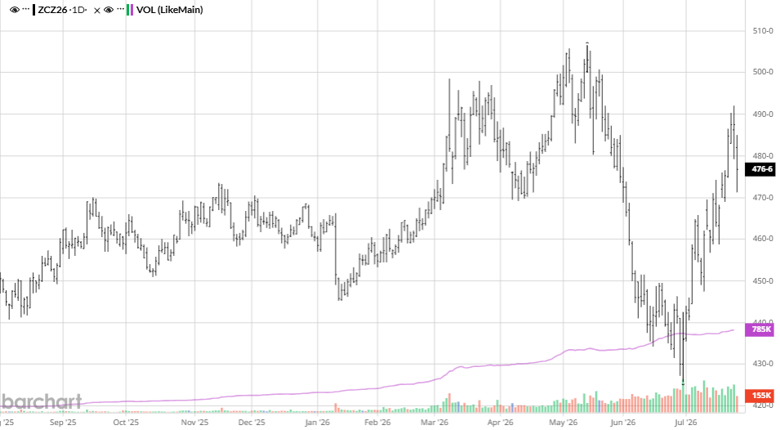
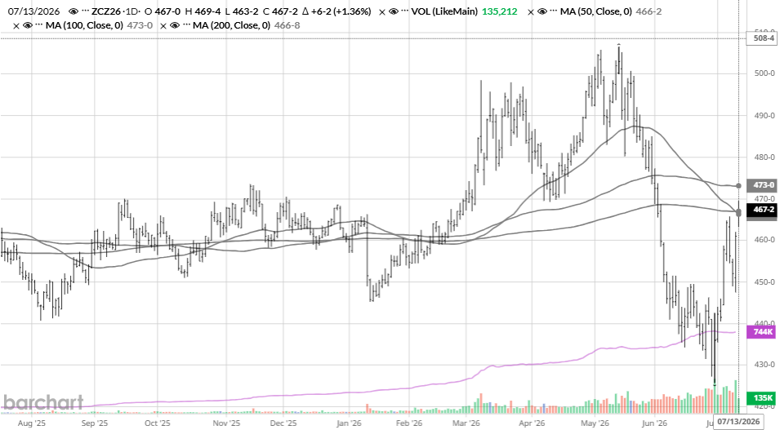
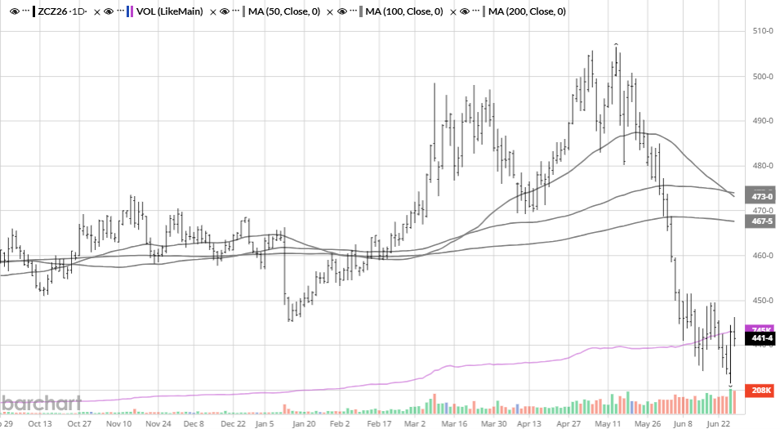
Corn continued to move higher off last month’s lows following the September USDA Report. Most of the numbers came in along estimates but they increased planted acreage 1.4 million acres. This brings the US corn crop to 98.7 million acres, a new record. With about 90 million acres expected to be harvested, we will harvest 7 million more acres this year than in 2024, which equates to about 2 billion bushels larger crop than last year. Despite the added acreage corn bounced post report as weather issues, a dry finish, and disease pressure have caused speculation on the real size of this crop. As harvest gets rolling we will learn more about this crop.

Via Barchart

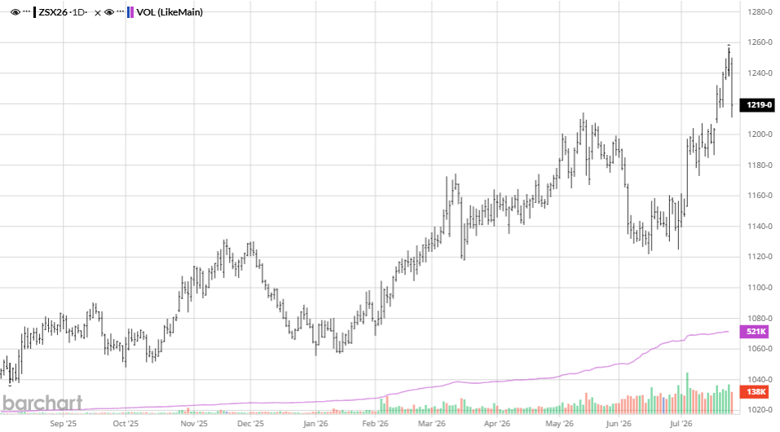
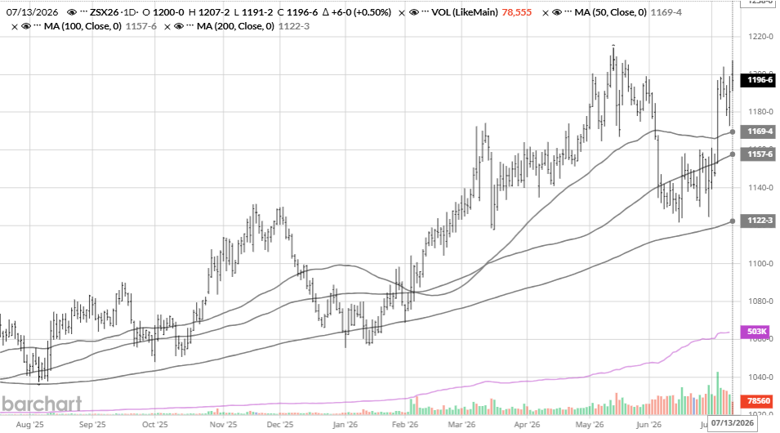
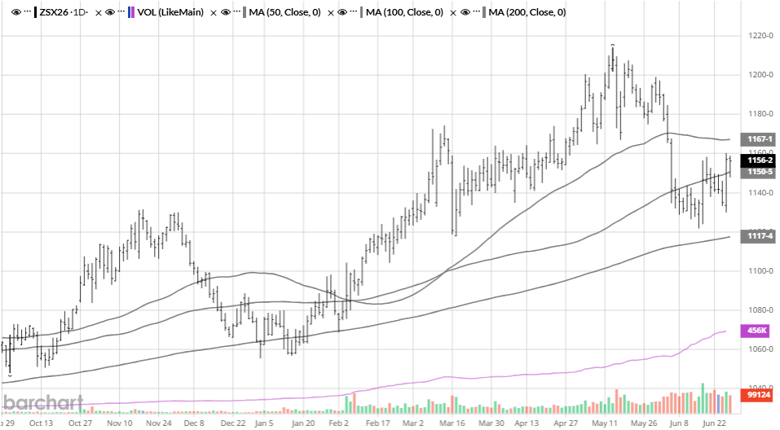
The USDA Report did not have any surprises for beans as most numbers were close to estimates, but the report could be viewed as slightly bearish. To get beans moving higher, China needs to show up as a buyer and trade talks with China need to make progress. China and the US are reportedly close to a deal over Tik Tok which can hopefully build some momentum for progress between the two countries. The size of the soybean crop, like corn, has been hurt by lack of rains down the home stretch but with the solid start the end result is still in question as harvest rolls.

Via Barchart

Equity Markets

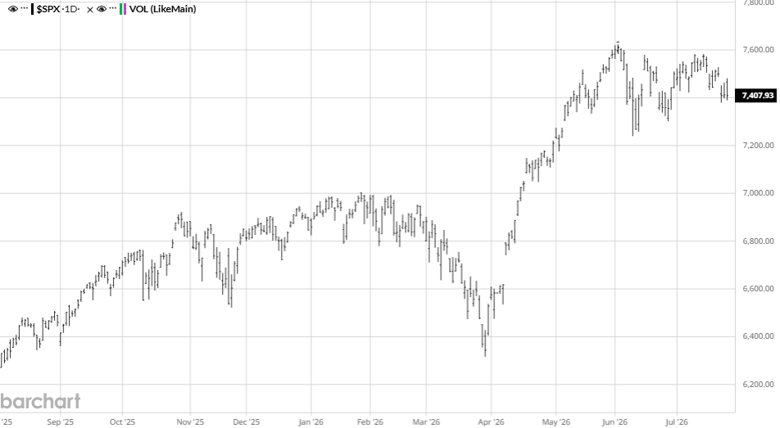
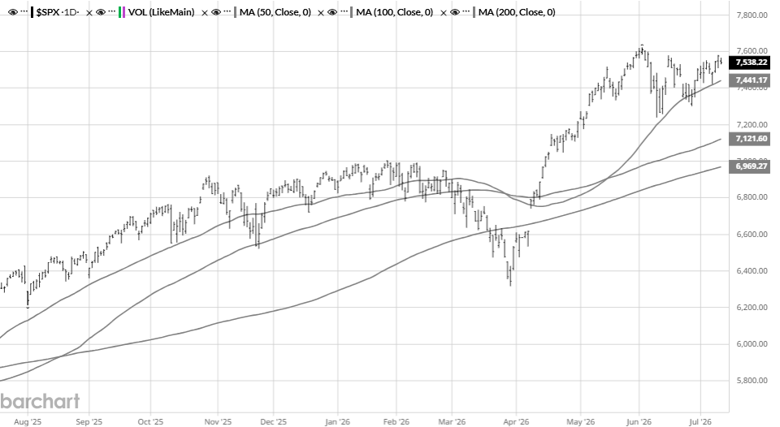
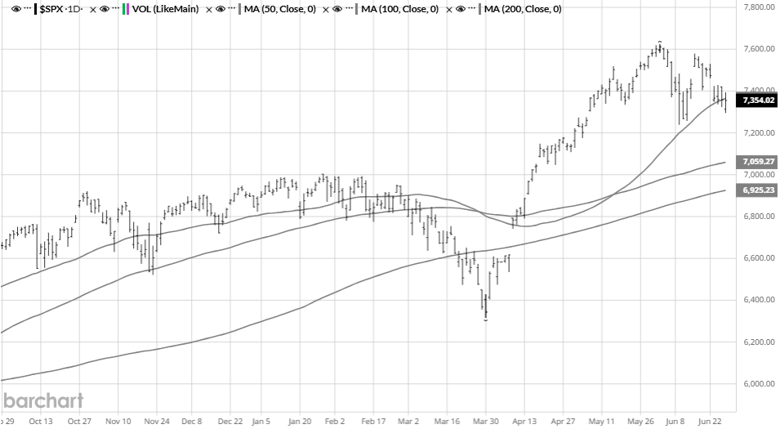
Equity markets continue to make new highs with the Federal Reserve expected to start cuts this month. With the downward revision of 911,000 jobs from March ‘24 to March ’25 the labor market weakness gives the Fed some ammunition to lower rates with unemployment being one of their mandates.

Via Barchart

Other News

  • Secretary Rollins is in the process of looking into payments to farmers for this year with the low prices.
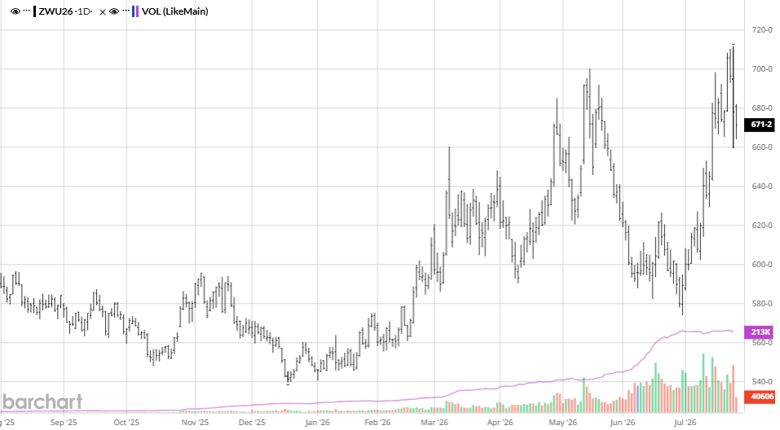
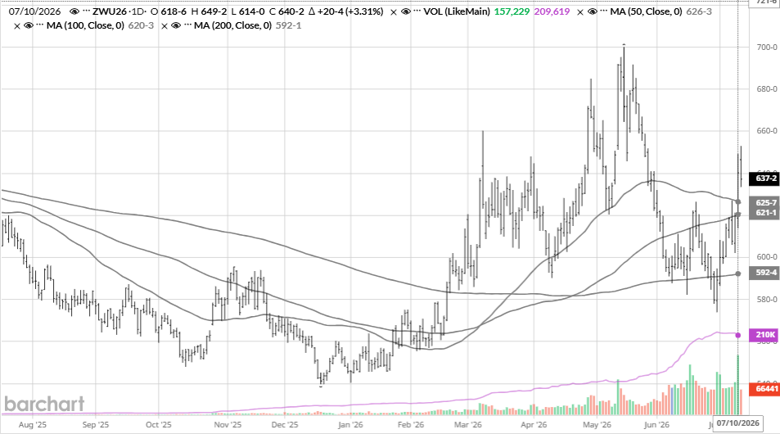
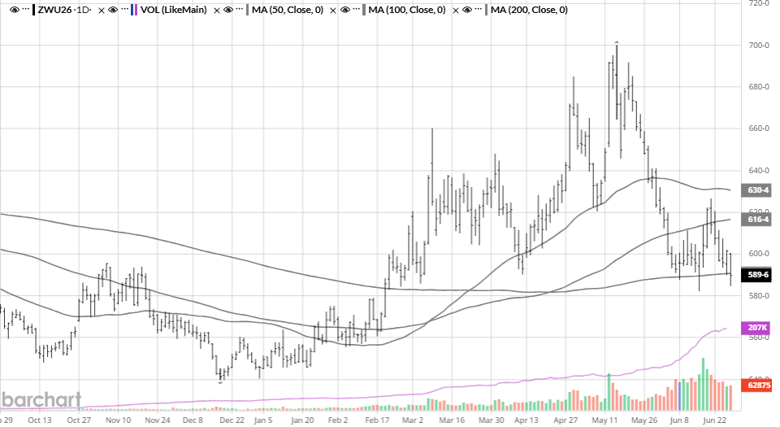
  • The wheat numbers were actually a bit supportive but lower world cash prices (Black Sea mainly) continue to plague prices. Wheat will remain an anchor for any potential corn rally as more wheat will be swapped in for corn in feed. Prices are back testing the 5 ½ year Covid lows.

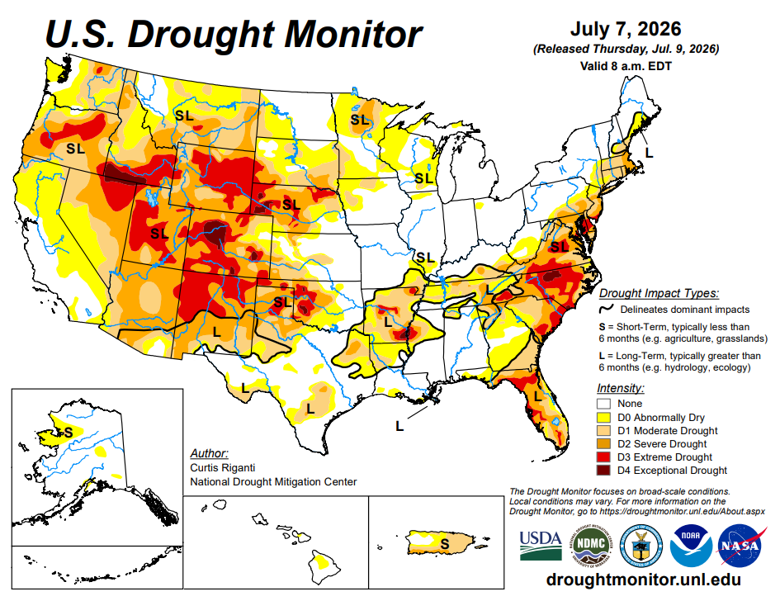
Drought Monitor

Here is the most recent drought monitor as harvest begins.

Contact an Ag Specialist Today

Whether you’re a producer, end-user, commercial operator, RCM AG Services helps protect revenues and control costs through its suite of hedging tools and network of buyers/sellers — Contact Ag Specialist Brady Lawrence today at 312-858-4049 or blawrence@rcmam.com.

Check it Out:

Bulls, Bears, and Beef: Risk Management When Prices Run Hot

08 Sep 2025

LEONARD LUMBER REPORT: You need to go back a year to find futures prices this low

The Lumber Market:

You need to go back a year to find futures prices this low. That makes the next move either a return to previous lows or a bounce to a sustainable level. This isn’t a ‘could go lower’ or ‘could go higher’ statement. It’s a warning shot that the next lower targets are significantly lower if the reduced supply doesn’t support prices. There remains a wall of concern about economic issues that could hurt housing in the future. I’ve been hoping for a lower supply for two years now to offset this, but nothing has changed. All the run-ups have been driven by speculation. The market has never been short on optimism. The main issue with all this is that our industry, like the Fed, is data-driven, and that data lags. Economic data comes after the fact. I’m hoping that’s not the case today.
Once September expires, the industry will focus closely on the November contract, looking for any signs of increasing value. If demand stays the same, shrinking production will start to tighten the market. This process must be gradual enough for the industry to accept higher prices. Rumor or announcement rallies rarely last, and their aftermath often results in prices lower than needed. I believe lumber, as a commodity, is very efficient at price discovery and will, given enough time, settle near its true value. Today, however, we’re pushing it too high or too low based on nothing. Speculators love this, but it’s tough on the industry.


The Technical Read:

The factual data is that the last low was in July 2024 at 418.50, and the next low was in January 2023 at 352.50. That is the major worry. The minor read is a weekly gap from 499.50 to 493.00. The next down leg is to the trendline at 466.01. This market has always reduced its confidence level to zero and saw prices go well below value. That is a real fear today. I drove by a lumber yard in Mokena, Illinois, that was packed, and a few unloaded cars were still sitting idle. The only thing I could think of was that I hope it was hedged. My point being that we are focusing on the reduction in production while a shit load of wood is sitting in the US. The result of that focus has been lower prices, still heading lower.

Enough gloom and doom. The production side of the industry has been working very hard to find a breakeven level that carries through the spikes and valleys. The gap mentioned above, from 499.50 to 493.00, is probably a good value level on paper. There has been enough supply reduction to warrant a better cash price. Sub $500 (futures) is cheap. We still need the marketplace to adapt to levels that will be sustainable during economic uncertainty; it takes time.

The funds are getting short again. I’m not sure if that is good news or not.


Daily Bulletin:

https://www.cmegroup.com/daily_bulletin/current/Section23_Lumber_Options.pdf

Southern Yellow Pine:

https://www.cmegroup.com/markets/agriculture/lumber-and-softs/southern-yellow-pine.volume.html

The Commitment of Traders:

https://www.cftc.gov/dea/futures/other_lf.htm

About the Leonard Report:
The Leonard Lumber Report is a column that focuses on the lumber futures market’s highs and lows and everything else in between. Our very own, Brian Leonard, risk analyst, will provide weekly commentary on the industry’s wood product sectors.


Brian Leonard

bleonard@rcmam.com

312-761-263

02 Sep 2025

LEONARD LUMBER REPORT: I have to start with the chart. It helps to clarify the argument that the mills’ added variable costs are of little relevance to the market

The Lumber Market:

I have to start with the chart. It helps to clarify the argument that the mills’ added variable costs are of little relevance to the market. That said, it did cause waves. The market bottomed in July of 2024 after Biden dropped out. It rallied up until the tariffs were put on hold, fell, and then rebounded into the duties. The argument today states that the flat demand warrants the market to test the low again. After Friday’s disappointing trade, it could be possible. Outside influences have moved the market higher since July 2024. We could return to the mean, but that is unlikely. What is likely is a 61% retracement of the move back to $525. That is based on the Sept contract. The cash market has not found a foothold yet. A $20 break in futures is nothing. Market indicators:

We remain a very efficient supply and demand market. Outside variables, while catching some momentum, do not change dynamics. Today, we have a macro issue. Stocks are too high for the pending increase in unemployment. Regional decreases in building activity can’t be picked up. And the last issue, and maybe the most important, is that a home is not affordable today. We keep putting lipstick on a pig, but housing is not affordable.

Note:

I like to mention the retirement of an outstanding person once in a while. Today I want to offer my congratulations to Jack Stevenson. We go back to the Tim Stock days. He finished up with USLBM. Great character and great market knowledge! Enjoy!!

Daily Bulletin:
Southern Yellow Pine:
The Commitment of Traders:
About the Leonard Report:
The Leonard Lumber Report is a column that focuses on the lumber futures market’s highs and lows and everything else in between. Our very own, Brian Leonard, risk analyst, will provide weekly commentary on the industry’s wood product sectors.
Brian Leonard 

bleonard@rcmam.com
312-761-263
02 Sep 2025

AG MARKET UPDATE: AUGUST 12 – 29

Corn has rallied off the post USDA report lows with a large up day on Friday to end the week. Pro Farmer Tour wrapped up their crop tour and has an average US corn yield of 182.7 bu/ac which would still be a record on top of the added acreage, but well below the 188.8 the USDA came out with. The two sides from the USDA’s report is that they likely won’t come out with a higher yield again with some small weather issues developing, but if they keep it high and make another big correction in January saying the crop wasn’t as big as they thought it could cost the farm community billions. The weather has cooled off for much of the country but the lack of rain for extended periods may be a problem in the home stretch.

Via Barchart

The Pro Farmer Tour found a bean crop more along the lines of what the USDA had coming in with a 53 bu/ac estimate vs the USDA’s 53.6 bu/ac. Beans biggest problem right now has been lack of rain for pod fill but a few well timed rains down the stretch could lead to a massive crop. China really needs to show up as a buyer for beans to leg higher but they can get all they want from South America right now even though they are paying a premium to get them vs US beans. The funds have a neutral position on the market as they wait for news that could send the market any direction other outside of the $10 – $10.50 range it has been trading in the majority of the last 6 months. China still remains a cloud over the market with the Trump administration needing to get Ag purchase commitments whenever they work out a trade deal in the coming months.

Via Barchart

Equity Markets

Equity markets continue to claw higher amidst pullbacks as earnings wrap up and AI and tech still drive the market direction. The Fed is expected to cut rates in September while the Trump administration’s attack on the Fed’s independence continues with Lisa Cook in its crosshairs currently.

Via Barchart

Other News

  • ADM plans to close a soy protein plant in Bushnell, IL.
  • Brazil’s investigation into the Soy Moratorium (curbs Amazon deforestation) could threaten sustainable soy sourcing, with potential ripple effects in the global supply chain.
  • Wheat has been relatively flat the last couple weeks.
  • Cotton continues to trade sideways waiting on demand to pick up.

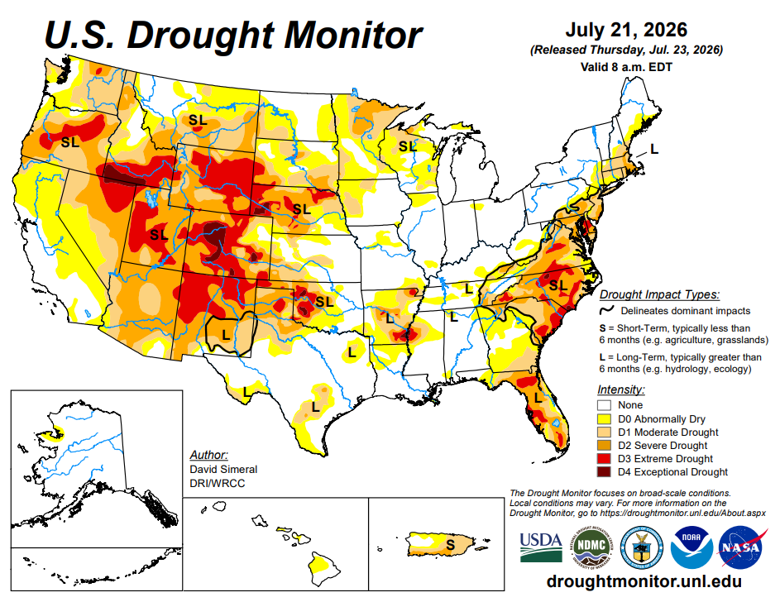
Drought Monitor

Here is the most recent drought monitor.
Contact an Ag Specialist Today

Whether you’re a producer, end-user, commercial operator, RCM AG Services helps protect revenues and control costs through its suite of hedging tools and network of buyers/sellers — Contact Ag Specialist Brady Lawrence today at 312-858-4049 or blawrence@rcmam.com.


25 Aug 2025

LEONARD LUMBER REPORT: The feature last week was the fact that the futures market made a new low at a time when there was a massive round of short covering

The Lumber Market:

The feature last week was the fact that the futures market made a new low at a time when there was a massive round of short covering. That should have at least kept the market flat and at most rallied it sharply. By Thursday, the mills were in full panic mode and looking for orders. That brought in the noise of the week, with the conversation focused on a 15% tariff on Europe, 232, and a mill shutting down. By Friday, the industry saw a sharply lower print as the Fed, I mean Random, dealt with faulty data. September futures ended the week after all that excitement $7 lower. The noise on Thursday did chase some newly positioned shorts out.

The Commitment of Traders report again showed a steep drop in industry shorts. It also saw a sharp drop in fund longs. At 7000 open interest, the market is fully balanced. There had been a shift out of the short side for the funds, but the long side never picked up much. The funds, in general, are maintaining a very soft position in lumber.

It looks like Carney fell into line with the US, ending many of the added tariffs he imposed. We heard about the shift on Friday. This, like everything else we hear, lacks substance. I’m still in the camp that the smart people in the room want to end all of the duty and tariff drags and end up with a number.

Finally, the majority of economists out there are taking some of Powell’s delivery from his speech as meaning that there will be a cut in September. Nothing has changed. There are a couple of inflation reports coming out before the next Fed meeting. They will be inflationary. The Jobs report has to be weak. That said, a reduction in short-term rates does not immediately affect long-term rates. A quarter point in September will have little impact on the mortgage rates. The second cut will.

Technical:

September made a new low for the week and then rallied. At 17% RSI and low open interest, this was expected. When you throw in outside noise, the industry now turns hypervigilant. It no longer matters whether the news is correct or not; it only matters how the trade reacts. I do not use short-term moving averages very often because we are an all-in or all-out market. All in hedging all out rumors. This are no support or resistance points, per se.

The takeaway from the technical side is that if futures take out the lows of 588.00 this week, there is a fundamental problem much bigger than the economists and experts think. I don’t see it, but I have been wrong before.

Daily Bulletin:
Southern Yellow Pine:
The Commitment of Traders:
About the Leonard Report:
The Leonard Lumber Report is a column that focuses on the lumber futures market’s highs and lows and everything else in between. Our very own, Brian Leonard, risk analyst, will provide weekly commentary on the industry’s wood product sectors.
Brian Leonard

bleonard@rcmam.com
312-761-263
18 Aug 2025

LEONARD LUMBER REPORT: The feature of the week was the extreme down move between Monday and Wednesday

The Lumber Market:

The feature of the week was the extreme down move between Monday and Wednesday. Sept futures dropped almost $46 in three days. At the same time, the open interest was rapidly decreasing. It was all liquidation. The longs were selling, the algo was selling, and the industry was buying their shorts back. The algo doesn’t accumulate a position, so it was all sides of the trade exiting. The Commitment of Traders report showed a sharp drop in the industry shorts. After nine sessions of selling, futures caught a breather on Thursday and returned to the sedate mode on Friday. At this point, the market needs a macro look now that most of the noise is behind us. The following points are key:

It’s a tough call here. A bit of good news can pop the market, while no news erodes your inventory value. The data is neutral. I would look for a general pickup in demand or at least building going into the fourth quarter, but this outside noise never ends. Selling your cash is the best trade.

Technical:

The September futures have corrected 85% of the move. The majority of the time, if it goes 61% it goes 100%. That puts the 594.50 low as an objective. Now most are out of shorts already, so there won’t be a large volume to buy from here down. That makes least resistance down. The one caveat is that the RSI is only 20%. It needs a better correction.

Note:

Tuesday:

Starts 1.30 down from 1.32

Permits 1.39 down from 1.4

Friday: Existing a smidge higher…. more inventory, more sales.

Daily Bulletin:

https://www.cmegroup.com/daily_bulletin/current/Section23_Lumber_Options.pdf

Southern Yellow Pine:

https://www.cmegroup.com/markets/agriculture/lumber-and-softs/southern-yellow-pine.volume.html

The Commitment of Traders:

https://www.cftc.gov/dea/futures/other_lf.htm

About the Leonard Report:

The Leonard Lumber Report is a column that focuses on the lumber futures market’s highs and lows and everything else in between. Our very own, Brian Leonard, risk analyst, will provide weekly commentary on the industry’s wood product sectors.

Brian Leonard

bleonard@rcmam.com

312-761-263

12 Aug 2025

AG MARKET UPDATE: AUG 4 – AUG 12 USDA REPORT

188.8 bu/acre… Hard to find a silver lining in the report for corn as the USDA ripped the band-aid off from the start instead of slow playing it. The average trade guess was 184-185 bu/ac which led to a big selloff seeing new contract lows. On top of the big yield number the USDA took the FSA planted acreage data and added 3 million acres in planted corn. The extra yield and acres could add nearly an extra 1 billion bushels of corn to the US and world ending stocks. The report did nothing to help the direction corn has been trading.

Via Barchart

The bean yield was also above pre-report estimates, coming in at 53.6 bu/acre. Prices were higher though following the 3 million acre planted acreage cut and total production cut by 90 million bushels. The market was caught off guard by the 3 million acre shift as evidenced in the opposite price reaction to the report numbers. The bean rally will give farmers a chance to catch up on sales but it will also motivate more acres to be planted in South America on stronger prices.

Via Barchart

Equity Markets

Equity markets continued to perform well as AI and tech companies are still the major movers. Nvidia and Microsoft are now a combined 15+% of the S&P 500 index, causing some to worry about concentration, but luckily they are performing well so right now a rising tide raises all boats (money in S&P ETFs).

Via Barchart

Other News

  • Wheat was in line with re-report estimates and had no major surprises. The weakness in corn will continue to weigh on wheat however.
  • Cotton saw a boost post report after the USDA lowered planted and harvested acres. Production was trimmed by 1.39 million bales to 13.21 million bales.

Drought Monitor

Here is the most recent drought monitor.
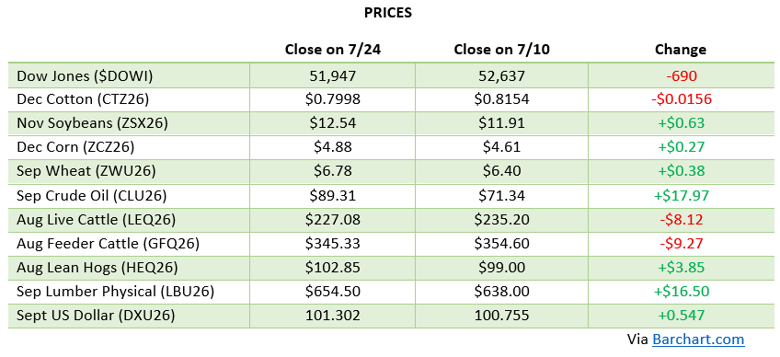
Contact an Ag Specialist Today

Whether you’re a producer, end-user, commercial operator, RCM AG Services helps protect revenues and control costs through its suite of hedging tools and network of buyers/sellers — Contact Ag Specialist Brady Lawrence today at 312-858-4049 or blawrence@rcmam.com.