This market remains challenging. Last week, futures hit new lows almost every day, with all focus on the daily EFP deals. Most of the cash trades occurred at one mill, forcing the others to work hard to find value. This type of trade signals a bear market that is likely to continue. Throughout the year, the market has rallied because of the duties and tariffs, but without an increase in demand. Supply is tightening, but not at a pace to boost prices. We are waiting for signs of that scarcity. While we wait, there’s a large gap between the November expiration price and the January contract. These gaps are filled, but recent history shows it usually happens near expiration. The market typically gets a relief bounce before setting the lows. The issue today is the timing. We’re heading into a quiet period through Thanksgiving. We’ll see if the trade hibernates until then.
Technical:
Not that my writing isn’t confusing enough, I’ll try to beat it this time. There is a gap left from the September 2024 expiration from 499.50 to 493.00. Last week’s low was 496.00. That gap is finally getting closed. The elephant in the room is that now we have the Nov expiration gap and the older gap hanging over the market. The January contract settled on Friday at 560.50 with an RSI of 19.97%. Two takeaways: you can’t sell the January here, but your inventory is at a substantial risk over time. Macro: Hedge at $60, $80, and $100. Micro: When demand catches up, buyers will have PTSD thinking it is 2021 again. Buy cash or hedge.
This is the first time in many years that the risk is so evenly matched. There is a possibility of a $100 move in either direction. Hedge your risk! Your hedging dollars, if wrong, will be pennies per truck. If you don’t hedge and you are wrong, it will be bitcoins per truck. Hedging is a cost of doing business. Hedging is a medical insurance policy. Hedging is a production builder. For the mills, hedging is a paying customer who pays the next day. Hedge your risk and sleep better.
The Leonard Lumber Report is a column that focuses on the lumber futures market’s highs and lows and everything else in between. Our very own, Brian Leonard, risk analyst, will provide weekly commentary on the industry’s wood product sectors.
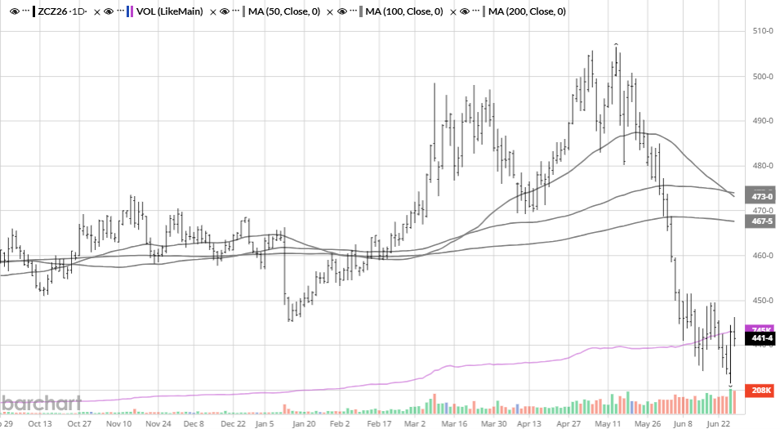
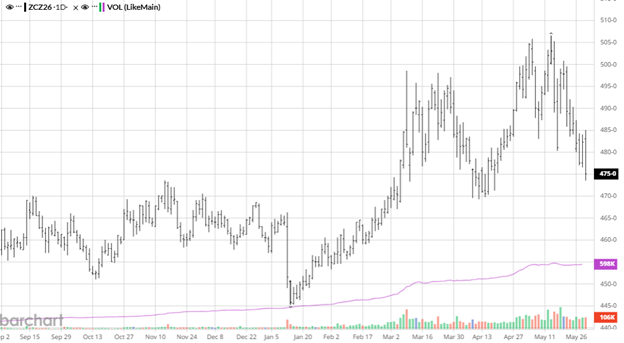
Corn’s Thursday rally was met with a post report Friday dip and gave up 10 cents back to $4.30. Despite the late season crop problems of drought and rust, the USDA did not find the corn yield loss that was expected and came in with a 186 bu/ac estimate, higher than the trade estimate. With higher production came higher US ending stocks, but those were not raised as much as yield as corn exports and domestic industrial demand has been exceptional this fall. The chart still looks constructive, but after a 30-cent rally in one month, the market will look to take a breather, especially after today’s report.
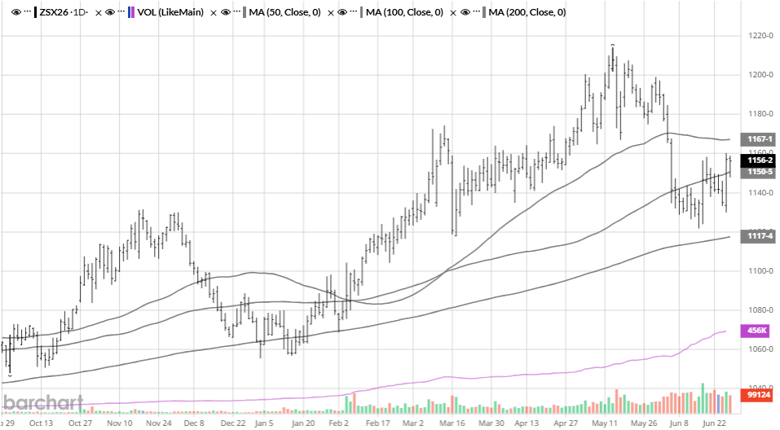
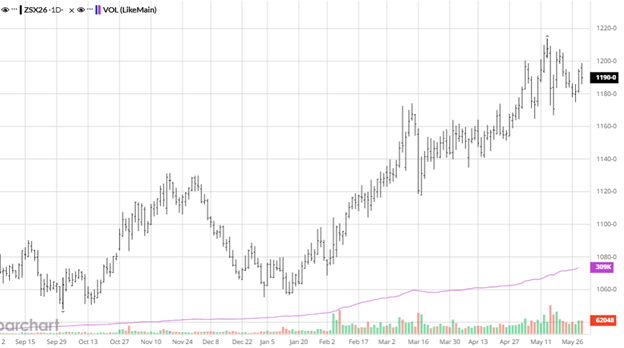
Beans have been on a great run higher, albeit with some volatility, until Friday’s USDA report. Coming in that hot to a report can lead to a let down which we saw to some extent. The bean yield numbers were not as surprising as corn, coming in close to estimates, but the market still took a hit. The number to look at was the US held bean imports to China unchanged at 112 MMT for the 25/26 marketing year. A flash sale report did show sales of 1.1 mbu to China around the time the trade deal was in the works. The delayed data is hard to fit with all the other news out there but China buying anything is a good sign.
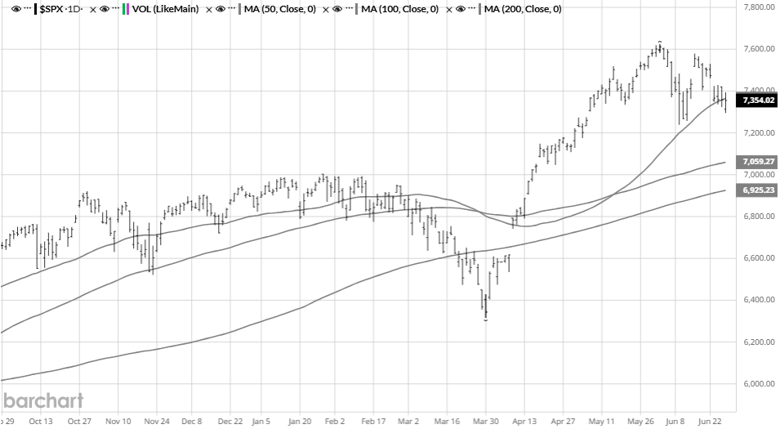
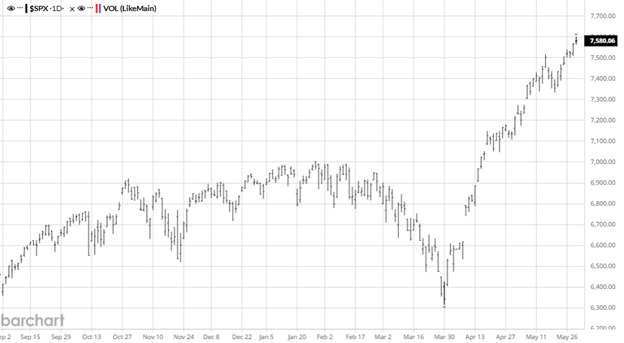
Equity markets have been volatile the last few weeks as worries of an AI bubble continue and several large companies such as Palantir, Meta and Oracle are well off their 52 week highs. Volatility will likely remain in the market for a bit as we will get caught up on economic data that was missing during the government shutdown.
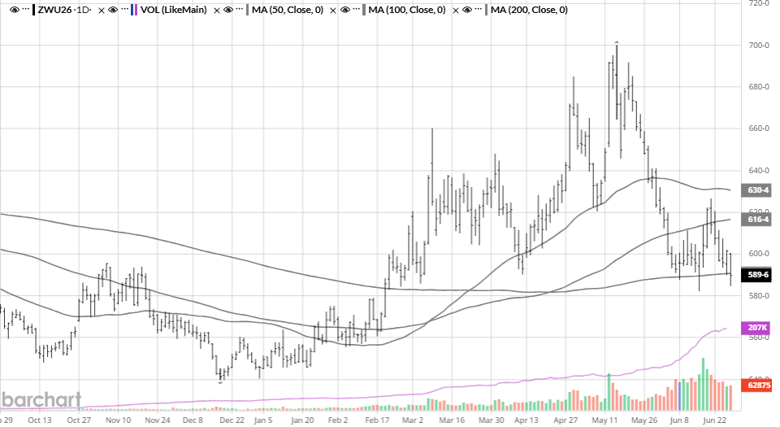
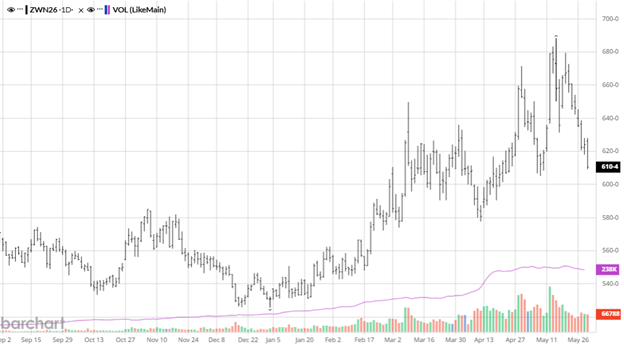
The wheat numbers were bearish as domestic and world stocks continue to climb on record world yields in all producing countries and exporters finding exports difficult to come by even at rock bottom prices. Wheat will remain an anchor on corn rallies.
Cotton adjustments show 900K more bales of US production, 200k more bales of US exports, and 700K more bales of US ending stocks compared to September.
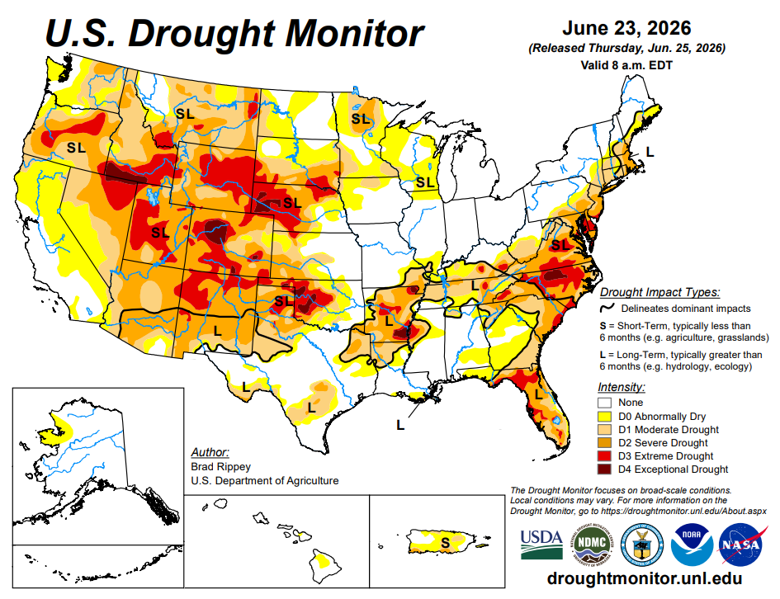
Drought Monitor
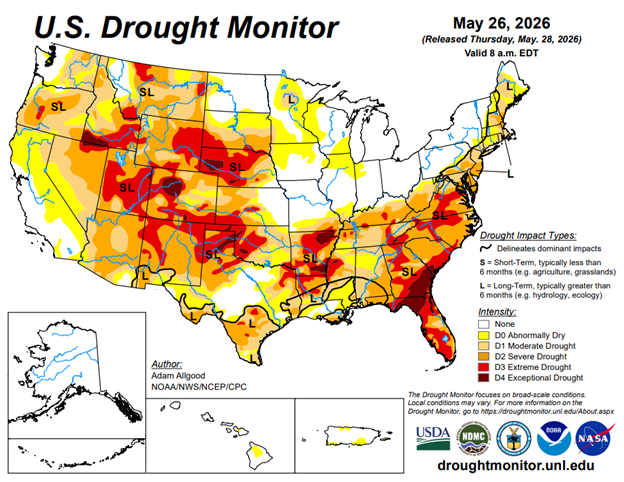
Here is the most recent drought monitor as harvest rolls on.
Contact an Ag Specialist Today
Whether you’re a producer, end-user, commercial operator, RCM AG Services helps protect revenues and control costs through its suite of hedging tools and network of buyers/sellers — Contact Ag Specialist Brady Lawrence today at 312-858-4049 or blawrence@rcmam.com.

“It’s the economy, stupid.” Remember that wise response to a reporter’s question many years ago? After another muted reaction to another shutdown on Friday, I’m worried that it is a much bigger problem than rates and home prices. I keep going back and forth each month, wondering if there is something wrong in Mudville. With a continued contraction in supply, rates nearing 6% and flat employment numbers, one would expect some upside anxiety. The raw data has pointed to a better marketplace for about three years now. We are consumed by a flood of data that has repeatedly been proven wrong about the market. Lumber prices have been held artificially high by the duties and tariffs, not because of a better demand equation. That scenario has pushed the producers back into the red numerous times this year, with the buyers “good dealed” to death. Today, the 2026 first quarter decision is to either add more cheap wood to the pile and watch it sit for months or hold off. Some of the prices talked about on Thursday and Friday tell me the cash buyers are on the sidelines. Data shows that the mills cannot continue to lose money at this pace. My argument is that determining pace has to include the millions of dollars they made post-COVID. Factor that in, and it may show their ability to hang on for longer than we think.
Futures trading is rather easy. In premium markets, you basis trade. In discount markets, you forward price. In premium markets, you should also hold a higher percentage of futures to cash. The opportunities are in the items and species that are undervalued compared to the historical norm. Today, we can’t define value, so you are buying undervalued products and selling a high premium futures market. A. it allows you to hold more wood because it is hedged, and B. is an opportunity.
Finally, momentum has been generally down in lumber this year. We did have strong rallies, but they were based on shorts covering off of news. Absent that news, the market is always seeing selling. That selling is computer-generated, but all the same, it is momentum. Create true upward momentum, and the algo switches sides. Not today….
Technical:
The futures low was $516 in 2025. That’s the focal point this week for November. If the market can’t break $17 in 5 sessions, then we have a positive. The RSI in January is 24.50% which is a higher RSI than the last time we were down here. Jan is trading near its lows but is no longer oversold. The slow stochastics have crossed back into negative territory. The technical read is for a wallow around the bottom, not a big selloff.
At 1452, the November open interest is normal. The US government is no longer shut down. I’m not sure anyone noticed. That could be another economic indicator of a larger problem.
The Leonard Lumber Report is a column that focuses on the lumber futures market’s highs and lows and everything else in between. Our very own, Brian Leonard, risk analyst, will provide weekly commentary on the industry’s wood product sectors.
It was another tough week as futures continue to decline. January futures are down $88 in just two weeks. This decline is scaring away all buyers from the cash market. Last week, the only activity was EFP’s layups. The market is showing signs of a shrinking business environment, even as reports still indicate steady sales. The main issue worsening the trade is inventories, which remain the key focus. Things have returned to a new normal pace. The slowdown occurred months ago, and the market is now settling into a slow rhythm. Once pipeline inventories decrease further, conditions will tighten again. Meanwhile, we are heading into a season of heavy holiday shutdowns, just as shipments from outside the US are slowing down. This situation resembles last year, when the market struggled most of November and December before turning up. Last year, we feared a reduction in supply caused by duties and tariffs. This year, we must be concerned about their actual effects. On Friday, I saw a 5.65% rate for a 15-year loan. Additionally, shipments from Canada and Europe are dropping. While these factors alone don’t resolve the housing market slump, they are moving in the right direction to help reduce producers’ losses.
Open interest was growing as the week came to an end. We are back in an area where the short funds add to their big winning position while the industry adds to their long position. We don’t get a CFTC report, but it would be the norm. Watch the open interest in November. It is holding over 2169 contracts with 10 sessions left. There is always a lag with the funds offsetting trades, so I’m not looking at it as important just yet. We also had the same open interest dynamics building last year at this time. There is a lot of deja vu on this one.
Technical:
January ended the week with a 19.40% RSI. It came into the week with a 34.60% RSI. It was off 1 to 1. Technically, the market is oversold. While not a perfect science, it usually isn’t off by more than a few days.
The Leonard Lumber Report is a column that focuses on the lumber futures market’s highs and lows and everything else in between. Our very own, Brian Leonard, risk analyst, will provide weekly commentary on the industry’s wood product sectors.
Corn has continued to trade range-bound between $4.10 and $4.30 with a nice recent run to the top of the range. Follow through buying to push towards $4.50 will be needed as harvest heads toward a finish and the large supply coming out of the fields. All crops got a boost after positive news from Secretary Bessent over the weekend saying China will be buying US soybeans (and assume other commodities as well). The market still has downside risk with a large US crop and global economic issues that for now are not flashing major warning signals but the market has been recession warry since the tariffs went into place in April.
Beans continued their recent rally with positive news on US and China trade relations from Secretary Bessent. We will need to see these soybean purchases from China come to fruition without any more escalations that could put this progress at risk. With the continued Government shutdown the lack of information to trade from the USDA will make private reports the main news.
Equity markets continue to move higher after a recent dip as Gold has fallen off its recent highs but equities, lead by AI and tech, continue to climb higher with 2 months left in the year.
Cattle futures have fallen quickly off record highs as question marks around the USDA and white house about how they want to address high beef prices continue.
Cotton remains quiet with no major news to get it out of the mid 60 cent range.
The government shutdown continues.
Drought Monitor
Here is the most recent drought monitor as harvest rolls on.
Contact an Ag Specialist Today
Whether you’re a producer, end-user, commercial operator, RCM AG Services helps protect revenues and control costs through its suite of hedging tools and network of buyers/sellers — Contact Ag Specialist Brady Lawrence today at 312-858-4049 or blawrence@rcmam.com.

What is the definition of insanity? Hoping the market will rise to get a better hedge in place. That’s where the trade was coming into last week, only to see the market give back over two weeks of gains in a few minutes. What made it worse is that the market continued to decline for the rest of the week. The January contract settled at 619.50, which is still a good place to hedge, barring any shutdown announcement. The fundamentals point to a well-supplied pipeline. This is early in the cycle and will need a pickup in demand to clean it up before going into the first quarter decision time. There is nothing out there to indicate that possibility. What is more likely to occur is more shutdown news. That will increase the buying patterns. The issue is that you are just throwing more wood on the pile. It still needs to go out the door. A substantial announcement tomorrow would spike prices but then end up being bearish.
The January contract at $600 equates to $490 mill. The mills have no choice but to find ways to lessen their losses. That will keep a slight premium in the market. $600 January might be a good support area with the current dynamics. There would have to be some undefined issues in housing lurking to think we are going back to last year’s lows.
Technical:
The good news after last week’s debacle is that the January contract broke through the 61% retracement area of $618.20 and then closed above it. That isn’t a glass-half-full statement; rather, the glass has a few drops left in it. Fridays are tough to gauge. More rumors were swirling about potential shutdowns, which could have prompted added short covering late. Whatever the case, we will see direction right off the bat tomorrow. The downside momentum is in place. It will start again when the bell rings. If not, the market is in correction mode.
This is a tough time. The spread is indicating that the November expiration will be weak. It will be hard to build a bullish case in January with a Nov heading towards zero. You have three weeks of rumors and November selling in front of you.
The Leonard Lumber Report is a column that focuses on the lumber futures market’s highs and lows and everything else in between. Our very own, Brian Leonard, risk analyst, will provide weekly commentary on the industry’s wood product sectors.
In this episode of The Hedged Edge, hosts Jeff Eizenberg and Ben Hetzel dive deep into the heart of agricultural markets with special guest Fred Seamon from CME Group. As harvest challenges mount with record-breaking rainfall across the Midwest, the conversation spans centuries of market innovation—from the early days of Chicago’s grain trade to cutting-edge futures contracts. Fred shares fascinating insights into the historical development of commodity exchanges, explaining how farmers went from local merchants to global market participants.
The discussion explores critical topics including harvest logistics, railroad transportation, the evolving role of the USDA, and emerging market tools like the new fertilizer futures contract. Listeners will gain a rich understanding of how technological advances and market innovations continue to transform risk management for producers. Whether you’re a farmer, trader, or agricultural enthusiast, this episode offers a comprehensive look at the complex ecosystem of agricultural markets, blending historical perspective with forward-looking analysis.
Packed with expert commentary, practical insights, and a touch of humor, this episode is a must-listen for anyone interested in understanding the intricate world of commodity trading and agricultural economics.
Check out the complete Transcript from our latest podcast below:
Harvest, Hedging, and History: Navigating Agricultural Markets from Grain Elevators to Futures Contracts
Jeff Eizenberg 00:57
Welcome to the next episode of The hedged edge. I’m your host, Jeff Eisenberg, and I’m here with my co host, Ben Hetzel. Ben, it’s almost big game season, and we’re talking waterfowl. What’s been going on? You get out any hunting yet?
Ben Hetzel 01:12
No, I haven’t. My my boys like to shoot some birds. I don’t mind going out a little bit. I much prefer to shoot the clay version, because I don’t know, I just, for some reason, I’ve always kind of grown up with the idea that if you’re gonna hunt
Speaker 1 01:28
wildlife, you have to be willing to eat the wild game that you hunt.
Ben Hetzel 01:33
And I’ve never been a real big fan of game bird, so I didn’t, we didn’t shoot a lot of them when I was a kid. So, but my boys like to hunt, and it’s a lot of our family hunts, so it’s, it’s just good to get out. But yeah, we’re coming up on, there’s, there’s tons of people out there along the roads, and sometimes not the safest practices going on with vehicles on these country roads. But definitely got bird season going on and and big games coming right around the corner, and that’s kind of what we do. We we enjoy that a little more, I’d say. So we’re excited.
Jeff Eizenberg 02:12
That’s good. Now, with all the weather we’ve had all the wet, rain and whatnot, that’s good for birds. Yeah,
Ben Hetzel 02:19
I mean, it’s, probably all right. In general, it’s good to have moisture versus drought, obviously, and it’s been crazy. I’d say this year has got to be right up there with a record for a lot of places. I hear producers talk across the trade area that they are at record levels. And when you have thunderstorms, they vary and that sort of thing. But it’s been an unbelievably wet year for this trade area, Southwest, North Dakota, Northwest South Dakota. I seen a visual on kind of the percentile, and we’re at like 150% to normal, is what our little area of the world showed, particularly right around where I live, near London, and so yeah, it’s, it’s good, but yet challenging at times. Harvest is slow to come off. These row crops are ready in a lot of areas, and harvest is definitely moving forward, but we see fields that are ready to be cut, fields that are cut. So it’s, we’re in the midst, and I know a lot of guys are anxious to get get everything out of those fields, especially when you got you know, we’ve had some high winds, 60 mile an hour us, and so guys are nervous about some of these row crops starting fall down or whatever it is. But again, the wildlife sure enjoy that cover. So more harvest that gets done makes it easier on the deer and antelope hunters, but it’s that season. Yep.
Jeff Eizenberg 03:52
And speaking of harvest, where, where are we in the process now, from the elevators perspective, you guys filling up, starting to put up any grain piles? What’s it look like as you’re driving around?
Ben Hetzel 04:04
I don’t see too many piles. You know, out here, we do a lot of grain bagging, past how that’s managed. Wildlife can be a challenge, especially in a wet year. No, you were curious of how that all kind of works. But for the most part, the bags are fine, unless wildlife get on them and start popping holes in them and then have some serious problems. But a lot of people manage them real close. Now, you know, there’s been some train wrecks on bags, but, yeah, it’s, there’s a there’s a fair amount of bags around, and guys were moving a little bit of small grain. A lot of canola has been moved. So I think there’s places to go with some of this row crop harvest, but we’re getting pressure all the time to continue to make space, pretty hard to keep the flax and the peas and the canola and the wheat, all that stuff moving because they want to try to market their corn and. And some fires as well. And so it’s been a real battle. Railroads kind of slipped a little bit. It’s gotten a little bit late on placements, so that’s a challenge as well. But it hadn’t been too bad, and I wouldn’t say we’re way behind. You know, seasonally, it’s not uncommon to expect some delays, but it’s it’s starting to show up a little bit more now, as corn harvest is ramping up in the east and and on the railroads defense, this soybean crop didn’t move like normal it was a non traditional flow for them, and so that they actually, I think, adjusted about as well as you could ever expect a large organization to shift their assets, and fortunately, it’s a smooth move to the Gulf. It’s not quite as smooth for us up here as going to the P and W, but that flow isn’t a bad flow, and so the railroad can do it fairly efficiently. And so that’s a positive. Unlike the Mexico market, where we can bottleneck the border and some of that stuff, and there is, there’s some congestion going on there. We’re hearing trains are getting held up across the border, slow to come back out, and so that is affecting some of this. But that’s just a volume issue, which is good. I mean, Mexico has been a great trade partner. We’ve talked about it on our podcast. People that tuned in to one of our earlier shows learned a lot about what’s going on with US and Mexico, and I think that’s key going forward still. But, you know, maybe we’ll get into a little bit of it today, on the rest of the world and what’s going on. There’s lots of news this last week that kind of rocked the market. China’s still obviously a big topic. So if
Speaker 2 06:52
you want to listen back to this episode or find past episodes of The hedged edge, visit kbjm.com or kndc radio.com under Listen Live and podcast options, or either station’s free mobile app under podcasts.
Jeff Eizenberg 07:08
Yeah, that’s a great segue. And yeah, I’m excited here today, we’re going to bring on a special guest that’s got a ton of history and experience in the markets, and take a look back in memory lane and understand what the importance is of the exchange, is how the exchange ultimately helps us to manage risk, and a lot of that comes down to understanding the history and how things flow, how trade flows, and how traders are able to manage some of the things you just talked about, people Bringing more crop to town than possibly in years past. How the rail systems could potentially slow down movement of grain from Southwest North Dakota down through to the Gulf, etc. So with that, we’ll take a minute here and introduce our guests. We have Fred Seaman joining us from the CME Group. Fred is with us, right out of Chicago, been part of the exchange for the last nearly 25 years. So welcome Fred.
Fred Seamon 08:08
Thank you, Jeff. Much appreciated. Really glad to be here.
Jeff Eizenberg 08:13
No thanks for jumping on this exciting for me, you and I basically have been involved in Chicago markets about the same amount of time you’re saying 2001 for you, I started out working at the Board of Trade, and in 2000 you know, our paths have kind of meandered, but we’ve never crossed until today. So this is exciting.
Fred Seamon 08:35
It’s amazing that we haven’t, but I did. I started in late 2001 and had been teaching at the University of Wyoming, so it was quite a change for me and my wife, but definitely haven’t looked back. It’s been the best job I’ve ever had by far.
Jeff Eizenberg 08:53
Yeah, you can’t beat the exchanges. The history goes back over. I think, I believe, 150 years, you know, the way in which they started out being Chicago, the center of the agricultural world, and the river and the rail all coming in, and now, now today, to be the place where innovation is happening, left and right. You know, the the thing that stands out to me, I think people miss and I always ask farmers that I meet, I ask elevator operators that I meet. Have you been to Chicago and have you seen the exchanges? And unfortunately, they transitioned away in our career, time from the pit traded. But I would love for you to help everyone remember the the training coats, the greens, the yellows, the blues, kind of the vibe that Chicago used to have.
Fred Seamon 09:46
I’m so glad that I got to witness peak four before, you know, it started to decline. And you know that did occur during my my tenure at the exchange. I. And, you know, it’s, it’s, it’s all electronic now, but you know that was, we got into a commodity boom in the, you know, early and mid, 2000s and you know, you would get really, really busy days. And I would hear from merchandisers, you know that, you know, they would, it would take some period of time before they would get confirmation on fills. So as efficient as the floor was, and it was extremely efficient, there’s a lot of things the floor did really, really well, but the markets had just grown to a point where, you know, the electronic screen just became, you know, the choice when, when we did start having daytime, electronic trade, the choice of most agricultural traders, and it started to to evolve away from the floor. But, you know, a lot of what happened on that floor is still relevant today. It’s just how we manage, you know, and how people enter and execute trades has changed. That’s all. But the underlying reason for them, the markets are still the same.
Jeff Eizenberg 11:10
Yeah, that’s That’s right. It’s a place to discover price and also manage risk. And the reality that the hedging community is what the exchanges were built for. Is so important for people understand it was built for hedgers, the speculators came in to provide liquidity. And today it’s a global marketplace that trades 24, six, effective, yeah. Well,
Fred Seamon 11:37
you know, it started as a spot market. If you go back into the 1840s you know what happened is, you know, everyone knows the US started 13 original colonies on the east coast. But as it started to expand westward, it didn’t take farmers long to recognize that they would rather farm ground in places like Ohio and Indiana and Illinois than they would Massachusetts and New York. So agricultural production moved westward, but most of the people were still in the east. So at harvest, you know, you’d have all these farmers bringing all of this grain into the major cities, Chicago, being one of them. And you know, they would try to find a merchant who was willing to buy their grain to, you know, arrange for it to be shipped back to the east where it would be consumed. And you know, some of those merchants were legitimate, some probably not. And you know, the the idea, did all producers get equal treatment? Well, probably not. So the exchange actually started. Well, there’s a few things. You know, the Board of Trade was a an organization that was started to promote commerce in the city of Chicago, and grain trade was one of those things. So, you know, their their first idea was just, let’s have merchant members, and let’s have them congregate in one place, and then, you know, a farmer can come to that one place, the members have been vetted, so, you know, hopefully they’re all legitimate, and something that we take for granted, but was real powerful at the time, was every time there was a transaction, they would post the price, so that the next farmer that came along probably wouldn’t receive the Same price, but would get an idea of the value of what they were, you know, selling, and that was the start of the exchange. It was just a spot market. Need to fall from there, eventually becoming forward contracts, and ultimately futures contracts in the 1860s that didn’t ultimately succeed, but corn, wheat and oak futures all launched on January 2. 1877 have existed continually since. It’s
Jeff Eizenberg 14:17
quite the history it is.
Ben Hetzel 14:19
It’s really kind of wild when you think about farmers and ranchers moving their goods far as they did. You know, I’ve got my aunt was going through the attic of the farmhouse where my grandparents lived for all my life anyway, and most of my mom and her siblings, but they found boxes of old receipts or tickets from when they would haul calves down to Sioux Falls, South Dakota. And mean to drive that today is a trek. I mean, it’s a six and a half hour drive. And to think back then they loaded their calves up and. The wagons and shipped them down there, or they took them in when the railroad came through, they took them in and put them on the rail and down there and sold them. And it’s just crazy to think of the dollars that they were transacting compared to what we’re transacting today. And of course, was cattle at all time highs. It’s just unbelievable. That journey that them, people went on to move that grain or those cattle was remarkable,
Fred Seamon 15:28
absolutely remarkable. And one of the things, Jeff, I think you, you mentioned, was about innovation and the farmers, indeed, the effort that they took to bring grain into the city, and then, you know, you got the railroads and so forth. And that certainly evolved. But, you know, transportation into the major merchandising points. But a couple of the innovations that occurred at the exchange early that we again take for granted, but it just completely revolutionized how grain was traded. Two of them were a system of grades and sampling. There wasn’t a USDA then, so a way to be able to differentiate grain so that it could be commingled in a grain elevator. And the first grain elevator in Chicago was was built in the late 1830s so the ability to commingle grain, and then the idea of receding grain within a facility, so that you could trade grain among multiple parties without it having to move to the multiple parties. It could just sit in one location, and you could just trade ownership of it. And that really revolutionized grain trade. And actually the center of grain trade in the Midwest. US moved from St Louis to Chicago because of those, those innovations, I
Jeff Eizenberg 17:08
think that’s really important for people to understand, is that the exchange has continued to evolve to support the farming community. It’s something that has been exciting the whole way through that, the point then became the delivery mechanism, right? Because that, I also believe is important to have multiple delivery points, of which the grade and quality is standardized. Was that the exchange that drove that? Or how did that come about?
Fred Seamon 17:35
They did and of course, there’s some great stories of shenanigans that went on along with that. But, yeah, a system of grades and a system of grading as well. But as you can imagine, when you know the Registrar of the exchange, the person that’s signing their checks, is a member of the change that also runs a grain elevator at the same time. There could be, from time to time, pressure on that exchange staff member to, you know, look one way or another when it came to grading grain. So at some point, the state of Illinois stepped in and said, enough of the shenanigans. We’re taking over. And those processes have existed at the government level, rather than the exchange level, for most of our existence. But did start at the exchange that’s
Ben Hetzel 18:39
kind of wild, because you’re talking like 1830 in the USDA started 1860 or Yeah?
Fred Seamon 18:47
Is that? Yeah? I think, I think that’s right. And it’s interesting. It was the 1860s when the state of Illinois took over inspection. So that was part of the learning process as things move from exchange regulated to state regulation and making it sound like the board was the Wild West. In some ways it was. But what they did and how, you know, they brought about organized trade. It definitely was a positive. You just anytime you have human beings and trade, there’s always going to be those few that are going to be looking for ways to benefit. So there definitely were some shenanigans.
Speaker 2 19:40
Want more agricultural market expertise. Listen to full episodes of the hedge edge podcast wherever you get your podcasts, or visit RCM, ag services.com get the complete market analysis and strategies you need to succeed.
Ben Hetzel 19:57
You can a wild west. Jeff, you’re I know you’re. Dying to jump on this. We have no government. USDA is not giving out reports.
Jeff Eizenberg 20:05
That’s right, that’s right. Ben, and that’s the part that he’s mentioned, the USDA didn’t exist back when the exchange started. The USDA effectively doesn’t exist today, because we don’t have a government operationally. And so you start to ask yourselves, the question is, how are we going to advance the needs that we have today for information without the USDA? And I’m going to go ahead and pose the question, do we even need the USDA anymore? After you know the innovation that could potentially happen as a
Fred Seamon 20:39
result. As of right now, we do, especially on the livestock side, feeder cattle is settled to our feeder cattle index, which is all based on USDA reported feeder cattle sales in the country and direct reports. We also use USDA reports for doing differentials in live cattle deliveries and lean hogs and pork cut out is all under mandatory price reporting. So one of the big things when you see a government shutdown coming, you know we always want to know is, is AMS market reporting going to be affected or not? And some of this, the shutdowns, they’ve been considered non essential, and those reports didn’t come out, and the exchange had nothing to to settle against. And other times they were deemed essential, and the reports continued to flow. Luckily, this time, the reports continued to flow at this point, so we haven’t had an adverse effect. And then on the grain side, you know, just having USDA price reporting adds additional trans transparency in the countryside relative to Chicago. So I think, you know, that’s a benefit to all. But, yeah, I mean that it’s we still rely pretty heavily on USDA, whether it’s for livestock settlements or for transparency when it comes to grains and oil seeds, and I should mention dairy too, that all is USDA based reporting as well. So we’d hate to see USDA go
Jeff Eizenberg 22:37
anywhere. Okay, so we’ll give them a break. They need to exist. Let’s get this government shut down, taken care of, and get these people back to work. Shifting gears a little bit, though, but similar topic, I do want to ask the question is from a research perspective, and as you start to think forward about news and information, you know, we’re having so many new private companies that have entered the market. We have private companies like stone X and many others that have existed over the years, and new ones are entering the marketplace for research yield updates, and we’re getting information from China and from Brazil, and you get all these questions of, How reliable is that data? How reliable is our own data? Are we going to eventually transition to a spot, kind of like when you and I were at the exchanges and the pit trade had existed, it was kind of slow. You mentioned it. People didn’t always get reported their trades in a timely manner to now it’s microseconds. Do you feel that perhaps, maybe even this government shutdown accelerates this but that we get to a point where the information is more real time and we rely on, call it an exchange of information, to truly understand where we are with yields and stocks and other things like that. Oh, I
Fred Seamon 24:04
feel for certain that we’re going to see incredible amounts of change going forward. The technology is just improving every day, right? And satellites, cameras, the I’m not one of these people that, oh my god, AI is going to replace people. I don’t believe that, but I think AI is going to be a good kind of first step for analyzing all of these data, and then people will ultimately, but it’ll be a massive amount of data that will come in, and the AI will make it manageable for a person to evaluate. So I think, yes, we will continue to see evolution, both in private companies, but also, I think at the USDA as well. We were just at an event at West Texas and a live cattle event. And, you know, some of the interesting things that they’re working on from that front. So I think there will be that, that evolution, and you will see a lot more data available in more real time or near real time, as we go forward. And that’s important. You know, one of my jobs at the exchange is new agricultural products. You know, me and my team are responsible for designing new agricultural futures contracts. And, you know, back in the floor days, and historically, that always meant physically delivered, right, you know, and that’s still the gold standard, don’t get me wrong. But bringing a physically delivered contract to market, you know, designing a delivery mechanism, getting firm signed up for, you know, participating in that. And, you know, it takes a lot of time and a lot of effort to do that, so the cost to bring a physically delivered contract to market is pretty high. So, you know, you’ve got to have, and again, it’s the gold standard. You would still do those, but you’ve got to have a lot of really strong supporting economics for the exchange to make that investment. But you have a lot of these, you know, firms, USDA data, but also, you know, price reporting agencies that are assessing, not just reporting markets, but assessing markets. And one of the areas that you know, we’ve had growth is the ability to bring cash settled contracts, based on these assessments, to market, and they’re a lot cheaper to bring to market. So things that historically probably would have never seen the light of day of a futures contract. The calculus is different just because the cost and the effort to bringing it is is there. So you know, that’s another area where we see a lot of evolution.
Speaker 2 27:10
If you’re enjoying today’s show, check us out on Facebook. Just search RCM, ag services for market updates and tips. Find us on Facebook today.
Ben Hetzel 27:22
Yeah, and I think one, one to call out that I recently learned about is the new fertilizer contract, the 10 ton, yeah, you know, I think that could be valuable. And there’s tons of arguments about size and and what the perfect fit would be, and is it more of a producer contract, or can commercials utilize it effectively and but I think it speaks to the innovation and some of what you’ve you’ve touched on today, and I think part of the challenges is promoting it and getting it utilized so that there’s plenty of liquidity and and and again, being cash settled makes that a more appealing situation.
Fred Seamon 28:05
Yeah, that’s been, you know, we’ve had fertilizer contracts for a long period of time, but they’re more wholesale directed contracts. And the idea was, hey, you know, could we package one of these and aim it more at the producer level. And that’s where the 10 ton came from. You know, the 10 ton urea. Let’s get some market makers involved. So there’s a good two sided market. And, you know, let’s put it out there. You know, that’s a major cost point for so many producers. And you know, a real inability to, you know, other than forward contracting. And then, you know, the elevators being able to have a tool to use. What could make better forward contracts to producers as well. But why can’t we do something at the producer level with respect to fertilizer, and this has been our first test case, and, you know, we’ve seen some uptake to it, so we’re still optimistic about it, but, you know, an idea that can certainly expand, you know, as we go kind of down from the wholesale level To the actual producer level with respect to fertilizer,
Ben Hetzel 29:22
I think every producer that that I deal with out here really recognizes the benefit of having a futures backed commodity with, you know, contract, because you take sunflowers and peas and and some of those type of products. A lot of the pulses are all the pulses, basically. And, you know, sunflowers can be really challenging to market, because there’s really no that gold standard you talked about having that backed by those contracts and and so thin markets. Obviously, the volumes dictate what, what? Makes sense to bring to market, but I think we all can really step back and realize that there’s a ton of value in and what’s what your company, the CME Group, and others, are doing, to bring these contracts to to the producers, or to the commercial side, or investors. And so I really, I think that’s a take home for people listening. Is this, this is a valid tool, and it’s been around a long, long time. It’s, it’s battle tested, it’s, it’s evolving still, and, and those are all great things, but really appreciate your insights. That’s that’s been fun to listen to that history, too.
Fred Seamon 30:40
Oh yeah, no, glad to share those things. And you know, that’s, that’s why we’re here. And, you know, I spend I’ve been here, you know, coming up on 24 years, and one of the big things for me is, you know, just because something didn’t work in the past does not mean that it won’t work in the future. So, you know, at least I, and I encourage my team to also not put on blinders. And, you know, it’s okay to evaluate something that maybe we tried, you know, a decade ago, 15 years ago, maybe the timings right now. So we work really hard to be non biased, and we are definitely customer driven, that’s for sure.
Jeff Eizenberg 31:29
Yeah, and we appreciate that tremendously, Fred. And you know the people that are listening here today, you recall the reason we brought this podcast on the radio and into the community and are taking taking your time and creating your time to listen is we want to focus on the importance of risk management and around producing crops, whether it’s corn, soybeans, wheat, you name it, trying to focus on helping people make the right decisions, forward thinking on how they actually are planning to sell and market their grain. And none of that exists without the exchange. And the exchange, again, the word innovation and willingness to continue to support the local communities. So for those that are that are listening, if you, if you have ideas of products that you’d love to hear or see. You can call us, you can text us, you can email us, and we’ll we’ll send it right out to chain to Fred. So the other way is obviously check in with Ben over at Scranton equity Co Op, and you know he’ll be able to explain all the different products that they use today, futures, options, some of the OTC solutions. And again, reminder, as we wrap up harvest and head out into the cold months that none of us want to talk about, that you still have grain in the bins, and we need to figure out the best timing to sell that, of course, but always think there’s opportunities to hedge manage risk and just put an offer out there to see if you can get something done. So thanks again to everyone who’s been listening and sharing their inputs, and thanks to Fred and Ben dear for all your time. It’s been a great it’s been a great week.
Ben Hetzel 33:19
Yeah, thanks Jeff, and thanks again, Fred, for bringing those insights. Good visit.
The extreme sideways trade continued last week. Futures dropped a quick $20 then recovered half by Friday. That is nowhere near what the industry experienced a few years ago, but it’s notable when margins are laser thin. The best way to summarize last week’s move was that prices fell to close the gap and then rebounded. The market was actually heading $40 lower, but was saved by another rumor. Today we’re holding a higher trading level based on business, and that must be respected. Is it better for a week or a month? For now, we hope it lasts a week. Hedging becomes even more important in these markets. Selling a $60 premium is simple. Buying a $60 premium for a forward sale is not. This wide gap in the trade indicates a market turning. Prices will move higher with many reversals attached. With $20 swings, it won’t upset the market but will affect profits. That’s likely what we saw last week with homebuilders’ stocks being hit hard. The facts are that more building will squeeze margins, while less building will reduce overall sales; it is not a reason to buy.
We come into the week looking for a push back up through $620 in November. The fact that a mill is getting a few cars done with the 10% added is a positive, but it will not be enough to change this pattern of trade. The roll could add a positive to the upside.
Technical:
That was a perfect correction last week. The futures fell, closed the gap, and rested the oscillators. It isn’t a buy signal. The market has to establish a higher trading level before that happens. Right now, every dollar up is a battle, while the downside has some room. Scaled up selling the last three years has paid off. Tell me this one is different….. Again.
The Leonard Lumber Report is a column that focuses on the lumber futures market’s highs and lows and everything else in between. Our very own, Brian Leonard, risk analyst, will provide weekly commentary on the industry’s wood product sectors.
In this episode of The Hedged Edge podcast, hosts Jeff Eizenberg and Ben Hetzel discuss the current harvest season with guests Lacy Schatz from LJS Insurance Agency and Dwayne Bowman from Dakota Western Bank. They provide insights into harvest conditions across different regions, highlighting challenges like frost and dry weather. Lacey shares updates on crop insurance, including new program benefits for beginning farmers. Dwayne discusses the current interest rate environment and its minimal impact on agricultural operations. The team focuses on marketing strategies, emphasizing the importance of forward pricing, storing grain strategically, and having a comprehensive plan to manage market risks. They also address the mental health challenges farmers may face during difficult economic times and encourage producers to seek support and collaborate with their professional team. The episode offers practical advice for farmers navigating the complex agricultural marketplace, with a strong message of proactive planning and teamwork.
Check out the complete Transcript from our latest podcast below:
Grain Marketing Survival Guide: Insights from the Field
Jeff Eizenberg 00:52
Welcome to the next episode of The hedged edge. I’m your host, Jeff Eisenberg, and I’m here with my co host, Ben Hetzel. Ben, last week, we couldn’t record I apologize. That’s that’s on me. I lost my voice.
Ben Hetzel 01:06
Yeah, it was a bummer not to get to see you last week. Jeff, so glad we’re able to do this, and looking forward to our discussion today. I think it’ll be really educational. We got two great guests with us. We brought Dwayne Bowman back. He’s president of Dakota western bank and Bowman, well, he sits in Bowman, but he oversees numerous branches. And then we’ve got another guest that joined us today from the crop insurance side, so we’ll intro her in moment. Perfect.
Jeff Eizenberg 01:34
Yeah, excited to have the group back and Dwayne, thanks for again, for jumping back on today. Really what we want to do a quick update. We’re well into harvest here, so check in on harvest, but also talk a little bit about the fact that the crop insurance guarantees out there are likely not to pay off big payments, and that’s a reality that farmers have to think about, and everyone has to discuss. And so what are the real decisions that need to be made? What harvest marketing plan do you have and do the farmers in our area have that we can help advise on? Are they going to sell off the combines store until March or July? These are the million dollar questions that we’re going to jump into today. One extra thing we wanted to add here today is so when we’re talking about harvest and updates, we want to hear from you. We’ve talked about hitting us up on Twitter and Facebook let us know what’s happening in your area. So with that, Ben, let’s get a quick update on harvest. How’s things looking from your side?
Ben Hetzel 02:29
Now we come out of the small grains harvest here at drug into September, further than normal. It was a long Spring this year due to the moisture in our geography, so it seemed like it took a little longer to get this get this wheat harvest and the canola harvest done, plus some additional rains and and stuff going on during harvest, kind of delayed things for a lot of producers. So that’s pretty well wrapped up seeing some quality concerns in some areas on some of that. But now we’re kind of into the beans. Not as many bean acres out in this geography on the fringe out west here, but they’re rolling through that pretty fast. Quality is up and down as we talked, we froze, so we’ve got areas that definitely seeing some issues there. So it’ll be good to have that discussion with in regards to crop insurance as well. I think some guys have actually started rolling on some corn this this week, some drier regions where it’s a little lighter soil, and guys plant short maturity corn. So there’s a few guys going on corn, and it won’t be long, and we’ll see some sunflowers. They’re getting pretty black. So that’s kind of where we’re at with what’s going on out west here.
Jeff Eizenberg 03:46
I gotta mention you, you brought canola up. You dropped a little tidbit the other day when we were talking that you are one of the largest exporters of canola out of North America. Do you want to care to comment on that?
Ben Hetzel 04:03
We, as far as we can tell, we are the largest shipper of canola in the US, and that would put us at the top of the export category as well out of the US. So not a lot of us doing that, but it’s pretty cool to be on top.
Jeff Eizenberg 04:16
Oh yeah, everybody loves to be on top. That’s great. Well, congratulations.
Ben Hetzel 04:20
Thank you. My comment to you was, we’re going after the North American number. That’s a big number because there’s a lot of canola in Canada. So I think it’s here. I think I think we could make our mark.
Jeff Eizenberg 04:31
So love it. Well, I’ll give you a quick update. I think most listeners know by now I live in Ohio. Harvest update out here is, it is dry. Everything you hear on the news in the radio, which you read, it is super dry out here, and it’s been that way for for months. Actually, it was the driest August on record. And as I drove around and saw the fields from mid August all the way through Labor Day on through here in October. Um, not much has changed. Dust is in the air, and I expect the yields to be down significantly. So want to be sure to share that from boots on the ground out this way.
Ben Hetzel 05:11
Thanks for the update. We’re kind of hearing some of that same stuff that yields maybe are not what people thought in some spots, and just don’t always know boots on the ground, what’s really going on out there. So it’s good to hear.
Speaker 1 05:23
If you want to listen back to this episode or find past episodes of The hedged edge, visit kbjm.com or kndc radio.com under Listen Live and podcast options, or either stations, free mobile app under podcasts.
Jeff Eizenberg 05:39
Yeah, let’s change gears here a bit and bring in our additional guest. We have Lacey Schatz from LJ Insurance Agency. Lacey, are you? Are you with us? I am. Hi. How are you? Thanks for coming on. Yep, you bet. Well, we’re we’re jumping in. We just went over the harvest update, and want to check in on insurance. So we’re setting price right now for for corn in October, and you’ve already set the price for wheat, you’ve had quite a bit of volatile weather, which is pretty customary. You’ve got hail, tornadoes, freeze. Ben already mentioned, where all these things, where insurance comes into play. So my guess is, you’ve been pretty
Lacy Schatz 06:17
busy. We have, yep, that frost created quite a bit of work. But we’re really in kind of a wait and see situation to see what that corn comes in after test weight and things like that
Jeff Eizenberg 06:27
got it so the freeze mostly affected the corn, and that’s, that’s what your thoughts are.
Lacy Schatz 06:31
Yeah, some beans, the flowers, seem to fare pretty well. You know, the bean crop, I think overall, is going to be better than expected from the frost. But the corn, you know, it’s so variable. So from an insurance standpoint, we just kind of have to wait and see what it looks like when they get in
Jeff Eizenberg 06:45
there. Got it and the hail really hits those beans pretty hard as well.
Lacy Schatz 06:51
Yes, yes, we’ve had 14 pages of claims, so you know, from the hail and from the frost. So a lot of damage out there. Crop insurance really did a good job of taking care of the guys with with the hail in particular, just because commodity prices are so low, and crop insurance prices are, as you know, based on futures, so they were actually covered very well for those situations.
Jeff Eizenberg 07:13
Got it and your your read on the prices here the Fall Harvest prices versus the yield is that we’re really not looking at a claim for most other other than these acts of God, right?
Lacy Schatz 07:28
Yeah, you know, if you’re harvesting, you know, 30 to 35 bushel wheat, for whatever reason, you know those lower harvest prices are kicking in that revenue part of their insurance. But for the most part, yeah, we’re not seeing any claims with a bigger harvest. And we just need some commodity prices to go with it.
Jeff Eizenberg 07:45
That’s why we’ve got, we got Ben here to will the markets for us. But in the meantime, you know, there’s, there’s been quite a bit of discussion about the marketing plans that people are needed to think about here moving forward. And you know, insurance is always a part of everyone’s plan. Is there anything new that’s happening insurance wise? You mentioned when we talked offline, the big, beautiful Bill had had some elements to it that ultimately impact insurance. Anything you’d like to share with the listeners?
Lacy Schatz 08:19
Yeah, so if you’re a big SCO eco supplemental coverage. You know, if you like to buy those options, that subsidy has increased from 65 to 80% I have coded that for our Montana and South Dakota winter wheat guys. That is very, very inexpensive now. So those farmers will be happy to see that. The other big thing is the beginning farmer rancher program has been went from five to 10 years. So basically, if you’ve been farming less than 10 years, you want to make sure that you get re enrolled in that program. Agents should kind of be doing that automatically, but I would definitely make sure that you’re checking with your agent to make sure you’re getting re enrolled in that program. The other thing would be, there’s more premium support that came out of that bill for optional and enterprise units, it’s not, I don’t think when we quote in March, you’re going to be like, Oh my gosh, my crop insurance is way cheaper, but it is there nonetheless. So so positive things moving forward. You know, crop insurance isn’t perfect, but a lot of these things were steps in the right direction.
Ben Hetzel 09:18
So Lacey with the Beginning Farmer program. Did it outline the parameters? Are they extending the 100% of T yield? Or do you know any of that this juncture?
Lacy Schatz 09:31
Basically they just extended premium subsidy support. It varies by how many years you’ve been farming. The best is one to five, and then it tapers off the last through 10 So, but you really do notice those savings on, on, you know, on your quotes and your premium, there’s a little bit of a how it calculates in last year’s how it kind of preserves your Eph a little bit better than a farmer who’s not in the BFR program. But that’s getting in the weeds a little bit. But it’s mostly just that premium support, and 10 years is a long. Time I feel like for a guy to be in that program.
Ben Hetzel 10:02
So I just had one other thing. There’s been some talk about base acres and stuff. Was there much to that?
Lacy Schatz 10:13
You know, that, quite honestly, that is not quite as clear yet. You know, that’s not so much an RMA as a USDA situation, and there’s not a whole lot of clarity how that’s going to work, yet. There is some material I could send out if needed, but I’m not very versed on that, just because it’s more the USDA. One other thing I will mention for 2026 is there may be a program. It’s briefly come out. The details are now, but it’s called clip, and that could be basically characterized as like a blanket for your crop insurance, like an overall coverage situation. So as we get more information on that, we can certainly get that out, you know, to everyone, but it’s just, it’s just something that’s briefly been mentioned at
Ben Hetzel 10:56
this point. So you don’t have an opinion on on that at this stage. It’s still, too early.
Lacy Schatz 11:02
I guess for me, it would really need to be quoted, and then I would have a pretty strong opinion on whether it was something a person should do or not. You know, our agency, we’re big into the whole farm revenue protection program. We really like the coverage that that provides. I feel that it’s this very strong program above and beyond typical multi payroll insurance. So I guess we’re just gonna have to see the mechanics and the pricing of it first.
Ben Hetzel 11:25
Yeah, I’m glad you mentioned that, because I think that’s kind of your mantra, saving producers money, protecting their investment, you know, all the way through. And that’s something that that I know that you’ve been actively involved in your career at the federal level and some boards in different committees or whatever that you’ve sat on, bring a wealth of knowledge in this crop insurance arena back to the producers in southwest North Dakota, Montana and Northwest South Dakota. So really appreciate those insights Absolutely. Last
Jeff Eizenberg 11:57
question I have for you, Lacey cattle price is still at all time highs here. How about the LRP insurance? You are you seeing a lot of renewed interest in that, with markets trending this way?
Lacy Schatz 12:11
Yeah, yep, there’s a lot of interest in LRP. One thing I would encourage ranchers to have a look at is insuring at like a 92.5% level instead of 100% level, you’re still getting really, really good coverage there, but you’re getting a higher subsidy, and it’s much more affordable. So that would be my very important thing. I would tell ranchers when they’re looking at LRP, but it is a strong program, and it’s, it’s nice to have that option. I mean, ranchers, I feel like ranchers don’t have the protections that farmers often do, so it’s nice to see LRP working really well for them right now.
Jeff Eizenberg 12:43
That’s great advice. Thank you so much for that.
Speaker 1 12:47
Want more agricultural market expertise. Listen to full episodes of the hedge edge podcast, wherever you get your podcasts, or visit RCM, ag services.com get the complete market analysis and strategies you need to succeed. Shit.
Jeff Eizenberg 13:02
Shifting gears a bit over into the macro side of things, big picture. We’ve got Dwayne, you’re at the bank. We’ve got interest rates have been cut. They’re forecasted cut a bit even further. How are you how are things shaking out at the bank? People thinking easy money is going to be better move forward.
Dwayne Bowman 13:21
Good question. Thanks again for having me on and up and Jeff, you know, the Fed is definitely in a difficult position right now. It’s going to depend on the strength of the economy going forward. There’s definitely a push and pull effect in place right now, and it’s going to be interesting to see wins. Obviously, we know the direction Trump wants to see interest rates go and Powell doesn’t seem to necessarily agree and and the economy ultimately probably be what decides that makes that decision. Right now, the biggest concern is probably stagflation. So it will be interesting to see how between unemployment numbers, inflation, the impact on tariffs, all that shakes out. But the expectation, you know, we just did see the Fed dropped interest rates quarter percent. The expectation is still probably at least another quarter percent before year end, possibly two rate cuts. We might see a half percent cut before year end, and then another drop is expected in 2026 but you know, really, when you look at it, Jeff, it’s, it’s a pretty minimal impact on the overall impact on a on the farmer, rancher. Right now, you know if, if your input costs are $200 an acre, and last year, you know, for instance, if you were paying 9% this year, you’re paying 7% you know you’re talking maybe about a $4 an acre savings. So it is not, it’s not substantial enough to have a huge
Jeff Eizenberg 14:36
impact. And then the other element comes, as we’re in the harvest season, is cash versus carry. Obviously, you just mentioned paying down an operating line. That might be nine that’s ideal. But at the same time, there’s carry on the board and there’s potential opportunities ahead. What is your position or thoughts from the from the bank side, you prefer farmers to kind of true up? And get back to square one with you here by the end of the year, or you like to see him carry and hold on into next year? Yeah.
Dwayne Bowman 15:06
You know, the anticipation that I have is that they’re gonna hang on to it, but they’re gonna carry it for a while. So, you know. And there is a cost, obviously, to doing that, you know, Ben, what is what storage cost? It’s grand equity
Ben Hetzel 15:17
now, six cents, which is too cheap for the carry in the market for sure, yeah.
Dwayne Bowman 15:22
So six cents, you know, you look at the course, if they hold on to that for 12 months, then you’re talking 72 cents. So, you know, almost, almost a buck a bushel to hang on to it for a year. You know, we talked, I talked to a lot of my producers last year on interest rates, on the cost of hanging on to it because of, you know, it’s sitting on an inventory loan, if it’s sitting on their operating loan. And last year, you know, when one grain was say, let’s use wheat and say, $6 a bushel, they’re hanging on to that, and they’re paying 9% interest. You’re talking 54 cents to hang on to it for years. So between storage and between the cost of of interest, of hanging on to that you’re looking at, you know, $1.30 or more a bushel, they certainly didn’t see $1.30 rally. They saw it go the other way, about $1.30 so a tremendous cost to hang on to it, but yet, as low as it is this year, so now we’re talking, say, $5 wheat and 7% interest rates. So now you’re looking at maybe 35 cents a year to hold, so a little less cost to hold. So I think you’re definitely going to see that gamble, that they’re going to hang on to it, that they’re going to see this market rally. You know, I’m not saying that’s the right thing, or what banks want to see, but that’s certainly the expectation. I think. What we saw, and could probably attest to this as well, that the sell, the selling that was taking place at harvest was probably because they didn’t have the storage, the only reason it was coming to town.
Ben Hetzel 16:39
And even post harvest, we’re seeing that push, like, I need 40,000 room for this. And, you know, whatever, the guys that bag, obviously, they have endless storage for a time. But, yeah, it’s, it’s kind of interesting. One of the things that I want to throw out there, too is we’ve seen a lot of bugs in the new harvested grain coming in this year, grain weevils in the field. I’ve seen it before. Actually was on a grain bin during harvest when my dad was cutting wheat years back, and that was the first time I’d ever seen it. I did not realize those burgers were in there, but the bin top was covered. And I was talking to a farmer the other day, and I said, you know, be on the lookout, because these bugs are in there. And if guys just throw it in these bins and don’t don’t condition it, and don’t pay attention to it. Come back in December, January, February, we’re gonna have bugs. And so anyway, we’re seeing some problems already with old stored grain because of the moisture. So we’ve had some bug issues, and guys got to be aware of that. And the reason I bring that up is, you talk about interest costs? Well, there’s other costs to carrying grain. You’ve got insurance. It’s on on that grain that you should be carrying insurance anyway, and of those inventories, and then also the quality concern, you got to keep, keep it in condition. So you’re likely running fans. Electric costs are, are not cheap to run those things, and so there’s additional cost to it. And in a year where guys are trying to figure out, especially on weed, how much am I going to lose per acre, these costs can start adding up pretty fast.
Jeff Eizenberg 18:16
That’s a great point. Then you’ve got shrink in there as well. That’s important to think about. And one thing that you mentioned in one of our last episodes, Ben, and I’d love to get Dwayne’s perspective on this or position, is that the reality is people are going to store grain. Dwayne, you just said it, they are. But my question, and what we really would need to drive towards is helping people to realize that they should be thinking about marketing the grain that they’re going to store in advance, because you mentioned Ben the last time that every year, no matter what people are thinking, I’m not going to market my grain until I harvest it. Well, they have grain left over already, and they’re going to plan to refill their bins at least, at least partially. So what I’d like to hear from Dwayne, do people constantly have grain in their bins that is unmarketed and should be forward priced?
Dwayne Bowman 19:12
Yeah, I guess I can start on that, you know? And, and, yes, we would love to see that grain move a little quicker, because then we know where we’re at. You know, Lacey talked about this as well. We’re still in this wait and see pattern, you know, see how that corn comes in, see the condition, the quality of the wheat that they’re going to sell. So at this point, we really have no idea what their loss is going to be. We expect there’s going to be a loss. We know that. You know, even with with record, record, I guess, but you know, above, well above average yields this year, with the price that we’re having and the discounts that are going to be there between, you know, like corn or or quality issues on the on the wheat side, we know there’s going to be some losses. So we would love to see that going to town a little bit earlier, just so we could, as a bank, that we could see where these producers are at start making some plans. You know, we know we’re going to have to be capitalizing some losses. Unfortunately. It’s never a good position to be in. But the earlier we can make those decisions, the earlier we can sit down with customers and start putting together plans, the better off we are. So yes, that’s the encouragement we’re going to have. Is them meeting with talking to van, talking to brokers, and seeing, okay, what can we do if we need to sell this, if we start moving this now, avoid some interest cost, avoid some storage costs, but we still want to have some upside on that market. You know what the market does rally. How can we leave that open? So that’s the decisions we want them to be talking to somebody on making some plans if
Speaker 1 20:29
you’re enjoying today’s show, check us out on Facebook. Just search RCM, ag services for market updates and tips. Find us on Facebook today.
Jeff Eizenberg 20:42
Yeah. And Ben in terms of opportunities at the elevator for HTAs and forward pricing and forward contracting. What are some of the solutions that you’re suggesting and talking to people about and brainstorming ideas on right now? Well, we’ve talked
Ben Hetzel 20:59
about it before, Jeff, and and this isn’t anything new to Dwayne, either. You know, it’s the basic to arrive contracts selling the carries. You know, we’re getting to a time in the year where you start to see that Jan, Feb, March, bid out there. Basis is historically pretty wide right now. We’ve seen this basis in these, this kind of territory we’re trading in right now, for the last few years, it’s, it’s not uncommon for us to be 7080, even, unfortunately, 90 under. It used to be crazy, crazy, wide years ago, but it seems like it’s more the norm now, to be, you know, above 60 under, for for wheat anyway, and and we haven’t seen it as much in corn. Corn is still maintaining more of a traditional baseline basis that 50 to 70 under out our way. It does narrow up at times, but it seems like that’s year in and year out. It’s it’s right in there. So that one is a little bit probably more palatable to the grower to see that basis that we’re experiencing today. But it’s really the wheat one that’s, I think it’s got all of the producers kind of perplexed, a little bit like, am I going to get a basis break here and post harvest? And is this, you know, maybe we catch a rally on the board, we can pick up 40 cents somewhere in this market, you know. And my my suggestions have been to quite a few producers, you know, you got to start planning out, you know, your logistics and when you want to get into the elevator, because with big crops come congestion, and not everybody. It seems like when, when basis does move, everybody wants to sell, and then it forces basis back out. Or if there’s a big futures rally, everybody piles on, and then, you know, you got basis just in shambles then. And so we really need to be watching these individually, like you said last episode, Jeff, we have to, we have to segregate them out and start working on them individually. If futures are what looks like the opportunity to take advantage of, let’s be doing that with hedge to arrives or or in in our own account with our brokerage firm. You know, we can, we can help with all of that and get things set up for a producer. So outside of that, you know, basis, there’s, there’s carries in the futures, and there’s, there’s a narrower basis out on the horizon. So maybe just have that conversation. But can I lock in flat price basis, or flat price, you know, just to be done with marketing some grain, because most guys are sitting there with almost all of it unprotected, you know, whether it’s corn, wheat, you know, we have moved a tremendous amount of canola, and I think we’re going to be way ahead of last year’s pace by the turn of the calendar. So guys have really taken advantage of a market that is profitable, which is good, experiencing a lot of congestion on that, but that’s, it’s at least a positive sign that guys are taking advantage of certain commodities that are crops are growing and hitting those markets that that are paying them a premium, you know, to what some of the other ones are, and they can, they can lock in some profits.
Jeff Eizenberg 24:25
That’s good, good advice. And then the other thing that we’ve talked about before, and I think it’s worth repeating here, is that we can’t just look what’s right in front of us. We have to look ahead. We got to look, possibly even looking at the 26 crop already. There’s some decent prices on the board due to the carry that it’s built in. And it’s going to be important as we move through this harvest and then get to the beginning of the year to see if we can identify some of those profitable levels that are looking attractive, at least, you know, break even now, if you forward sell and it’s at a break even price, if. Course you’re not happy that it’s break even, but is break even better than losing money, and if your worst sale is a break even price, because the market rallies, so be it. That’s, that’s where averages come in and come into play. So always reminder, keep ahead.
Ben Hetzel 25:18
Yeah, that’s perfect, Jeff, because that’s, that’s really what they have to do is work on an average. It’s, it’s not swinging for the home run. It’s, as we’ve referenced baseball terms in the past, on marketing, it’s singles and doubles and and just chipping away at it. You know, even in in our business, in the Co Op, we don’t always just take the full chunk right off, off the map, you know, we we layer into things, whether it’s inputs or or even our marketing strategy for what we anticipate growers to do, which we got to be careful, obviously, because we are expected to deliver on that, that contract, because we’re not just out there, you know, gambling In the market. So, but you do have to forecast some things, and you have to forecast freight. So there is risk in this deal for for everybody. And so layering in and having a position is is the ticket. Well, it’s no different for a producer, they should have a position other than just all cash, you know, throughout the year. And to your point, we need to be looking out further and further. And one tool that we’ve used a lot, and this feeds into what Dwayne mentioned, is selling some grain with some upside opportunity. Obviously, the changes in the Minneapolis market, as you’re familiar with, Jeff, and we’ve talked about it in our marketing meetings that we’ve had, the options kind of went away, and that was a nice tool when it worked for the producers to re own grain or take some premiums out of the market for selling grain. The quotes I’ve been running on some OTC stuff aren’t real great, but it does give you something. You know, if you are selling grain anyway and you’ve got a lot to market, that tool is a pretty good, pretty good tool. We’ve used it a ton. They do have double up features on a lot of those where you might potentially market twice the amount of grain on that contract is what you originally put up face face value. But if you’re sitting on tons of inventories, and you’ve got time to market it, and that’s what your plan is. Anyway, it works really well.
Jeff Eizenberg 27:29
Oh yeah, there’s there’s plenty of tools out there. The question is, are producers willing to have the tough conversation about getting ahead? And that’s what we’re talking about here today, is getting ahead and realizing that there’s strong yields out there this year, you’re going to carry a lot of grain from this season into next at least, you’re going to be storing it. You’ll be looking for new basis opportunities, of course, but at the end of the day, there’s always going to be grain in the bin that needs a home and needs a price, and that’s the piece that Ben myself, our team, we’re happy to talk with with you about it at any time, is, you know what price is right and what is your I would price, what Ben’s talking about, about the OTC and some of the structures that are done through cash contracts. By coming up with an I would sell price. Ben and the team can reverse engineer a price for you to say, Okay, here’s the risk of taking on that type of a trade. So a lot to a lot of education goes into learning about these products and learning about these these sale opportunities, and other people also interested in re owning the board. You know, you hear that a lot. And if you are going to sell off the combine this year, and you feel that there’s going to be a rally, or we think the markets are going to trend higher, maybe China comes in and buys from us, we don’t know. There’s always ways that you can re own the board in order to participate in the upside.
Ben Hetzel 29:00
Yeah, and one comment on that, you brought up China. I was listening to a webinar analyst, and they made the reference to the tariffs, and we didn’t really talk about it yet. But you know, the conversation around Trump saying, use tariff money to pay, you know, just send some of that back to the farmers. He wants to use some of it for for some help there. And China. China and Japan are the two that have been hit the hardest by the tariffs with the US. And so here we are on one side. We’re hoping that China wants to eagerly come buy our goods all the while we’re hitting them the hardest with our tariffs, I don’t that should not be back to the marketing strategy is not built on hope. There would be a lot of hope in that statement, you know, and so having a plan and looking out it’s tough to do, especially when they’re in the field, doing the work they don’t. Want to be thinking about this stuff. It’s the prices are flat, pressing, and that’s causing a lot of problems as well, mental mental health issues for people, and thankfully, these rural communities have a ton of help on that front as well. We haven’t touched on that topic, but there’s help out there. And definitely encourage people. If you feel like you’re you’re struggling, reach out and people listening that see it or see changes in behaviors, speak up, because it’s real. And aside from that, there’s tools out there. We’ve referenced them, but in addition, we’ve also talked about the team, your team, well, that includes Dwayne for DWB and their customers, or whatever the bank is, there’s crop insurance. You know, we’ll sit down together, all of us, and have conversations around, how can we help? Or what? What should this look like in a situation where that customer wants to engage that conversation with all of us in the room and try to try to make a plan together how we how we pull through it, especially if we’re leveraging losses and trying to, you know, provide some gap financing for guys and and in their operations. And so that team is super critical in tough times, and I think we’re going to have to see more of that joint conversation going forward.
Dwayne Bowman 31:24
That’s a really good point, man, you know, it’s, I see this as a so much different time than the 80s, you know, right now, I think we have so much better resources. We are partners. We’re in this together, you know, between the equity the banks, you know, we nobody wants to see anybody failing. So we’re everything’s going to be done possible to help people get through these difficult times. And, you know, we can’t sit here and, have you said, and have the expectation or have the hope, you know, we have to start putting together a plan. I do hope there’s going to be some government payments, some disaster payments coming out, but right now, with the government shutdown, you know, that’s probably going to be delayed, most likely going to be a new Farm Bill put in place in the next, you know, hopefully few months, but that’s really on hold right now too. And hopefully the timing of, you know, as low as commodity prices are will actually be a good time for a new farm bill to be issued. But although that’s kind of on hold right now,
Jeff Eizenberg 32:13
no, thank you guys both, and it’s been a great episode. You know, the reality is that you’ve both just said it this fall is not about waiting or hoping for insurance or hoping for the market to rally or hoping for a government payment. It’s about making real decisions. It’s about whether you should haul a green to town put it in the bin. Either way, you have to have a plan. And the reality is, the most expensive thing moving forward, other than storage, is indecision. So let’s, let’s make this fall a great fall. Let’s get excited about the great crop that you guys have just harvested. Bring it. Bring it to town. Get it on the board, get it sold, and let’s look the next year to hope for some good prices, but realize that we need to have a plan and use your team, as Ben said, to team around you to help help make those decisions become a reality. So thank you guys both, again. Reminder to our listeners that we want to hear from you. Tell us what you’re doing this fall. Let us know what you have going on with your harvest. How do things look? How do the crops look? And what is your strategy? You can reach us at 888752110, and we’ll tackle all that in our next episodes. Thanks again,
Ben Hetzel 33:25
guys. Thank you, Jeff and thank you. Thanks again, Dwayne for jumping on with us and really appreciate Lacy Schatz and LJS Insurance for stepping in with us today. That was super cool to have her on.
The higher trend continued last week after a tariff announcement. The announcement cleaned up the tariff-free wood. The next batch has the tariff increase on it. It is hard to project the anxiety of the next push. Unless you were hiding under a rock or a really bad lumber trader, you had already been “good dealed” to death and have a fair amount of inventory. It looks as if industry has wood. Now if we continue to see decent mill outtake, we can surmise that demand has picked up, and our long-term dynamics have changed. There will be a time when outtake cleans up the excesses. It’s early. Today, it is an assumption. Tomorrow it may be reality. We are going into the week with a look at whether the market is better or not. Futures will see a roll or buying from the funds in November. My guess is that they are over 5000 short now with the bulk sitting in November. There was no report last week. The government shutdown is another in a long line of psychological negatives (headwinds) we have lived with this year. This housing market will rally when a “normal” reappears. That could be a long way off.
The market will never change its stripes. Selling a premium in futures is the business way to trade. If it is $200 OSB, $300 SYP or $420 spruce, you should sell the board. Now, if you think you own it at a level that can’t lose, then hang in there. The fact is attaching a hedge every time the spread is wide is how this business works.
Technical:
The technical oscillators are aging. They are running out of upside. With a gap from 597 to 604 in November we have the perfect correction setup. Again, this is not bullish or bearish, but pure natural. If the futures market doesn’t start to correct and fill the gap, the takeaway is a pending breakout up. This type of chart pattern in lumber generally gives off good trend analysis so we’re watching close.
The Leonard Lumber Report is a column that focuses on the lumber futures market’s highs and lows and everything else in between. Our very own, Brian Leonard, risk analyst, will provide weekly commentary on the industry’s wood product sectors.
RCM Ag Services is a registered DBA of Reliance Capital Markets II LLC. Trading futures, options on futures, and retail off-exchange foreign currency transactions are complex and involve substantial risk of loss and are not suitable for all investors. Loss-limiting strategies such as stop loss orders may not be effective because market conditions or technological issues may make it impossible to execute such orders. Likewise, strategies using combinations of options and/or futures positions such as “spread” or “straddle” trades may be just as risky as simple long and short positions. There are no guarantees of profit. You should carefully consider whether trading is suitable for you in light of your circumstances, knowledge and financial resources. You may lose all or more than your initial investment. You should not rely on any of the information herein as a substitute for the exercise of your own skill and judgment in making such a decision on the appropriateness of such investments. Opinions, market data and recommendations are subject to change without notice. Reliance Capital Markets II LLC shall not be held responsible for any actions taken based on this website or attached links. Parties acting on this electronic communication are responsible for their own actions. Past performance is not necessarily indicative of future results.