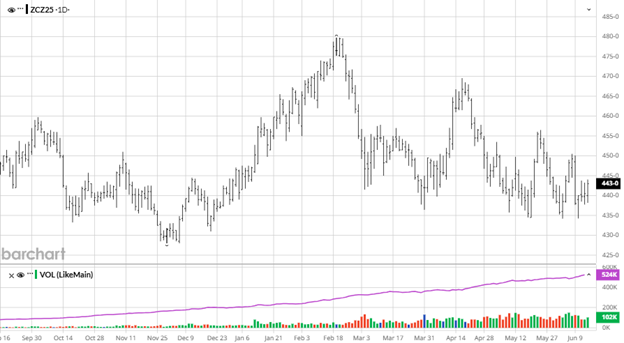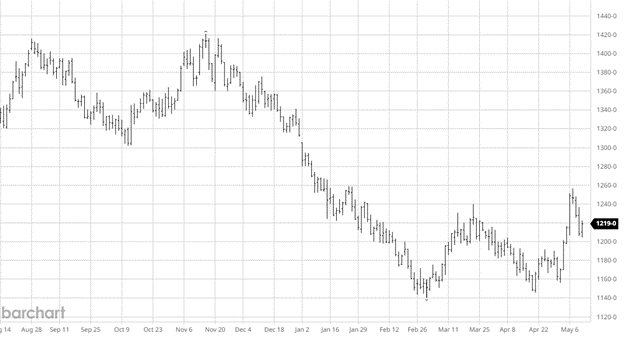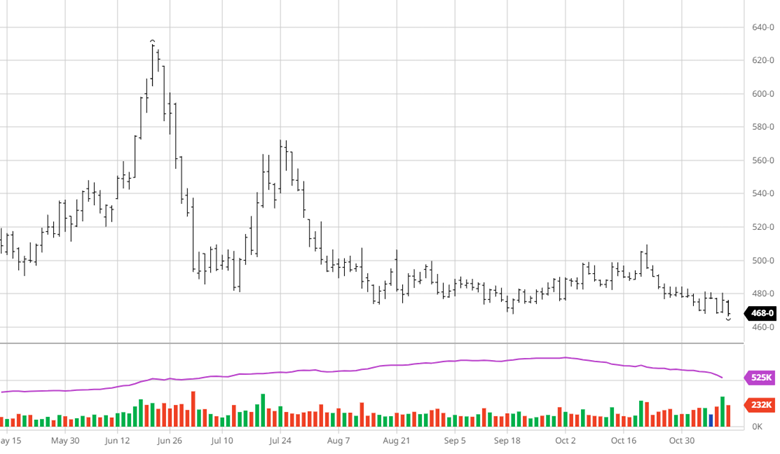


188.8 bu/acre… Hard to find a silver lining in the report for corn as the USDA ripped the band-aid off from the start instead of slow playing it. The average trade guess was 184-185 bu/ac which led to a big selloff seeing new contract lows. On top of the big yield number the USDA took the FSA planted acreage data and added 3 million acres in planted corn. The extra yield and acres could add nearly an extra 1 billion bushels of corn to the US and world ending stocks. The report did nothing to help the direction corn has been trading.
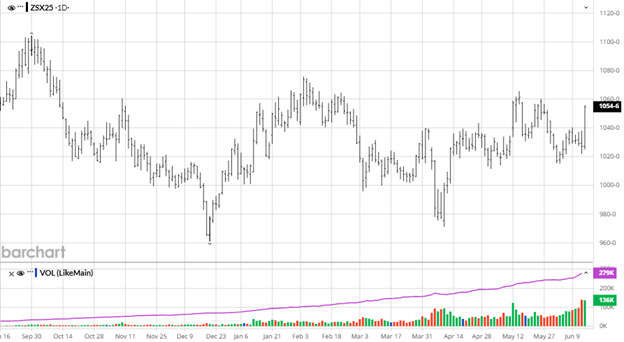
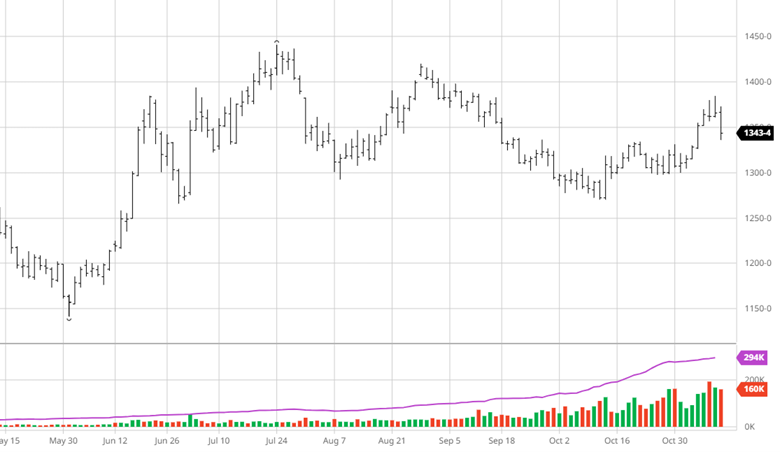
The bean yield was also above pre-report estimates, coming in at 53.6 bu/acre. Prices were higher though following the 3 million acre planted acreage cut and total production cut by 90 million bushels. The market was caught off guard by the 3 million acre shift as evidenced in the opposite price reaction to the report numbers. The bean rally will give farmers a chance to catch up on sales but it will also motivate more acres to be planted in South America on stronger prices.
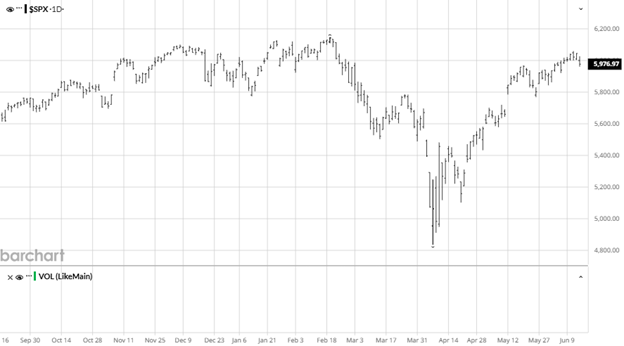
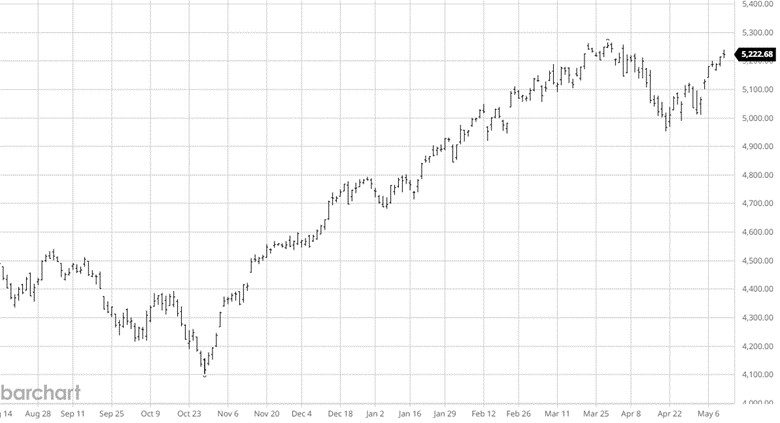
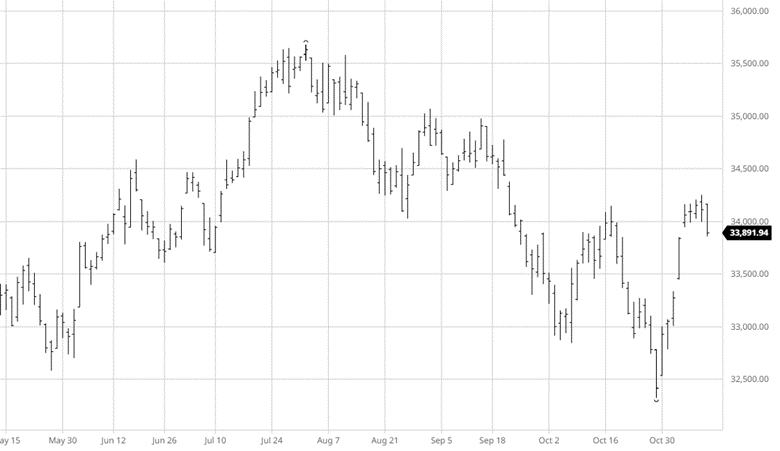
Equity markets continued to perform well as AI and tech companies are still the major movers. Nvidia and Microsoft are now a combined 15+% of the S&P 500 index, causing some to worry about concentration, but luckily they are performing well so right now a rising tide raises all boats (money in S&P ETFs).
Wheat was in line with re-report estimates and had no major surprises. The weakness in corn will continue to weigh on wheat however.
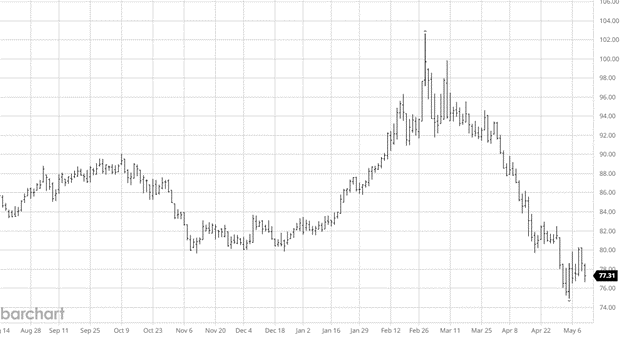
Cotton saw a boost post report after the USDA lowered planted and harvested acres. Production was trimmed by 1.39 million bales to 13.21 million bales.
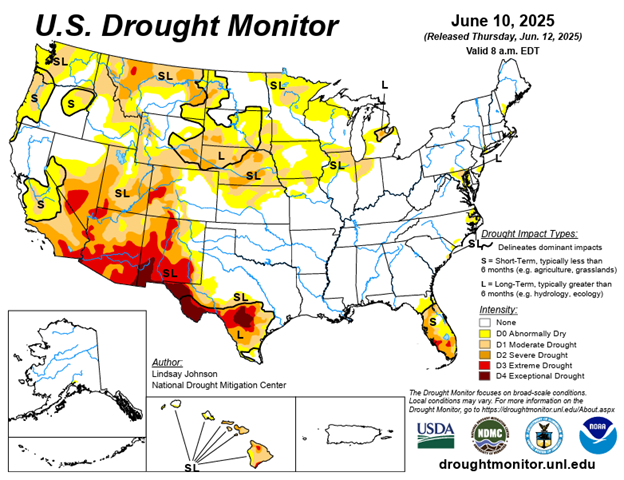
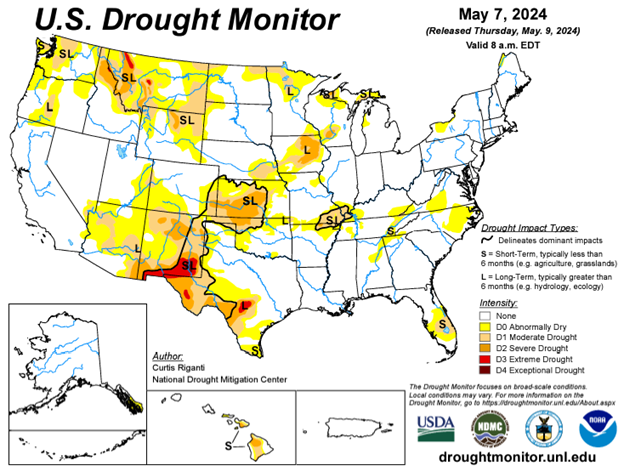
Drought Monitor
Here is the most recent drought monitor.
Contact an Ag Specialist Today
Whether you’re a producer, end-user, commercial operator, RCM AG Services helps protect revenues and control costs through its suite of hedging tools and network of buyers/sellers — Contact Ag Specialist Brady Lawrence today at 312-858-4049 or blawrence@rcmam.com.
Last week was rough for commodities as corn dropped to make new contract lows in Dec ’25. The charts do not look good for corn and there is no good news to help either. There are no major weather concerns and South America is producing another record crop allowing for ample ending stocks in the world. The USDA June 30th Planted Acreage Report stated that corn has 95.203 million planted acres. This number is neutral to bearish as the market was expecting a slightly higher number but anything 95+ with the weather to this point in the year looks for a huge crop. The bears have the momentum right now but there are some trouble areas and a long summer ahead to bring the bulls some help.
Soybeans gave back the recent gains as well last week before the report on June 30th. Beans will likely continue to trade in the range they have been until we receive news to direct the market either on the trade agreement side or weather. The Planted Acres report had 83.38 million acres, slightly below expectations. The tax bill going through congress right now may give beans some help by getting rid of a 45z tax credit loophole but until this thing passes everything is on the table to get cut from it. Weather is good for the next 2 weeks so the market needs positive news from a US and China trade deal to give it a boost.
Markets set new highs after another V shape recovery following the liberation day tariff dip. Several tech stocks have led the way outside of the Magnificent 7 as AI continues to dominate headlines with spending continuing and companies talking about how it can help improve their margins.
Cotton acres came in higher than expected at 10.12 million acres. Cotton has been stuck below 70 cents/lb for a while and while the acreage number came in higher than expected we know there are issues with the crop and a lot of abandonment.
Wheat, like corn and beans, yawned at the report as the numbers were close to the average estimate with no major changes. After a mid June rally, the weakness to end the month was disappointing dropping 50 cents from the highs.
The weakness in the USD over the past few months will be something to keep an eye on as the year continues with it trading at levels we have not seen since early 2022.
Tensions in the Middle East continue despite a drawdown in aggression.
Drought Monitor
Here is the most recent drought monitor.
Contact an Ag Specialist Today
Whether you’re a producer, end-user, commercial operator, RCM AG Services helps protect revenues and control costs through its suite of hedging tools and network of buyers/sellers — Contact Ag Specialist Brady Lawrence today at 312-858-4049 or blawrence@rcmam.com.

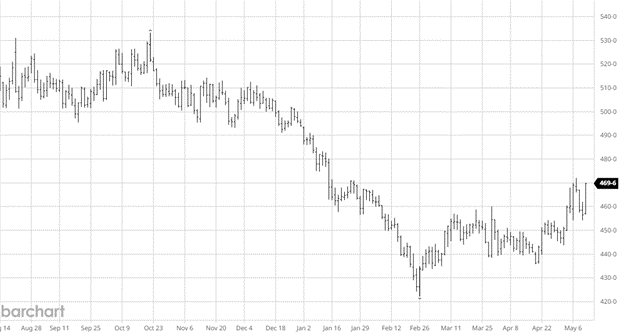
Corn continues to struggle with any rallies as you can see in the chart below every recent high is lower than the previous. The June 12th USDA report was lackluster with no real changes and not enough good news to give the bulls help. With the crop planted, 75% good/excellent, and non-threatening growing weather ahead, the bulls need a weather issue and/or positive trade news to change the direction of the market. The next major report is the June 30th Stocks and Acreage Report that tends to cause some volatility.
Soybeans received great news to end the week with better-than-expected biofuel mandates from the Trump administration. You can see how the news was received after a lackluster USDA report earlier in the week in the chart below. Beans will need to breakthrough recent highs or at least stay above the moving averages they broke through to keep some positive momentum as they are where they were back in February which is at least better than corn’s price movement. Planting should wrap up soon and good growing weather will move this crop along. Beans received one piece of good news in the biofuel mandates as they await news on any deal with China to help push higher.
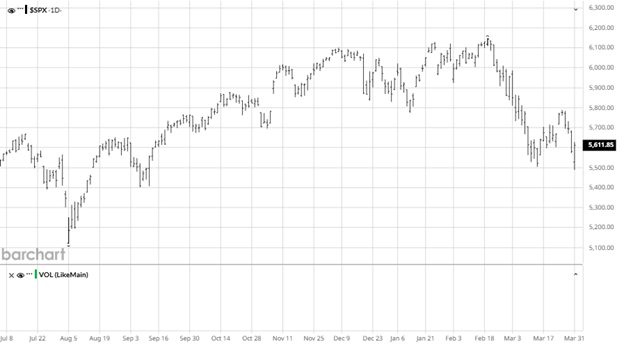
Markets have settled down after another V shape recovery following the tariff driven dip at the beginning of April. The leveling off slightly below all-time highs shows that the market is hesitant in what to expect moving forward but acknowledges that the initial reaction to tariffs with negotiations ongoing were an overreaction. While the market could fail here and move lower with negative trade news the biggest domino the market is watching is China while also keeping an eye on developments in the Middle East.
Israel and Iran’s conflict appears to be getting worse with more attacks while the US tries to position itself to lower tensions. Crude Oil prices will watch the news as a global economic slowdown vs lower production due to war would face off.
Cotton has been quiet with a lack of foreign demand with global economic uncertainty.
Drought Monitor
Here is the most recent drought monitor.
Contact an Ag Specialist Today
Whether you’re a producer, end-user, commercial operator, RCM AG Services helps protect revenues and control costs through its suite of hedging tools and network of buyers/sellers — Contact Ag Specialist Brady Lawrence today at 312-858-4049 or blawrence@rcmam.com.
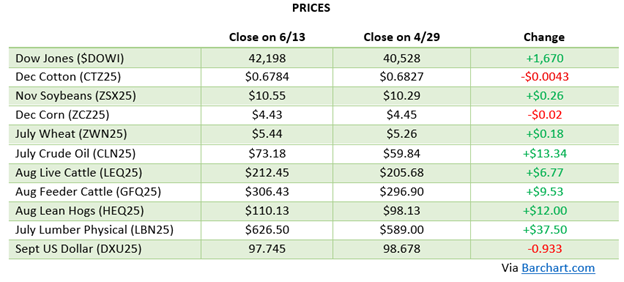
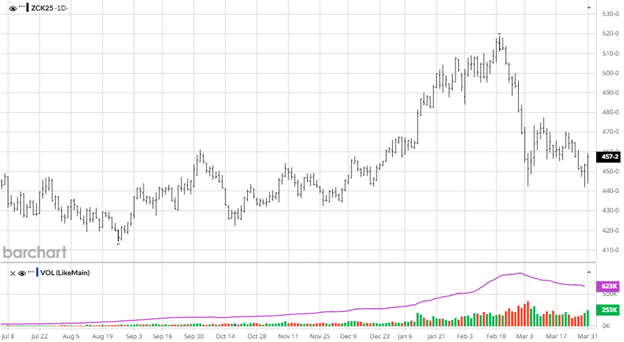
The March 31 Stocks and Acreage Report did not provide any fireworks as there were no major surprises in the report with the USDA saying there will be 95.326 million acres planted. While this is a large acreage number the trade and talk the last couple weeks was about the likelihood of the USDA coming out with a 95 number. While the report could have been worse, stocks coming in exactly in line with the estimate did not pile on with bad news. As we head toward planting, weather, South America and tariff wars will be the main movers now.
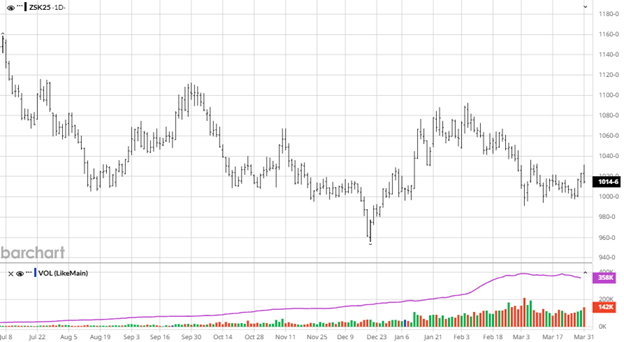
Soybeans came in at 83.495 million acres as their lack of profitability at current prices is making farmers switch some acres to corn. As you can see from the chart below there have not been much help for beans but if this acreage number is close to what we see, it is hard to think they would dip much below $10. The post report action was disappointing as beans continued lower.
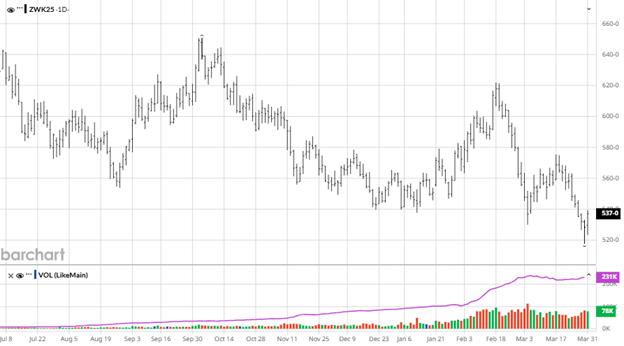
Wheat had bullish news from the report as acreage came in 1.125 million below estimates. Wheat has some bullish world news for price with emergence concerns in the Black Sea and US Plains, despite recent price action. News out of the Black Sea and any issues with the US crop will be market movers for now.
The equity markets continue their volatile swings while President Trump’s “day of liberation” approaches on April 2 when tariffs are supposed to be going in place. Volatility will be the name of the game as many unknowns remain in the trade wars.
Cotton acres came in at 9.867 million. This is 1.315 million acres less than last year. Cotton needs to see demand pick up to get back and stay over 70 cents/lb.
Drought Monitor
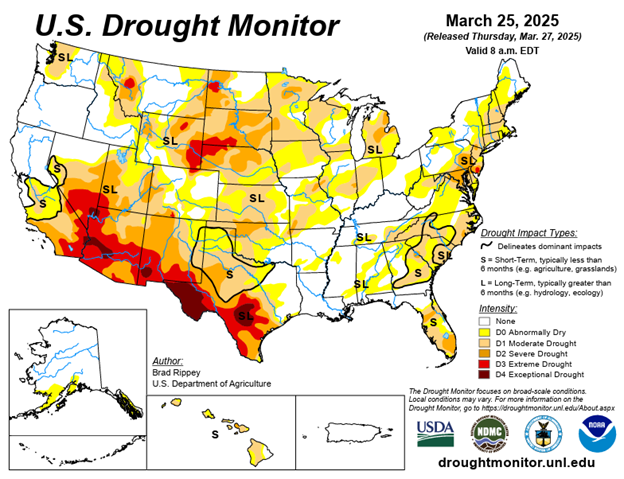
As planting approaches the drought monitor begins to become important again as subsoil moisture always seems to be a problem somewhere.
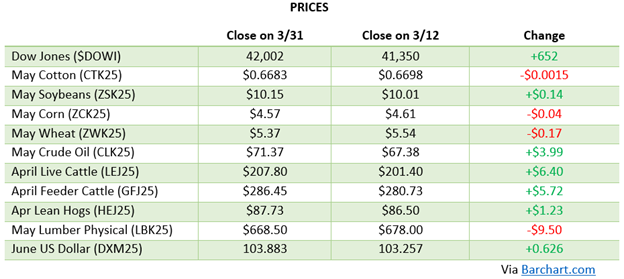
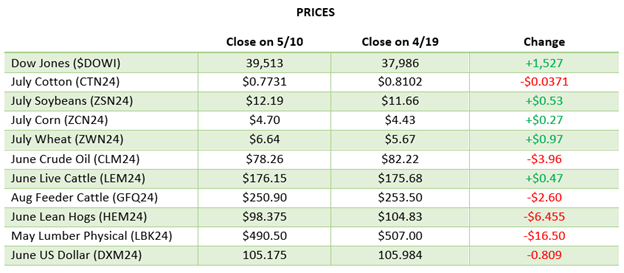
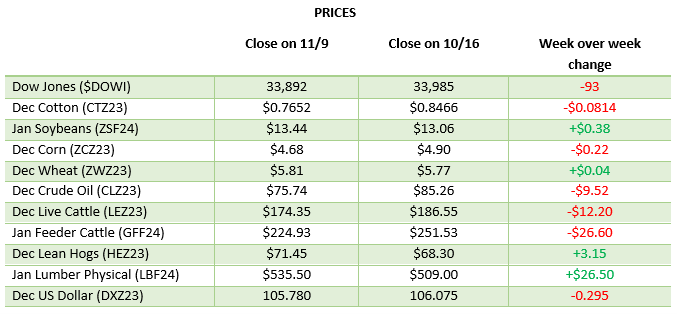
PRICES
Contact an Ag Specialist Today
Whether you’re a producer, end-user, commercial operator, RCM AG Services helps protect revenues and control costs through its suite of hedging tools and network of buyers/sellers — Contact Ag Specialist Brady Lawrence today at 312-858-4049 or blawrence@rcmam.com.
Corn has seen a strong rally over the last couple of weeks as planting is slightly delayed in parts of the US and funds seem to have changed their tone a bit. Last week’s USDA Report did not have any earth-shattering news but did provide some good news for the markets. US corn stocks were lower than estimates heading into the report along with world stocks for both 23/24 and 24/25. The production outlook for this year, 181 bu/ac, continues to show how the advances in agronomic practices and seed genetics continue to grow. All of these carryout and stocks numbers are based on those production estimates so if we begin to see weather issues or problems at the end of planting, we could continue to see revisions to the downside, and vice versa with great weather and conditions.
Beans had a rough week after a strong start to May. The USDA Report leaned bearish as the South American production continues to expand for the upcoming year. The USDA is slowly trimming Brazil’s bean crop but is still above CONAB’s estimates by a bout 300 million bushels. The recent flooding in southern Brazil will force their hand to lower their expectations but the CONAB estimates on losses will be closely watched. Another promising development in the report was the expectation of record imports and usage in China. While much of this is expected to be met by Brazil and issues with their production will still need to be met.
The equity markets have rebounded over the last couple weeks with earnings season going on. The feeling on Fed rate cuts keeps pushing them back with one not expected until the fall and at least one fed chair thinking we may not get one this year as inflation remains sticky. Rates will remain data dependent but the feeling of higher for longer continues to seem more likely.
Cotton has fallen well off the February and March highs as the lack of demand in the global market mixed with funds exiting their long positions has beaten down the market.
Wheat’s recent rallies are welcome after struggling to find much positive movement in the market to start the year. Frost damage to Russia’s wheat crop and a dry pattern in the Black Sea has been the recent mover as the USDA Report had some mixed numbers. Smaller than expected US stocks, 24/25 world stocks and total production with higher than expected world wheat stocks for 23/24.
Other News
Conflict continues between Israel and Palestine as a ceasefire has been negotiated on many sides, but nothing has been agreed to yet.
Major flooding across southern Brazil has killed thousands of livestock and will have an impact on their crop but the extent of which is not known yet
Drought Monitor
Here is the current drought monitor as we head toward planting with subsoil moisture a focus.
Whether you’re a producer, end-user, commercial operator, RCM AG Services helps protect revenues and control costs through its suite of hedging tools and network of buyers/sellers — Contact Ag Specialist Brady Lawrence today at 312-858-4049 or blawrence@rcmam.com.
The November USDA Report raised US yields and ending stocks. From what we have been hearing about yields in the eastern corn belt the rise in yields was not that unexpected while a 1.9 bu/ac jump higher to 174.9 was not quite expected. Rarely does the November report differ so much from the Sep/Oct yields, but the yields in IL, IN, and OH made up for losses seen in the western corn belt and plains. Current support is at $4.67 for Dec corn, but a close below that could lead lower. If that holds, we should expect the sideways trade we have seen for the next month+. US corn yield 174.9 bpa. Us corn production 15.234 billion bushels.
Soybeans had seen a good run over the last couple of weeks until the USDA report took a hit. While beans are still well off their lows the report’s reaction saw beans lose 20 cents. Like corn, soybeans saw their yield increased to 49.9 bu/ac. The Chinese demand situation and northern Brazil’s dry weather have been bullish for beans and will be a bullish talking point if they last and the main news moving forward. US soybean yield49.9 bu/ac. US soybean production 4.129 billion bushels.
The equity markets had their longest winning streak of the year in the past couple weeks, climbing back from the latest move lower. Inflation is cooling and the Fed appeared to be done (for now) with changing rates which allows the market to take a deep breath as a “soft landing” appears attainable. Fed Chair Powell today said that he is not confident the Fed has achieved sufficiently restrictive rate to bring down inflation, allowing for some concern of further rate hikes. While earnings have not been stellar across the board strength in some important areas has given the markets fuel for this most recent rally.
Cotton is a supply and demand story right now with ample supply and a lack of demand. World geopolitical issues and the risk of a recession have kept buying down as producers do not want to be stuck with inventory nobody wants to buy.
Whether you’re a producer, end-user, commercial operator, RCM AG Services helps protect revenues and control costs through its suite of hedging tools and network of buyers/sellers — Contact Ag Specialist Brady Lawrence today at 312-858-4049 or blawrence@rcmam.com.
Corn had its best 2 week stretch in quite a while. As you can see from the chart below this has been the first meaningful rally, we have seen in 2023. As corn planting was 81% complete to start the week, ahead of the average pace, the trade has started to look at the weather outlook as we head into June. A dry pattern has begun forming in the coming weeks as it begins to warm up across the corn belt. While the heat in June is not overly worrisome it will be important to keep an eye on it as a warm dry June, followed by a hot dry July, could be plenty to do some serious damage to the US crop. We are a long way from this becoming a reality but a few weeks of dry heat to start June could help this rally keep some momentum or at least not give back the recent gains. Exports continue to be disappointing, and the extension of the Black Sea grain corridor isn’t bullish, but as usual the focus will be on final planted acres and weather in the coming weeks.
Soybeans can’t get any momentum as South American beans continue to be the preferred option in the world market. November futures made a new low this week before getting a modest bounce on Friday heading into the long weekend. As demand continues to struggle the USDA will likely continue to trim exports in the next report, which will add to ending stocks for 22/23. Beans were 66% planted, ahead of the average pace, as weather concerns won’t hit the soybean market just yet. Beans are lacking any bullish news as they wait for a spark but struggle to find where it will come from.
Cotton had a volatile week as seen in the chart below. When these opportunities present themselves, you do not want to miss the opportunity to hedge your risk. Have a plan and be prepared if there is another 5-cent spike that could make a big difference in your bottom line and potentially a good spot to place a hedge. The 78-84 cent range of Dec 2023 cotton has been consistent with pops to the upside and dips back to the bottom. The world economic outlook and US weather will be the main drivers moving forward into the long weekend.
The equity markets continue their mixed run of late with the DJI continuing to struggle while the S&P and NASDAQ stocks see gains. NVIDIA was the big winner of the week as chips and AI have investors’ focus. While the jury is still out on Artificial Intelligence and what role it will play in the coming years, one thing is clear, investors don’t want to miss the boat even though we do not know if the boat is the Titanic or the USS Missouri.
The drought monitor below shows the struggles in the weestern corn belt as the eastern corn belt is in good shape as planting wraps up.
Podcast
With every new year, there are new opportunities, and there’s no better time to dive deeply into the stock market and tax-saving strategies for 2023 than now. In our latest episode of the Hedged Edge, we’re joined by Tim Webb, Chief Investment Officer and Managing Partner from our sister company, RCM Wealth Advisors. Tim is no stranger to advising institutions and agribusinesses where he has been implementing no-nonsense financial planning strategies and market investment disciplines to help Clients build and maintain wealth and reach financial goals since
Inside this jam-packed session, we’re taking a break from commodities, and talking about the world of equities, interest rates, tax savings, and business planning strategies. Plus, Jeff and Tim delve into a variety of topics like:
The current state of the markets within the wealth management industry
Is there a beacon of hope, or is it all doom and gloom for the markets?
Other strategies to think about outside of the stock market and so much more!
Whether you’re a producer, end-user, commercial operator, RCM AG Services helps protect revenues and control costs through its suite of hedging tools and network of buyers/sellers — Contact Ag Specialist Brady Lawrence today at 312-858-4049 or blawrence@rcmam.com.
Corn had a rough week, especially to end the week falling over 20 cents after a small rally. Poor weekly exports, fund selling and the potential for rain in the driest parts of the US pushed prices lower this week. Corn planting was 8% complete to start the week, slightly behind where it was expected to be but in fine shape for this point of the year. Weather will remain a problem from the Midwest with cold temps continuing. Any news out of Russia and Ukraine will continue to move markets.
Soybeans had a similar week to corn with weakness into the weekend. Brazilian soybeans continue to be at a big discount to Chicago, $2.00, with their record production and storage shortage. China is not as active a buyer as expected in Brazil but less demand from them will lead to more from other places taking away from US exports. The soybean balance sheet has been tight so that would not be a bad thing for global supply but would not be friendly to getting back to $14 beans.
Cotton was limit down at one point during Thursday’s trade, before bouncing slightly for its worst day in over a month. The export report was less than impressive this week at a 15-week low. The chart broke through its support level during the down trade, changing how the charts look. The chance of rain in west Texas was one of the drivers as it only takes a few well-timed rains to make the markets nervous. While it is still only a chance of rain all eyes will be on if that rainfall comes to fruition. Any widespread rain in west Texas would lead to another limit move lower.
The equity markets bled a little this week as the market looks for direction from earnings. The S&P 500 was unable to break through the 4,200 level, coming close before moving lower for the week. Earnings next week for some major companies (Microsoft, Google, Meta, and Amazon) will give us a lot of information that will determine the market’s next move.
The eastern corn belt has gotten plenty of moisture, some too much, so far this winter with the western corn belt dry.
Podcast
With every new year, there are new opportunities, and there’s no better time to dive deeply into the stock market and tax-saving strategies for 2023 than now. In our latest episode of the Hedged Edge, we’re joined by Tim Webb, Chief Investment Officer and Managing Partner from our sister company, RCM Wealth Advisors. Tim is no stranger to advising institutions and agribusinesses where he has been implementing no-nonsense financial planning strategies and market investment disciplines to help Clients build and maintain wealth and reach financial goals since
Inside this jam-packed session, we’re taking a break from commodities, and talking about the world of equities, interest rates, tax savings, and business planning strategies. Plus, Jeff and Tim delve into a variety of topics like:
The current state of the markets within the wealth management industry
Is there a beacon of hope, or is it all doom and gloom for the markets?
Other strategies to think about outside of the stock market and so much more!
Whether you’re a producer, end-user, commercial operator, RCM AG Services helps protect revenues and control costs through its suite of hedging tools and network of buyers/sellers — Contact Ag Specialist Brady Lawrence today at 312-858-4049 or blawrence@rcmam.com.
The USDA prospective plantings and quarterly stocks reports were released today, March 31st, with a mix of news. The report pegged this year’s crop at 92 million acres while the trade estimates were about 91 million. This led to a mixed trade as pre-report strength faded with futures ending mixed for the day. Current US weather conditions and the expectation of a slow start to planting could lead to this number falling, it is unlikely we will see a number higher than this the rest of the year, similar to last year. Corn stocks were lower than estimates by 69 million bushels and over 350 million bushels lower than last year.
Soybeans received a boost from the report as with lower acreage and stocks than expected. The planted acreage number came in at 87.5 million acres, lower than the 88.24 million trade estimate. The quarterly stocks were 247 million bushels lower than a year ago, continuing to show the tightness on the balance sheet. South America still has some uncertainty around their crop, but we should get a better idea in the coming weeks. Both numbers from today’s report are seen as bullish for the market.
Wheat saw some bearish numbers with higher planted acreage and higher stocks than pre-report estimates. 49.9 million acres, 1 million over estimates, and 946 million bushels in stocks, 934 mbu estimate, were both bearish while the price did not overreact. Wheat will follow corn’s lead for now with many questions still surrounding the conditions in the southern plains and the Black Sea.
Cotton’s bounce this week back to over 83 cents was very welcome after a couple weeks of lower trade. The market did not have a major reaction to the report with planted acreage estimates coming in at 11.3 million acres vs the 11.2 million trade estimate. Speculative short covering helped cotton rally this week while spreads were also a lower than normal percent of the trade. The problem continues to remain of recession fears and how that affects companies purchases trying to weigh supply and demand.
Equities had another good week as investors seem to believe the Fed will relax with rate hikes and the banking fears have calmed down along with an ease in inflation pressure as we slowly move lower. Tech companies would be the beneficiary of lowering rates by the end of the year but the Fed’s recent comments would indicate they have no intention to lower rates before the end of the year. There was strength in most sectors this week.
The eastern corn belt has gotten plenty of moisture, some too much, so far this winter with the western corn belt needing more heading into the spring.
Podcast
With every new year, there are new opportunities, and there’s no better time to dive deeply into the stock market and tax-saving strategies for 2023 than now. In our latest episode of the Hedged Edge, we’re joined by Tim Webb, Chief Investment Officer and Managing Partner from our sister company, RCM Wealth Advisors. Tim is no stranger to advising institutions and agribusinesses where he has been implementing no-nonsense financial planning strategies and market investment disciplines to help Clients build and maintain wealth and reach financial goals since
Inside this jam-packed session, we’re taking a break from commodities, and talking about the world of equities, interest rates, tax savings, and business planning strategies. Plus, Jeff and Tim delve into a variety of topics like:
The current state of the markets within the wealth management industry
Is there a beacon of hope, or is it all doom and gloom for the markets?
Other strategies to think about outside of the stock market and so much more!
Whether you’re a producer, end-user, commercial operator, RCM AG Services helps protect revenues and control costs through its suite of hedging tools and network of buyers/sellers — Contact Ag Specialist Brady Lawrence today at 312-858-4049 or blawrence@rcmam.com.
The last 2 weeks have not been friendly to corn despite a neutral to bullish USDA report this week. The USDA lowered Argentina’s production by 40 mmt, but the crop could still be smaller amid a historically poor weather year in Argentina. Corn took a nosedive to end the month of February and has taken another leg lower this week, with the new crop hitting $5.50. After a flat trade for most of February the move lower presents farmers with important decisions regarding what to do for crop insurance. With the Feb average price of $5.91, 40ish cents higher than current levels, farmers should seriously look at the highest level of revenue protection you can get. The premiums will likely be high, but the recent price movement has created an uncertain environment with a long way to go.
Soybeans moved lower again this week after rebounding last week as soybeans have held together better than corn. Bean stocks were tighter than the trade expected while exports were up 25 mbu but crush down 10 mbu. Global oilseed supply and demand forecasts include lower production, crush and stocks. Like for corn, the USDA lowered Argentina’s production below the average trade estimate. While the news out of the report was mildly bullish, the negativity around corn and wheat bled into beans to end the week.
Cotton was punched in the mouth on Friday after trading lower this week. The USDA did not make any significant changes to the supply and demand report. The lack of demand is the main problem as the global 22/23 forecasts this month include lower consumption and trade with higher production and stocks. The world economic outlook is questionable for the coming year and a global recession would hurt cotton more than other areas.
The story for wheat has not changed as markets continue to get crushed. The report made no major changes to forecasts and balance sheets and there has not been any major changes in Ukraine as Russia continues their assault. Russian officials are expected to meet with UN officials in Geneva on March 13 to discuss the grain deal renewal and trade sanctions.
Equity Markets
Equity Markets moved lower this week on overall market weakness and the Silicon Valley Bank news. While one day doesn’t make a trend, the trend lower since the start of February looks to have room to move lower with another big jobs added number keeping the Fed rate hikes as a question mark.
The eastern corn belt has gotten plenty of moisture so far this winter with the western corn belt needing more heading into the spring.
Podcast
With every new year, there are new opportunities, and there’s no better time to dive deeply into the stock market and tax-saving strategies for 2023 than now. In our latest episode of the Hedged Edge, we’re joined by Tim Webb, Chief Investment Officer and Managing Partner from our sister company, RCM Wealth Advisors. Tim is no stranger to advising institutions and agribusinesses where he has been implementing no-nonsense financial planning strategies and market investment disciplines to help Clients build and maintain wealth and reach financial goals since
Inside this jam-packed session, we’re taking a break from commodities, and talking about the world of equities, interest rates, tax savings, and business planning strategies. Plus, Jeff and Tim delve into a variety of topics like:
The current state of the markets within the wealth management industry
Is there a beacon of hope, or is it all doom and gloom for the markets?
Other strategies to think about outside of the stock market and so much more!
Whether you’re a producer, end-user, commercial operator, RCM AG Services helps protect revenues and control costs through its suite of hedging tools and network of buyers/sellers — Contact Ag Specialist Brady Lawrence today at 312-858-4049 or blawrence@rcmam.com.
RCM Ag Services is a registered DBA of Reliance Capital Markets II LLC. Trading futures, options on futures, and retail off-exchange foreign currency transactions are complex and involve substantial risk of loss and are not suitable for all investors. Loss-limiting strategies such as stop loss orders may not be effective because market conditions or technological issues may make it impossible to execute such orders. Likewise, strategies using combinations of options and/or futures positions such as “spread” or “straddle” trades may be just as risky as simple long and short positions. There are no guarantees of profit. You should carefully consider whether trading is suitable for you in light of your circumstances, knowledge and financial resources. You may lose all or more than your initial investment. You should not rely on any of the information herein as a substitute for the exercise of your own skill and judgment in making such a decision on the appropriateness of such investments. Opinions, market data and recommendations are subject to change without notice. Reliance Capital Markets II LLC shall not be held responsible for any actions taken based on this website or attached links. Parties acting on this electronic communication are responsible for their own actions. Past performance is not necessarily indicative of future results.