
Summary:
Steady outtake, steady demand, steady prices—that’s a recipe for a dull trade with thin margins.
Seasonally, May into early June is dead money. “Sell in May and go away” exists for a reason. But this year, the takeaway is just firm enough to keep everyone from stepping away entirely. Add in historically lower field inventories (possibly by design), and the market doesn’t have the cushion to relax.
Right now, the industry is playing prevent defense—always on the field, focused on not losing. That’s a tough way to operate in a commodity business, especially when costs are sticky and conviction is low.
Flip Side:
I think what most are missing is that there are inventory pockets—and they’re full. It’s not enough to supply the whole market, but it’s a real risk for the guys sitting on it. And right now, there’s no appetite to hedge any of it.
In a market with no clear direction, that’s a problem. Everyone needs to stay disciplined—we’ve seen how quickly this can turn into a bottomless pit over the past year. It doesn’t take much. Hedge 20–30%, give yourself some cover, and live with it.
Step back and nothing has really changed in three years. The guys who bought wood and consistently hedged made money on the futures side—that’s just fact.
I think the weakness is running out of gas… but I’ve said that before.
Starting back in June of 2023.
Technical:
Last week’s trade was a step back technically. It’s not a sell signal, but it did give back some hard-earned momentum. Most oscillators have rolled back to neutral-to-negative, and it’s going to take some work to turn those higher again. The fact one stayed positive since mid-April just reinforces how sideways this market really is.
Levels to watch:
July futures need a close over 603.50—the recent spike high—to confirm things are tightening underneath the surface.
On the downside, there’s real air between 580 and 560. That zone keeps catching volume month after month, with a few thousand contracts likely changing hands there since January. It’s become a magnet.
Markets tend to build a base in areas like that… and eventually move higher from them.
Daily Bulletin:
https://www.cmegroup.com/daily_bulletin/current/Section23_Lumber_Options.pdf
Southern Yellow Pine:
https://www.cmegroup.com/markets/agriculture/lumber-and-softs/southern-yellow-pine.volume.html
The Commitment of Traders:
https://www.cftc.gov/dea/futures/other_lf.htm
About the Leonard Report:
The Leonard Lumber Report is a column that focuses on the lumber futures market’s highs and lows and everything else in between. Our very own, Brian Leonard, risk analyst, will provide weekly commentary on the industry’s wood product sectors.
Brian Leonard
bleonard@rcmam.com
312-761-263




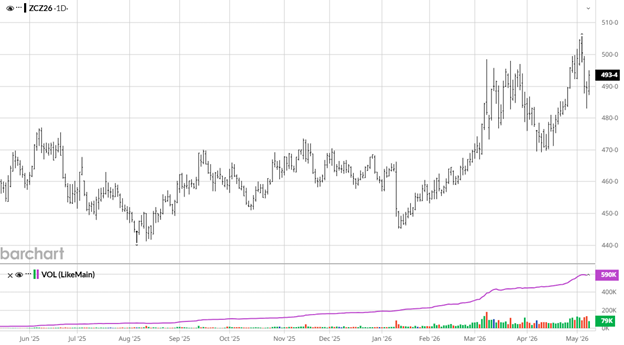
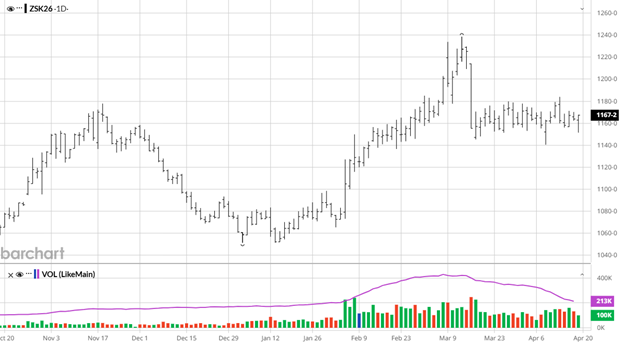
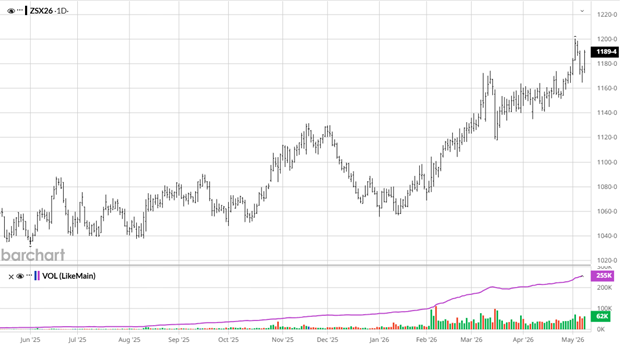
 The market continues to wait for a fresh demand catalyst, and the one most closely watched, a potential resumption of Chinese buying linked to a Trump-Xi summit, has been repeatedly delayed amid ongoing Iran conflict negotiations, but appears to be on for this month. The bullish case for soybeans continues to rest on crush economics. Board crush margins holding above $3 per bushel are exceptional by historical standards and are supporting the nearby contracts. NOPA March crush are expected to far exceed year-ago levels, underscoring the strength of domestic demand for meal and oil. Brazil’s Conab raised its 2025/26 soybean production estimate once more to 6.582 billion bushels, and May shipment estimates from Brazil’s Anec were raised to 533.8 million bushels, peak export season for the world’s largest shipper. That supply overhang remains the key obstacle to a sustained rally with South America having such a large crop. Beans planted were at 33% for the week of May 4th, slightly lower than expected but still very strong for this time of year.
 Equity Markets