Tag: Ag Commodities

16 Nov 2026

LEONARD LUMBER REPORT: I’m not sure whether this is the tail wagging the dog

Recap:

I’m not sure whether this is the tail wagging the dog, but November’s 478 low on Friday satisfies another downside target in my book. We can either chalk it up to an expiration trade or view it as a setup for the 418.50 low. Better news, next Friday’s weekly chart will look healthier if January can hold.

The issue with January holding is volume. Last week’s volume remained light, which matters. The market made a fresh low without the kind of participation that would clearly signal capitulation. The market is getting oversold, but an oversold market can stay oversold until positions are cleaned up and buyers become willing to defend a level. We still believe this is a timing issue, not a price issue.

The broader setup remains the same. Futures continue to discount weak demand and an oversupplied market while the industry looks for a sustainable bottom. Earlier positioning showed fund shorts largely staying in place through the roll, so the question remains whether a lower trade finally forces liquidation or whether the market simply continues grinding lower on limited volume.

We have starts and permits this week. Last week’s existing-home sales report wasn’t friendly: October sales fell to a 3.75 million annual rate, a new cycle low. But these reports have numerous dynamics built into them, and the field is already being told to expect a slower fourth quarter. It is showing up, but it does every fourth quarter.

The reality is that we operate in real time. If a bid matches an offer, a trade occurs. No company is looking to add extra inventory simply because the price is lower. They will buy when they can sell into it. That means even a little tightness can trigger a buy; falling prices alone will not.


Technically, the 61.8% retracement sits at 536.40. If the algo takes some time off, that is my objective.


Daily Bulletin:

https://www.cmegroup.com/daily_bulletin/current/Section23_Lumber_Options.pdf

Southern Yellow Pine:

https://www.cmegroup.com/markets/agriculture/lumber-and-softs/southern-yellow-pine.volume.html

The Commitment of Traders:

https://www.cftc.gov/dea/futures/other_lf.htm


About the Leonard Report:

The Leonard Lumber Report is a column that focuses on the lumber futures market’s highs and lows and everything else in between. Our very own, Brian Leonard, risk analyst, will provide weekly commentary on the industry’s wood product sectors.


Brian Leonard

bleonard@rcmam.com

312-761-263

13 Nov 2026

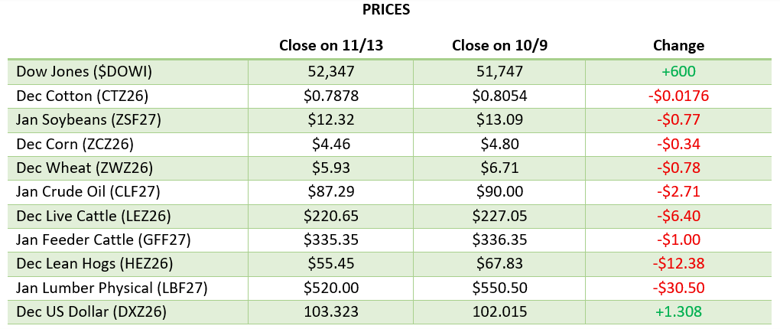
AG MARKET UPDATE OCTOBER 9 – NOVEMBER 13

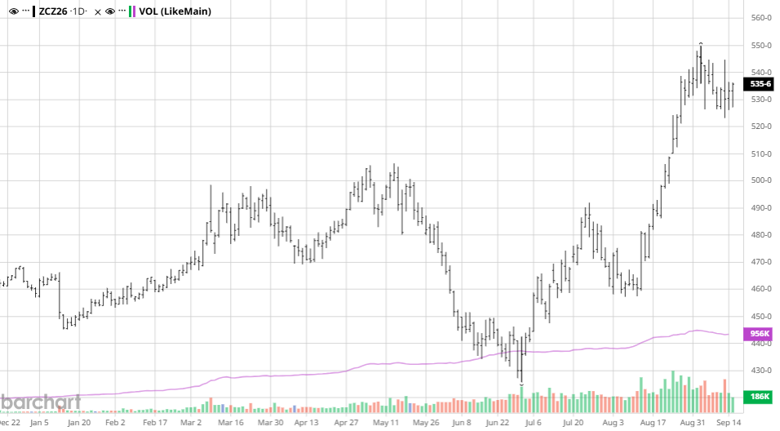
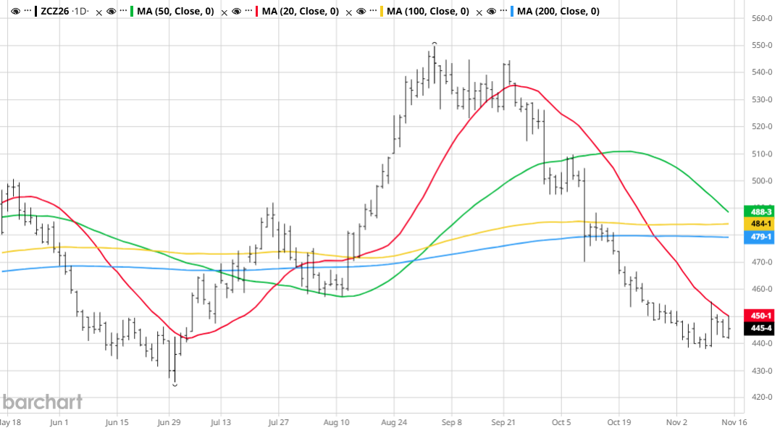
Corn opened this period with one of the most bearish USDA surprises in years. The October 9th WASDE raised the national yield 2.7 bushels per acre to 181.2 bpa, the largest September-to-October jump since 2005, when the trade was looking for a cut to roughly 177.7. That pushed production above 16 billion bushels, lifted 2026/27 ending stocks 282 million bushels to 1.849 billion, and sent stocks-to-use back above 10%. December futures briefly traded limit down, and the funds that had built a record net long in early September headed for the exits, slashing their net long from roughly 231,000 contracts in mid-October to about 56,000 by October 27th. Add in harvest pressure and export inspections running about half of last year’s pace, and December corn slid to $4.39 by November 9th, its lowest since mid-August and more than $1.10, or 20%, off the $5.50 high posted September 2nd.

The November 10th WASDE flipped the script. USDA cut yield 1.6 bpa to 179.6, below the 180.3 trade average, with Illinois down 8 bushels to 200 and Indiana down 5 to 195. Production fell 141 million bushels to 15.893 billion and, even after trimming exports to 3.275 billion, ending stocks dropped to 1.758 billion (10.8% stocks-to-use). December corn jumped nearly 10 cents to $4.49 on report day, but the rally lacked follow-through and settled at $4.42½ on Thursday as a stronger dollar, weak wheat, and favorable Brazilian weather weighed. With harvest only 81% complete as of November 8th, five points behind average and slowed by wet conditions in Iowa, some analysts think USDA may trim yield further before the final number in January. Between now and the next update, watch the 20-day moving average near $4.50 in Dec as overhead resistance, the weekly export pace, and early-season weather for Brazil’s crop.
Via Barchart

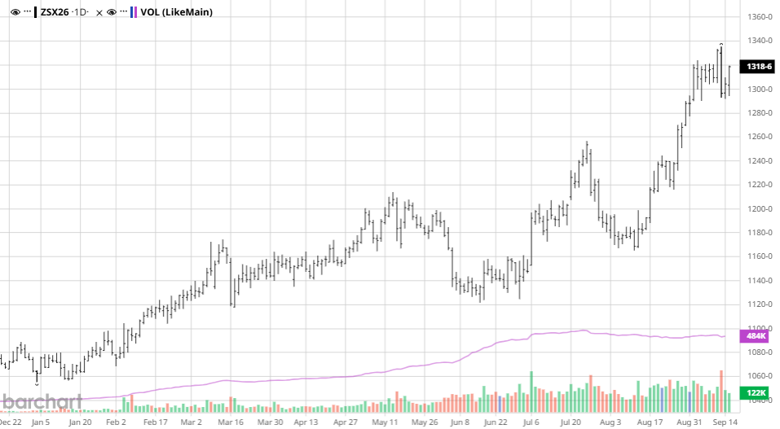
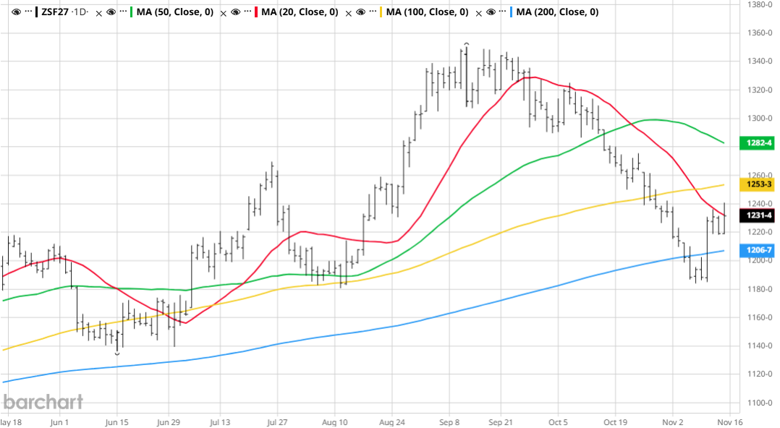
Soybeans followed a similar round trip. The October report was neutral to slightly bearish, with yield raised to a record 53.1 bpa and ending stocks at 315 million bushels, and beans bled lower through October as harvest raced ahead. The bigger blow came from Brazil, where Lula’s surprise October 25th runoff victory sent the real roughly 11% lower, making Brazilian beans cheaper on the world market and knocking November soybeans down 34¼ cents that week. January futures bottomed at $11.84 last week, about 12% below the September 11th high near $13.50, before China stepped back in with announced purchases on five of six business days into November 6th. The November WASDE then delivered a friendly surprise: yield rose only to 53.3 bpa against a 53.6 trade guess (and whispers near 55), exports were raised, and ending stocks fell 15 million bushels to a tight 300 million, a 6.5% stocks-to-use, while the season-average price was raised 10 cents to $12.10. January beans rallied nearly 40 cents to $12.28 on report day before profit-taking pulled them back to $12.19 Thursday. The next major catalyst is the Trump-Xi meeting at the APEC summit in Shenzhen on November 18th-19th, though observers expect major deliverables may wait for the G20 in Miami in mid-December. Brazilian planting weather and the pace of Chinese sales remain the other key watch items.
Via Barchart

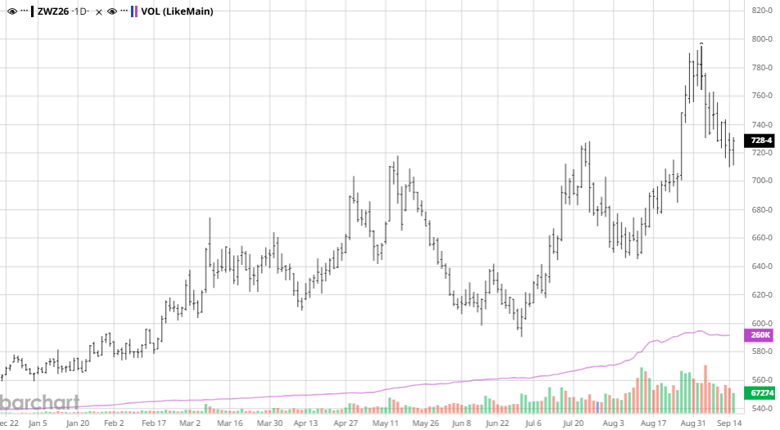
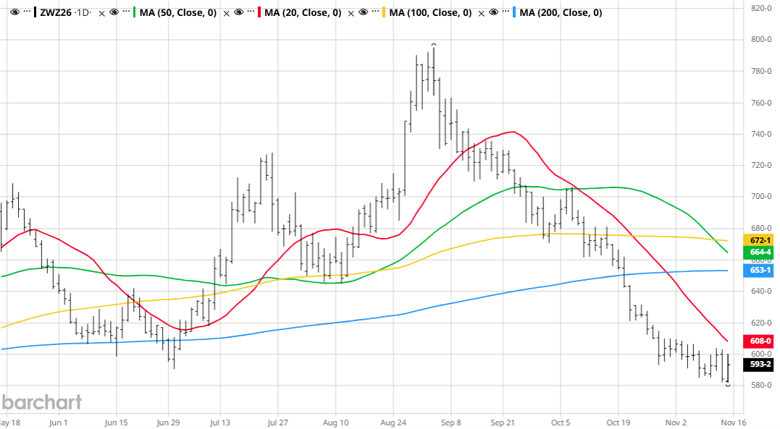
Wheat has been the weakest link in the complex, extending its losing streak to nine straight weeks into early November. Managed money flipped from long to short in Chicago and has kept pressing, with the net short reaching roughly 88,700 contracts as of the most recent report. The main driver has been diplomacy: U.S.-brokered Russia-Ukraine talks in Abu Dhabi on November 10th-11th, the first such discussions since February, have raised hopes that Black Sea grain flows could eventually be restored, and Russia temporarily resumed some Sea of Azov shipments under Kerch Strait permits valid through November 15th. The November WASDE added to the pressure, leaving U.S. production unchanged at 1.534 billion bushels, nudging ending stocks up to 743 million, and raising world ending stocks 4.8 million metric tons to 280.8 million, well above trade expectations. December Chicago SRW settled at $5.84¼ on Thursday, down from above $7.30 in early September. Going forward, the outcome of the Russia-Ukraine talks is the swing factor, and with funds carrying a large short, any breakdown in negotiations or renewed Black Sea disruption could trigger sharp short-covering.
Via Barchart

Equity Markets

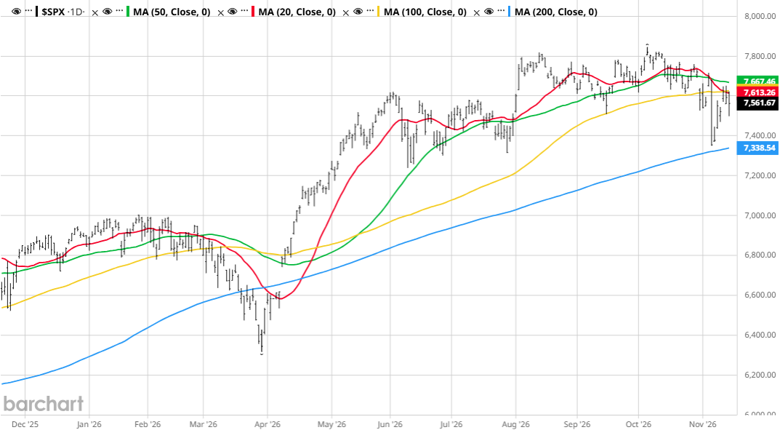
Equity markets have been on a roller coaster. Stocks slid for four straight weeks into early November as concerns over AI financing and data center spending collided with the midterm elections, and the S&P 500 fell 2.7% in the first week of November alone. Wall Street then recovered most of those losses on November 9th, with the Dow jumping more than 1,100 points to 52,389 as oil prices fell, before a hotter-than-expected inflation report on November 10th revived rate-hike fears. That is the backdrop to watch: after hiking in September and holding with two hawkish dissents on October 28th, the Fed is widely expected to raise rates again at its December 8th-9th meeting, with the 10-year Treasury yield already north of 5%. It also doesn’t help when the CEO of the largest company in the world is forced to resign amongst scandal.
Via Barchart

Energy Markets

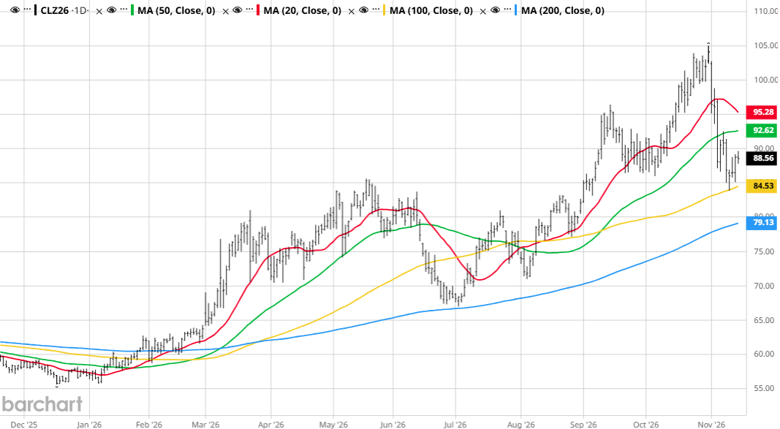
Crude oil continues to take its cues from the war with Iran, now in its ninth month. Prices rallied through October, with Brent hitting a six-month high and November WTI trading above $100 per barrel, before diplomacy took over after the midterms. President Trump said further strikes are highly unlikely as long as talks progress, and Brent fell to its lowest level since late August with crude posting its steepest weekly decline since 2020. December WTI bounced $2.33 to $88.94 on Thursday, a reminder that physical barrels remain tight and Strategic Petroleum Reserve holdings are at their lowest since 1982. For producers, any lasting peace deal would bring welcome relief on diesel and fertilizer costs, but analysts caution that normal Hormuz flows could take months to return even with an agreement.
Via Barchart

Other News

– The Trump-Xi meeting at APEC in Shenzhen (November 18th-19th) is the most important near-term demand event for soybeans. The U.S.-China trade truce has been extended to January 10th, and the leaders are expected to meet again at the G20 in Miami on December 14th-15th.

– Cattle futures sold off sharply as USDA continued its phased reopening of the Mexican border to feeder cattle, with Columbus, New Mexico becoming the third crossing to reopen on October 26th and Nogales scheduled next. December live cattle fell more than $10 in one week in late October, and November feeders dropped another $15.45 the following week.

– Hogs were the weakest livestock market, with December lean hogs down 9% in the week ending November 6th and speculators holding a record net short of more than 50,000 contracts.

– USDA cut U.S. cotton production 267,000 bales to 13.18 million bales in the November WASDE, while harvest is running well ahead of normal.

– Brazil’s post-election weaker real is a lingering headwind for U.S. export competitiveness across soybeans, corn, and cotton heading into the South American growing season.

Drought Monitor

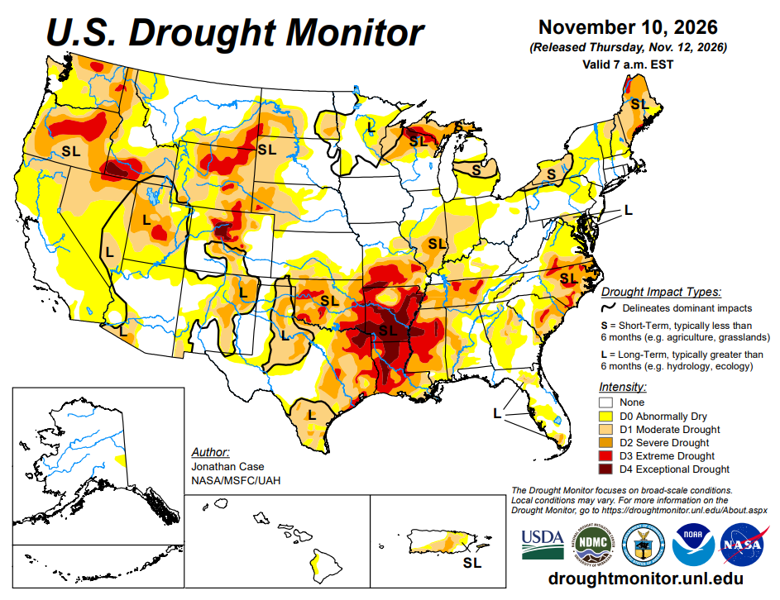
Here is the most recent drought monitor with harvest nearing its end.
Contact an Ag Specialist Today

Whether you’re a producer, end-user, commercial operator, RCM AG Services helps protect revenues and control costs through its suite of hedging tools and network of buyers/sellers — Contact Ag Specialist Brady Lawrence today at 312-858-4049 or blawrence@rcmam.com.


 

02 Nov 2026

LEONARD LUMBER REPORT: Seems like all the focus is on cutting supply

Seems like all the focus is on cutting supply. Is the supply risk real? Yes, the risk is real: current economic conditions in this industry could force closures. Yet, with all that risk, January futures still closed down $8.50 for the week. So, who is selling it down here?

First, it is industry longs who simply can’t take it anymore. Next are the commodity funds. Yes, they are rolling positions, but they are also adding. Remember, their design is to hold X amount of positions with Y dollars in the account. When the market moves in their direction, they add. They don’t have more information than the industry; they just trade more aggressively.

And when their position goes against them, they will pare it. Remember that.

By Friday, the futures market seemed to be dug in, especially in the November contract. Despite the drop in print, the trade is more reluctant to be short after the WF earnings and shutdowns. “Where there is one, there is normally more.” There wasn’t any activity on the cash side. It was all on the futures side and reflected the trade’s reluctance to be short.

The housing industry dances to its own tune. Outside influences might slow a trend, but they won’t stop it. The entire industry is backing off going into the end of the year. Between the elections, Iran and crude, rates, and the stock market, no one has a clear view of future demand. That’s why the focus is on supply. One thing my buddy Jay used to say is that when all the wood is sitting at the mills, prices go up. Let’s hope.


Daily Bulletin:

https://www.cmegroup.com/daily_bulletin/current/Section23_Lumber_Options.pdf

Southern Yellow Pine:

https://www.cmegroup.com/markets/agriculture/lumber-and-softs/southern-yellow-pine.volume.html

The Commitment of Traders:

https://www.cftc.gov/dea/futures/other_lf.htm


About the Leonard Report:

The Leonard Lumber Report is a column that focuses on the lumber futures market’s highs and lows and everything else in between. Our very own, Brian Leonard, risk analyst, will provide weekly commentary on the industry’s wood product sectors.


Brian Leonard

bleonard@rcmam.com

312-761-263

19 Oct 2026

LEONARD LUMBER REPORT: It was another miserable week in both futures and cash

Recap:

It was another miserable week in both futures and cash. The rallying cry for the fourth quarter is, “If we can only break even.” Hell of a way to run a business.

The proactive stance this year was to have inventory when things spiked. That strategy drastically cut into margins. The fact that product never got cheap enough to help navigate the trade is likely to continue through the rest of the year.

That same scenario does not appear on the futures side. Futures have fallen sharply and are starting to look at the 2025 lows as an objective. My guess is that we don’t get there, but it needs to be said for affect.

There really is no reason to spend much time on the demand equation when the 30-year mortgage continues to make new highs. Coming into the year, there was an argument that the affordability issue could ease with a 5% or 5.5% mortgage rate. That argument is gone now. The reality is that even builder buy-downs are doing little to stimulate interest.

There is a real disconnect. In 2025, we averaged 909,000 single-family starts. In August, single-family starts were running at a 918,000 annualized pace. The market is stable, and that takeaway is keeping cash prices higher than most want, but still lower than the mills can stand.

Futures, on the other hand, perceive more of the same. That kills any upward momentum. Thus the disconnect: cash prices are higher than expected while futures prices are lower than anyone wants.


Summary:

Look for the futures market to offer little, but what it does offer should be more upside movement than downside. Today, the 515 low and the 2025 low of 496 are just rounding errors in the macro picture.

We are in the camp that the producer side can exist under these conditions—and by conditions, I’m talking about another three quarters of losing money. The loans will run out, and reality will force many hands. That tension alone should slow any sharp selloff in futures.

At this point, there aren’t any basis or forward opportunities, only risk management. If you own wood, hedge a percentage on any spike. It doesn’t matter if you’re hedging a loss. You are buying time.


Daily Bulletin:

https://www.cmegroup.com/daily_bulletin/current/Section23_Lumber_Options.pdf

Southern Yellow Pine:

https://www.cmegroup.com/markets/agriculture/lumber-and-softs/southern-yellow-pine.volume.html

The Commitment of Traders:

https://www.cftc.gov/dea/futures/other_lf.htm


About the Leonard Report:

The Leonard Lumber Report is a column that focuses on the lumber futures market’s highs and lows and everything else in between. Our very own, Brian Leonard, risk analyst, will provide weekly commentary on the industry’s wood product sectors.


Brian Leonard

bleonard@rcmam.com

312-761-263

12 Oct 2026

LEONARD LUMBER REPORT: Open interest in the short fund category jumped 396 last week

The Market:

I have to lead with this fun fact. The Sept-Nov roll traded as high as +22.40. It started around -20 in early August and spent all of September positive.

Open interest in the short fund category jumped 396 last week. At 6,605, that is the most we have seen in months. The roll starts next week and will probably continue right up to expiration.

If you paid -17 and it only gets to -7, you pick up $10. When was the last time you made $10 on a car of cash? I’m just saying……

The focus is on the 10% reduction and the roll. Most likely, neither will have much effect on cash or futures. Put those to rest and move on.

Friday was a short-covering day on light volume. Nothing more and nothing less. That said, when you move that sharply there is always a chance for some nervousness and follow-through.

The technical read has a few positives now. On a weekly basis, closes through 546.70 and 552.00 would actually add some momentum to the buy side. With the stochastics nearing a positive cross, there is some upside room, but those levels need to be crossed first.

On the daily, the read is more positive in real time. The stochastics have crossed to the positive. We also saw the industry adding longs as the market broke.

A bottom is trying to form.

I’ll end with this. On Thursday, November futures hit $515, or roughly $393/mill. That is not sustainable. The industry stepping up to buy confirms the thought process, but when it is only the computer trading, the computer wins.

 
For those interested: The Bears losing to the Packers the week Ditka passed away tells me the current coach shouldn’t relocate the family to Chicago just yet….

Daily Bulletin:

https://www.cmegroup.com/daily_bulletin/current/Section23_Lumber_Options.pdf

Southern Yellow Pine:

https://www.cmegroup.com/markets/agriculture/lumber-and-softs/southern-yellow-pine.volume.html

The Commitment of Traders:

https://www.cftc.gov/dea/futures/other_lf.htm


About the Leonard Report:

The Leonard Lumber Report is a column that focuses on the lumber futures market’s highs and lows and everything else in between. Our very own, Brian Leonard, risk analyst, will provide weekly commentary on the industry’s wood product sectors.


Brian Leonard

bleonard@rcmam.com

312-761-263

09 Oct 2026

AG MARKET UPDATE: SEPTEMBER 15 – OCTOBER 9

Corn came into the report already on the defensive. After running to the $5.30 area in mid-September on Black Sea export disruptions and USDA’s September yield cut to 178.5 bu/ac, December futures broke hard on September 30th when the quarterly Grain Stocks report found 2.095 billion bushels of old-crop corn on hand, 173 million more than USDA had been carrying and roughly 35% above a year ago. December corn lost 21 cents that day and has spent the last week defending the $5.00 level, with a U.S. dollar sitting near a 1.5-year high adding to the pressure. The one supportive factor has been the weather: El Niño-driven rains made September the wettest on record in Lincoln and the second wettest in Des Moines, leaving corn harvest just 23% complete on October 4th, four points behind average, with only 54% of the crop rated good to excellent.

Today’s Crop Production report went the opposite direction of what the market was positioned for. USDA raised the national yield 2.7 bu/ac to 181.2, well above the 177.7 trade average and near the top of the range, lifting production to 16.03 billion bushels, the second-largest crop on record. Record state yields were forecast in Iowa, Ohio, Kentucky, Tennessee, Mississippi and Arkansas. That pushed 2026/27 ending stocks to 1.849 billion bushels, versus 1.670 expected and 1.567 in September. Corn tumbled as much as 30 cents after the release. Many in the trade will question a yield increase in a crop with poor ratings and a slow, wet harvest, and combine results over the next few weeks will either confirm or chip away at this number ahead of the November report.

Via Barchart

Soybeans held up far better than corn. USDA raised the yield 0.3 bu/ac to a record 53.1, putting production at a record 4.56 billion bushels, with 2026/27 ending stocks at 315 million bushels, 5 million above September and 10 million above the trade guess. That is mildly bearish, but the balance sheet remains far tighter than corn. Since the last update, the Trump-Xi summit in Washington September 24th-25th extended the U.S.-China trade truce to January 10, 2027, and China has now booked roughly half of its 25 MMT annual purchase commitment. November beans slipped to a four-week low near $12.78 after the summit as the market sold the news, then recovered back above $13 on harvest delays and quality concerns, with harvest only 25% complete as of October 4th, eight points behind average. Export commitments are running nearly double last year’s pace, and record-large crush demand remains the backbone of the complex. Over the next two weeks, watch the mid-October NOPA crush report, the pace of Chinese flash sales, and early Brazilian planting conditions as El Niño develops.

Via Barchart

Wheat had a rough September, with Kansas City futures falling more than $1 per bushel as Black Sea grain flows showed marginal improvement and ceasefire talks gained traction. Those talks have since stalled, and wheat appears to have found a short-term bottom near its early-August lows, with December SRW around $6.83 and December KC HRW around $7.36 heading into the report. USDA raised 2026/27 U.S. ending stocks 23 million bushels to 740 million, above the 721 million trade guess, reflecting the larger 1.534 billion bushel crop from last week’s Small Grains Summary and weak export demand. First-quarter shipments were the second lowest in 50 years and the strong dollar is not helping U.S. competitiveness. World stocks were trimmed slightly to 276 MMT, but those numbers are distorted by grain building up behind the closed Black Sea ports. Winter wheat planting was only 27% complete on September 27th, seven points behind average, and emergence in the Plains will be worth watching.

Via Barchart

Equity Markets

Equity markets have been range-bound since August, with the S&P 500 trading roughly between 7,620 and 7,800 and testing record highs, though breadth has been thin with fewer stocks participating in the move. Oil back above $90 has kept inflation front and center, and the bond market is increasingly pricing in the possibility of a Fed rate hike rather than a cut. September CPI on October 14th and the October 27th-28th FOMC meeting are the key events ahead. The Mag 7 stocks have helped keep the markets at highs while most stocks are struggling and well below their 52 week highs except in some areas.

Via Barchart

Energy Markets

Crude oil has moved sharply higher again as Iranian attacks on tankers in the Strait of Hormuz have been more frequent this month than at any point since the war began in late February. Brent pushed back above $100 on Thursday and WTI traded above $92, with Hurricane Isaias also shutting about a quarter of Gulf of Mexico oil production. Oil eased Friday morning after President Trump cited productive discussions with Iran, and a deal with Russia to release barrels in exchanged for pausing sanctions but the headline risk remains two-sided.

Via Barchart

Other News

– Cotton production was raised to 13.44 million bales, well above the 12.97 million trade guess, with 2026/27 U.S. ending stocks at 3.80 million bales versus 3.46 expected. That is a bearish surprise for a market that had been holding near 80 cents in December futures. Producers with unpriced bales should be weighing downside protection while keeping some upside participation.

– Sovecon cut its forecast for Russian 2026/27 grain exports to 44.7 MMT from 49.4 MMT and warned that Azov and Black Sea ports may remain shut into 2027, keeping a structural question mark over world wheat and corn supplies.

– Key dates ahead: weekly Crop Progress reports every Monday, September CPI on October 14th, NOPA crush in mid-October, the FOMC meeting October 27th-28th, and the November WASDE.

Drought Monitor

Here is the most recent drought monitor with harvest rolling.


Contact an Ag Specialist Today

Whether you’re a producer, end-user, commercial operator, RCM AG Services helps protect revenues and control costs through its suite of hedging tools and network of buyers/sellers — Contact Ag Specialist Brady Lawrence today at 312-858-4049 or blawrence@rcmam.com.



05 Oct 2026

LEONARD LUMBER REPORT: November futures fell $11.50 for the week on low volume

Recap:

November futures fell $11.50 for the week on low volume. The commitment of traders report shows a gain in both the commercial longs and in the commodity fund shorts. Total open interest for the week was up 700 to 10,546. The additional 300 after the Tuesday report will be added to both piles. It indicates that both are committed to their positions. That’s important.


Macro:

Having a long position anywhere in this industry is difficult when rates are making new highs. The longs are locking in lower pricing—a very micro strategy in a market being driven by macro forces. At the same time, the funds are piling into a winning short position as the macro data continues to gain momentum in this commodity. It really is that simple.

So let’s talk about rates.

The 30-year fixed mortgage averaged 7.28% for the week ending October 1, up from 7.03% the week before. That is a meaningful move for housing, especially with so many existing homeowners still locked into cheap mortgages. Through Q2, 49.1% of outstanding mortgages were below 4% and 65.6% were below 5%. Why move???

The part that continues to be ignored is that a 7% mortgage rate is not historically abnormal. The abnormal period was 0% short-term interest rates turning into 3% mortgages. That was not a healthy economic equilibrium; it distorted the global rate market, flooded the system with cheap capital and changed the way consumers think about the cost of money.

The problem today is not simply that mortgage rates are 7%. It is how the marketplace repairs the damage created by years of near-zero rates. Calling for a return to ultra-low rates misses the point. The market has to learn how to function at a higher nominal rate, and that adjustment takes time.

We are still digesting an enormous amount of capital that was pushed into the system. Until that liquidity works its way through, housing has to adjust through time, income growth, home prices and eventually rates. Rates are only one part of the repair.

That creates two problems for lumber. First, affordability gets worse for the marginal new-home buyer. Second, existing homeowners have even less incentive to sell and move. Neither dynamic creates urgency for the lumber buyer. Builders can lock in attractive wood prices, but cheap wood does not offset an expensive mortgage.

More importantly, even a drop in mortgage rates to 5.5% may produce only a marginal bump if home prices and monthly payments still do not create value. The sector cannot simply be bought off with cheaper money again. Real value has to rebuild.

That brings us to the simplest question in housing: is paying 7% on a large mortgage a better economic decision than renting? For many buyers today, the answer is no. Until that equation begins to change, lower rates alone are unlikely to unleash the demand the lumber market keeps waiting for.

This is where the micro and macro stories separate. On the micro side, lumber prices can look inexpensive, mills can curtail production, and a buyer can justify owning futures against future needs. On the macro side, rates are telling the industry to remain defensive. Until that changes, the funds have little reason to abandon a short position that continues to work.

And that leaves lumber with a familiar solution. If demand cannot be stimulated enough to move prices higher, supply has to come down to meet demand. Once again, the burden shifts back to production cuts and mill discipline.


Here we go again…..


Daily Bulletin:

https://www.cmegroup.com/daily_bulletin/current/Section23_Lumber_Options.pdf

Southern Yellow Pine:

https://www.cmegroup.com/markets/agriculture/lumber-and-softs/southern-yellow-pine.volume.html

The Commitment of Traders:

https://www.cftc.gov/dea/futures/other_lf.htm


About the Leonard Report:

The Leonard Lumber Report is a column that focuses on the lumber futures market’s highs and lows and everything else in between. Our very own, Brian Leonard, risk analyst, will provide weekly commentary on the industry’s wood product sectors.


Brian Leonard

bleonard@rcmam.com

312-761-263

21 Sep 2026

LEONARD LUMBER REPORT: The one feature of the week was computer-like selling

Week Recap:

The November futures fell $33 on light volume. The one feature of the week was computer-like selling in most sessions after expiration. What became apparent was that the pre-expiration rally was liquidation-driven. Once that was complete, the downward trend continued. Open interest fell by about 800 contracts. November futures are now down $120 in 43 sessions.


Market make up:

The producer side has 5,305 longs in place and 439 shorts. Yes, the industry is not short. The funds are short 6,066 contracts. We see a limit to how many shorts they are willing to carry, so much of the selling late in the week was most likely algorithmic in nature. We are also seeing a marked pickup in swap trades for this contract.

I would note that open interest remains high despite the lack of trade. There is no discount and no premium. Today, the only thing being offered is cheap and cheaper. There will be a rather large roll. The question is where it starts from.


Funds:

The funds remain very difficult to track. We know that interest rates, the dollar, and other economic factors all play into the equation. What we do not know is how they are positioned in other commodities, nor do we know their true capacity. The futures market rallied to $660 because they were exiting positions and fell to $536 on Friday because they continued to add shorts.

In trading-floor lingo, we blew them out, and now they are back with a vengeance.


Summary:

The discussion around the funds has little to do with why November futures settled at $537. The market settled at new lows because the housing market is sputtering just as mills are ramping production back up following summer shutdowns. Over the last few years, demand has remained relatively consistent. I believe the healthy premium in the futures market encouraged buyers to step up more aggressively than necessary. Today, that advantage is gone, leaving buyers strictly hand-to-mouth. Add a modest increase in post-shutdown supply, and the result is an imbalance. There is little appetite for risk in this environment. The trade will buy when it needs wood, and it does not matter if they have to pay up. At this point you have to create value in the futures market by going to a premium or discount. That could take time. 


Daily Bulletin:

https://www.cmegroup.com/daily_bulletin/current/Section23_Lumber_Options.pdf

Southern Yellow Pine:

https://www.cmegroup.com/markets/agriculture/lumber-and-softs/southern-yellow-pine.volume.html

The Commitment of Traders:

https://www.cftc.gov/dea/futures/other_lf.htm


About the Leonard Report:

The Leonard Lumber Report is a column that focuses on the lumber futures market’s highs and lows and everything else in between. Our very own, Brian Leonard, risk analyst, will provide weekly commentary on the industry’s wood product sectors.


Brian Leonard

bleonard@rcmam.com

312-761-263

15 Sep 2026

AG MARKET UPDATE: AUGUST 31 – SEPTEMBER 15

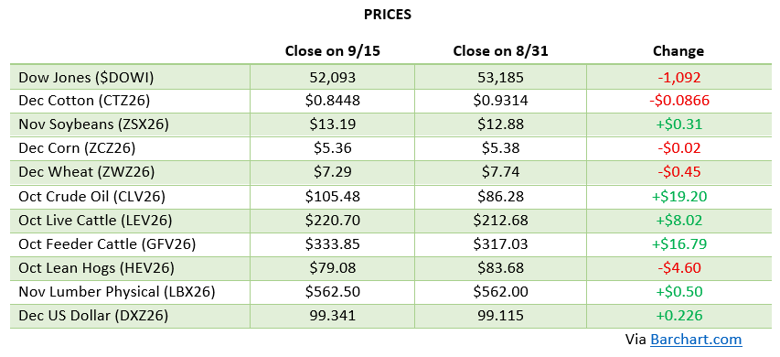
Corn spent the two weeks since August 31st grinding higher into last Friday’s USDA September Crop Production and WASDE report, with December futures pushing up toward the $5.30 area as the market priced in a tightening balance sheet. The report delivered on that theme without shocking anyone: USDA trimmed the 2026 national yield to 178.5 bushels per acre, essentially in line with pre-report estimates, while total production came in at 15.800 billion bushels. The bigger story was on the stocks side: 25/26 ending stocks were revised down to 1.922 billion bushels and the 26/27 figure came in at 1.567 billion bushels, keeping the stocks-to-use ratio tight enough that some analysts are now targeting the $5.80-$6.00 range on the board. Corn traded 1 to 2 cents lower in the immediate reaction, but the chart still looks constructive with a choppy, higher pattern intact. A modest reduction to harvested acres reflects some early silage cutting in the western Corn Belt trimming the acreage base, and with the new marketing year underway since September 1st, attention now turns to how much of this story gets revised when harvested-acreage data arrives in the October report.

Via Barchart

Soybeans have been the standout of the row-crop complex, setting a new contract high on November futures in overnight trade ahead of Friday’s report before giving back a chunk of those gains into the close. Chinese demand has been the driver, buyers picked up another 136,000 tons ahead of Friday’s open, pushing the running total over the prior three sessions above 700,000 tons, all under the 2026/27 marketing year, with a formal purchase window reportedly set to open September 24th that should keep the buying headlines coming. The WASDE itself held few surprises: USDA nudged the 2026 yield up to 52.8 bushels per acre, raised production to 4.535 billion bushels, and, the one real surprise in the report, added roughly 12 million bushels to the 26/27 ending stocks estimate, bringing it to 310 million bushels. Beans traded 25 to 30 cents lower on the day as funds booked profits after the recent run, and the chart looks tired and toppy in the short term, though with China back in the market a break much below $13 on November futures would be a surprise.

Via Barchart

Wheat has been the laggard of the three since the last update, sliding into Friday’s report and losing another 13 to 15 cents on the day. The WASDE showed U.S. 2026/27 wheat stocks essentially steady at 717 million bushels, but a surprise increase of roughly 100 million bushels to the world stocks figure, now projected near 276.3 million metric tons, added pressure, compounded by unconfirmed chatter around progress in Black Sea negotiations. Ukrainian export logistics remain a persistent drag on the world balance sheet as well. With the domestic supply story unchanged and global stocks trending the wrong direction, wheat will likely need a fresh weather or geopolitical catalyst to turn the recent slide around.

Via Barchart

Equity Markets

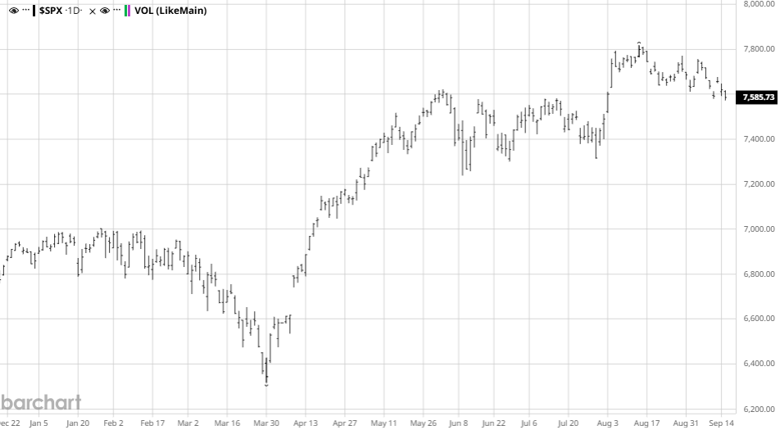
Equity markets have been choppy and headline-driven since the end of August. Stocks sold off sharply into month-end and again to start September, then whipsawed on the August jobs report, nonfarm payrolls came in at 162,000 versus the roughly 53,000 economists expected, reigniting debate over whether the Fed’s next move is a cut or a hike given the current 3.50%-3.75% target range. That debate has only intensified as crude oil has surged on renewed U.S.-Iran hostilities in the Strait of Hormuz, adding a fresh layer of inflation concern heading into the Fed’s September 15-16 meeting, the next major catalyst for the broader market. The market has priced in over a 90% chance of a 1/4 point hike this week.

Via Barchart

Energy Markets

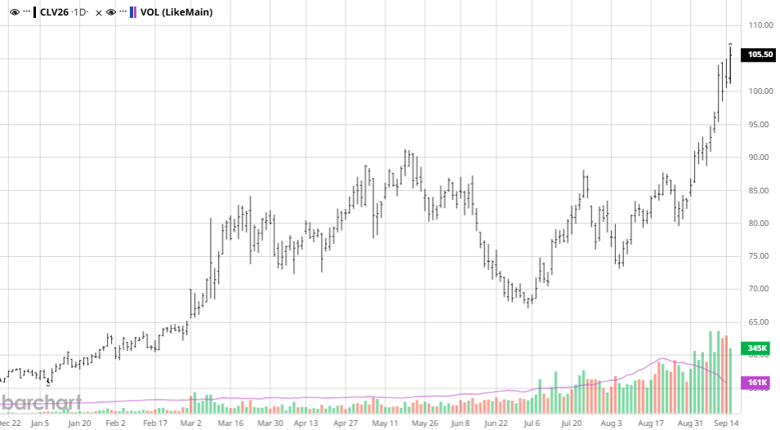
Energy markets took a sharp turn over the past week as the fragile calm around the Strait of Hormuz broke down. The U.S. and Iran exchanged direct strikes on shipping and naval assets, and strikes shutdown a major pipeline in Saudi Arabia, causing Brent crude to jumped back above $100 per barrel, with WTI trading near contract highs. Traffic through the Strait has reportedly collapsed to a small fraction of normal levels, and with several banks warning that disruptions could persist well into 2027, the renewed energy premium is worth watching closely for its knock-on effects on fertilizer and freight costs heading into fall applications and harvest.

Via Barchart

Other News

– The new 2026/27 marketing year for corn, soybeans, and sorghum began September 1st; July soybean crush came in at 222 million bushels, up 4 million from June and 17 million from a year ago.

– China’s formal purchase window for new-crop soybeans is reportedly set to open September 24th: a date worth watching for confirmation of the recent pace of buying.

– Ukrainian wheat export logistics remain constrained, continuing to weigh on the world wheat balance sheet.

– The October Crop Production report will be the first to incorporate harvested-acreage data and is expected to be a significant mover for corn given the recent yield trend.

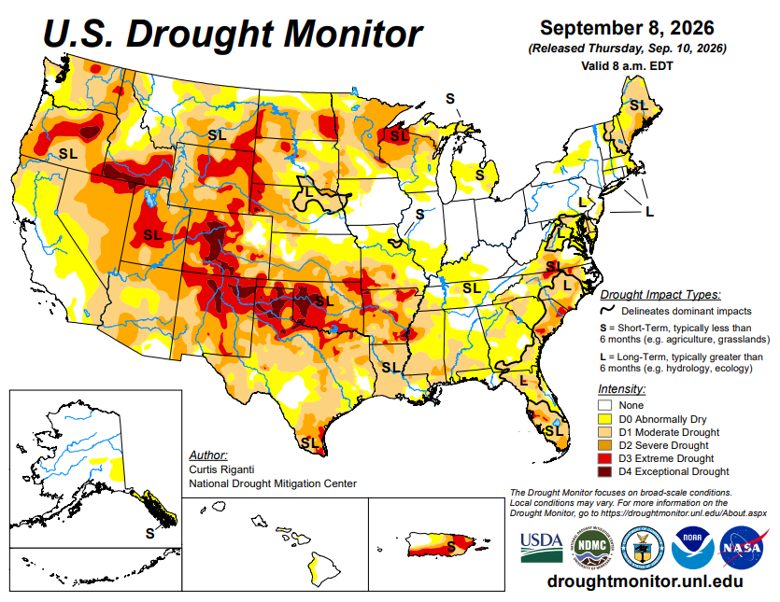
Drought Monitor

Here is the most recent drought monitor.

Contact an Ag Specialist Today

Whether you’re a producer, end-user, commercial operator, RCM AG Services helps protect revenues and control costs through its suite of hedging tools and network of buyers/sellers — Contact Ag Specialist Brady Lawrence today at 312-858-4049 or blawrence@rcmam.com.


08 Sep 2026

LEONARD LUMBER REPORT: THE CHALLENGE IS TO NOT SEEM TO BE HOLDING A POSITIVE TONE WHEN NO DATA SUPPORTS IT

The challenge for me is to not seem to be holding a positive tone when no data supports it. But here goes.

We came into last week with weak cash reports, which continued on Monday. By Wednesday, those few transactions had disappeared, and some mills were actually reporting better days. Items like 9′ tightened up.

So, while this is far from a roaring commitment to getting long, it does suggest there is a fight to find a bottom.

Today’s strategies and cycles are not very sophisticated. Run inventories down to the dirt and be forced to buy something. Buy when inventories get low, then sell into the rally. That is how many companies profit today. There is no glamour and very little margin in it.

At the moment, inventories are not at panic levels, so the trade is only cautiously looking at the market. The focus now shifts to the September expiration and whether there will be a debacle or not.

This is a difficult time of year to get bearish. The next round, which could also be the last meaningful move of the year, starts to define itself in early September. The trade has time to wait it out, and it likely will. I just do not see that process lasting through the traditional seasonal lows in October. It is simply not that bad out there.

The funds added another 1,000 contracts during the latest reporting period. At roughly 6,300 shorts, it appears they are once again fully invested. Open interest was stagnant to lower throughout the week, suggesting they were not adding to positions.

If that is the case, future selling pressure will likely have to come from a weakening cash market rather than another wave of fund activity. What the 6,300 figure also tells us is that the spread trade is alive and well again.

If the market reaches early October with a high level of indifference, there is at least a case to be made that a soft long bias could emerge from the roll. For now, that remains a possibility rather than a forecast, but it is something worth watching as expiration approaches.


Technical:

The technical picture is becoming well defined. The November contract appears to be building a bottom between 548.00 and 573.50. A break below 548.00 would be very destructive and would likely force a reassessment of the broader outlook. The upper trading range sits between 573.50 and 589.25. Those levels define the current trading boundaries. With the stochastics turning positive, it would take a considerable amount of selling pressure to drive the market through 548.00. By comparison, it would not take much to push futures through 589.25. A round of short covering alone could accomplish that.

Again, I am not trying to sound positive. But after a $100 correction and with much of the trade firmly in the “going to zero” camp, futures may finally be in a position to put up a fight.


Daily Bulletin:

https://www.cmegroup.com/daily_bulletin/current/Section23_Lumber_Options.pdf

Southern Yellow Pine:

https://www.cmegroup.com/markets/agriculture/lumber-and-softs/southern-yellow-pine.volume.html

The Commitment of Traders:

https://www.cftc.gov/dea/futures/other_lf.htm


About the Leonard Report:

The Leonard Lumber Report is a column that focuses on the lumber futures market’s highs and lows and everything else in between. Our very own, Brian Leonard, risk analyst, will provide weekly commentary on the industry’s wood product sectors.


Brian Leonard

bleonard@rcmam.com

312-761-263