

Tag: corn

13 Jul 2026

AG MARKET UPDATE: JUNE 26 – JULY 10

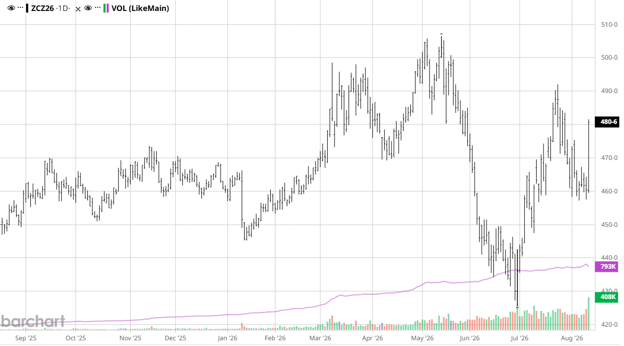
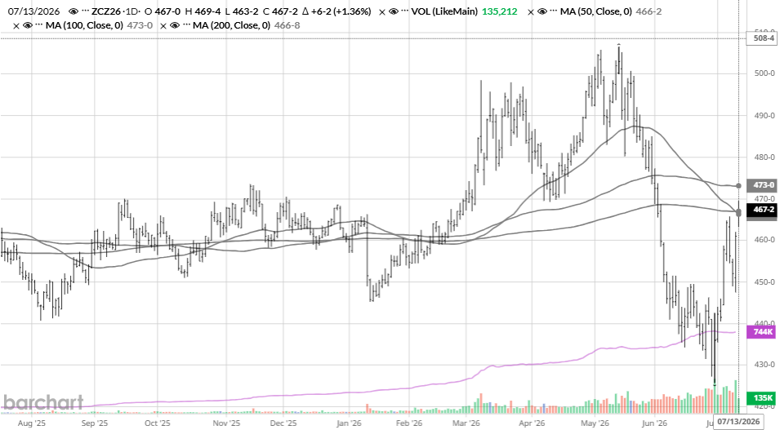
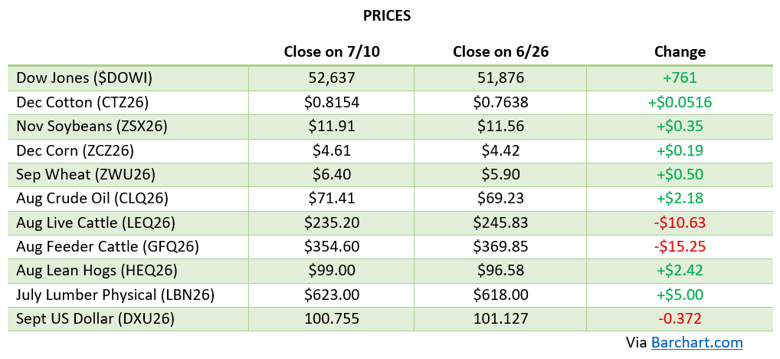
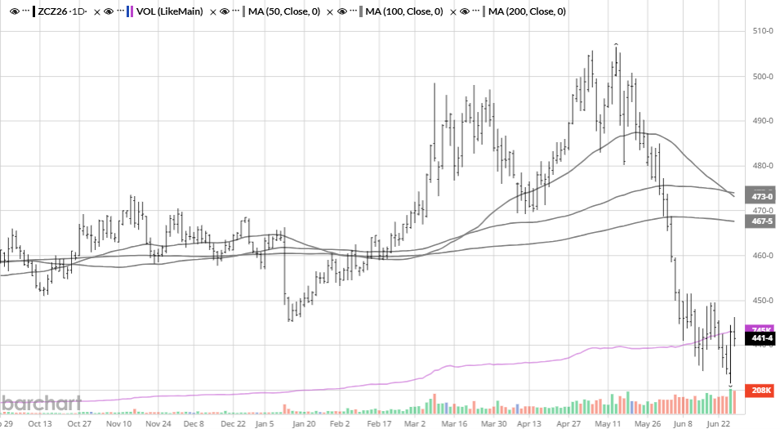
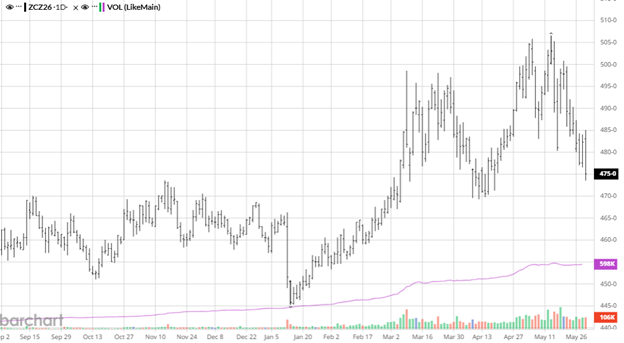
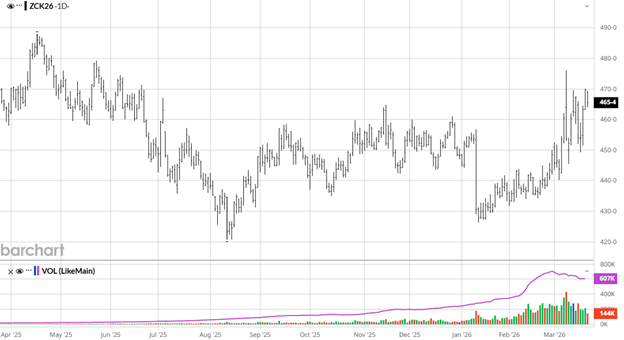
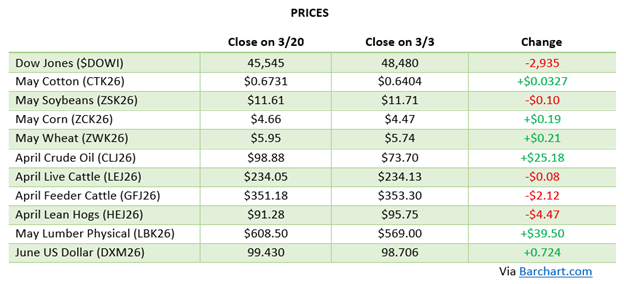
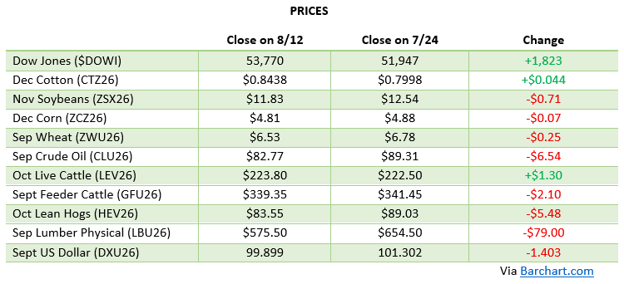
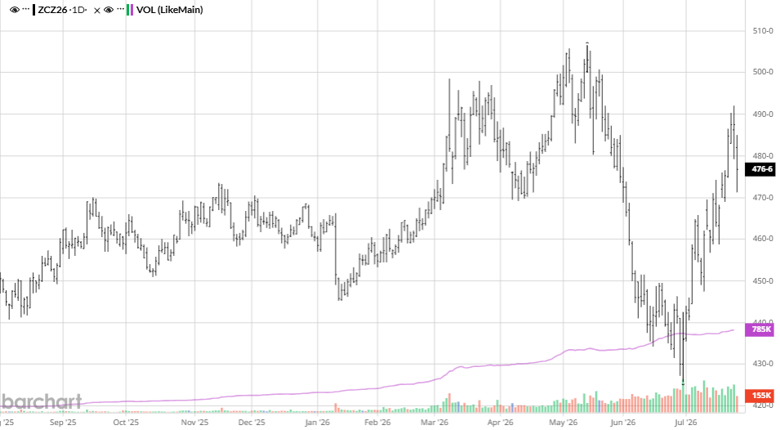
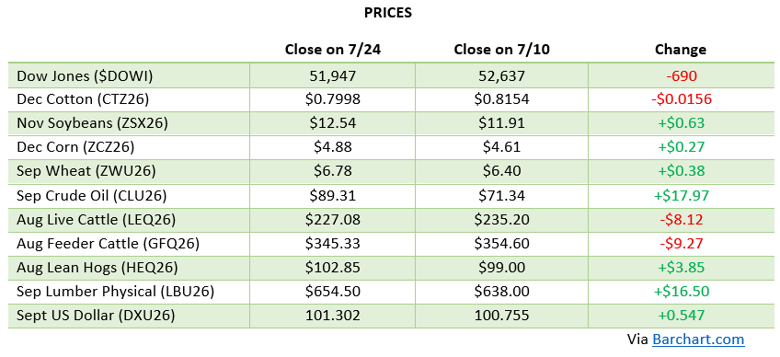
Corn spent the first half of this stretch grinding to fresh contract lows before finding its footing over the past week, catching a bid on a firming weather-risk premium heading into pollination. The June 30th Acreage and Grain Stocks reports were largely a non-event, with planted acreage at 95.343 million acres, essentially unchanged from the March intentions despite widespread expectations for a cut, and harvested acreage pegged at 87.4 million, down 4% from last year. Friday’s report delivered the bigger surprise: USDA cut 2025/26 old-crop ending stocks 125 million bushels to 2.020 billion, 50 million below expectations, on stronger feed and residual use, while 2026/27 new-crop ending stocks were slashed 170 million bushels to 1.790 billion, a full 80 million below the average guess. Production held at 16.0 billion bushels on an unchanged 183 bu/ac yield, and the season-average farm price was left at $4.40. December corn has worked back into the $4.60s on the tighter stocks numbers and improving Chinese demand optics, though the weather forecast into pollination remains the market’s next major swing factor.

Via Barchart

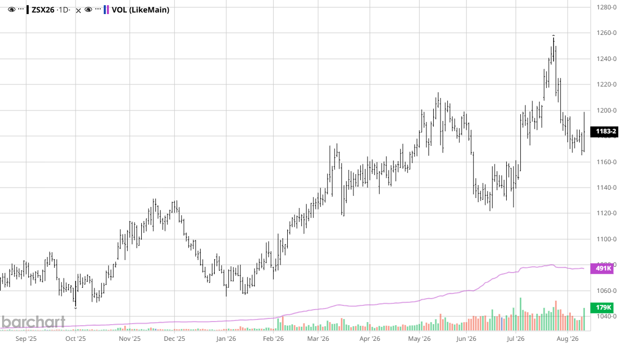
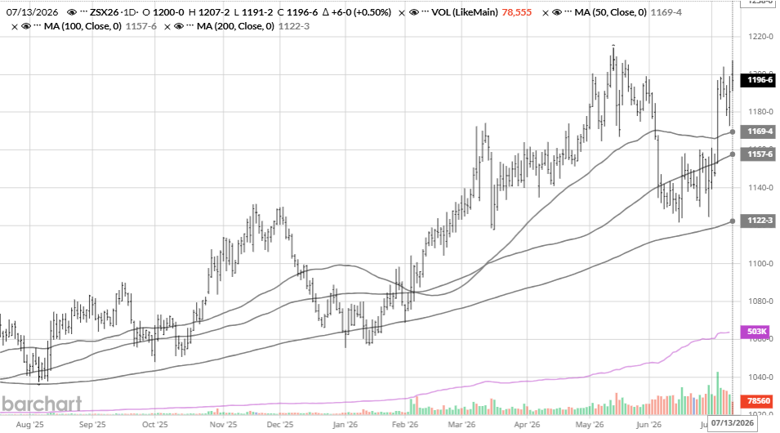
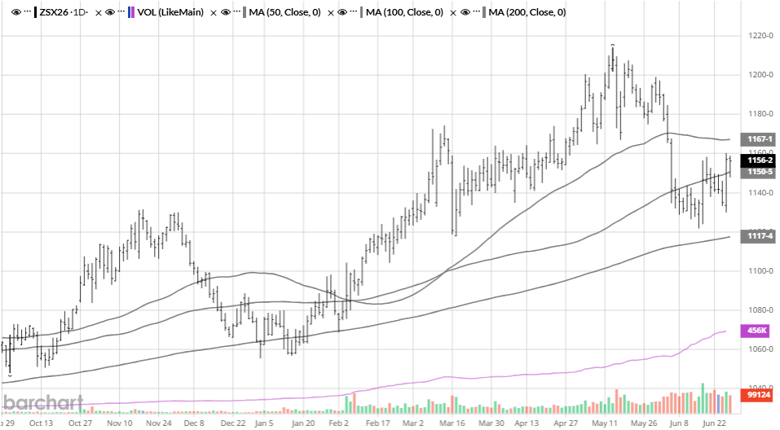
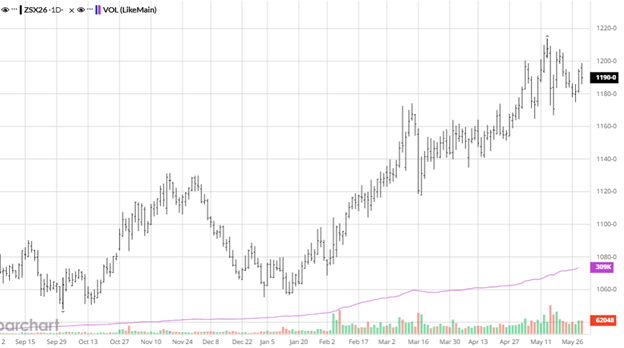
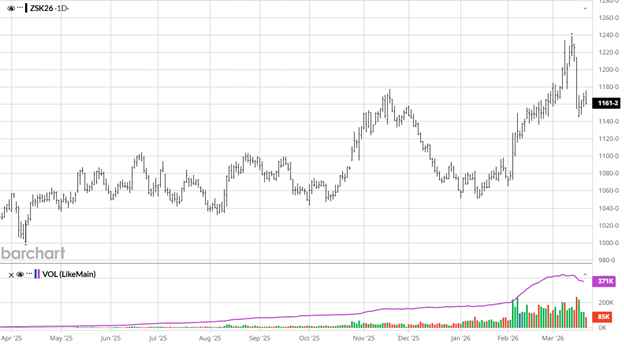
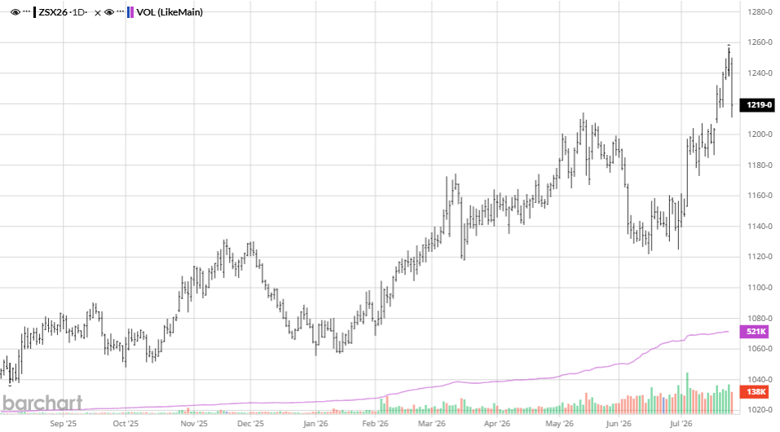
Soybeans got a mixed signal from the June 30th reports: planted acreage came in at 85.365 million, up 5% from last year and above both the March estimate (84.7 million) and the pre-report trade guess, while June 1 stocks of 1.06 billion bushels, up 5% year-over-year, also landed above expectations, a modestly bearish combination that limited November futures to just a nickel move on report day. The real driver since has been China. After the Commerce Ministry confirmed it would roll back its reciprocal tariff on U.S. ag goods (matched by a cut to the U.S. fentanyl-related tariff), actual purchases followed in short order: a 17.3-million-bushel private sale, another 9.7 million bushels ahead of the WASDE, and Chinese state trader Cofco booking at least six cargoes for September/October shipment. That buying pushed November beans to their best levels in about five weeks, briefly testing the $12 mark. Friday’s WASDE raised 2026/27 production to 4.475 billion bushels on higher harvested acres (yield held at 53 bu/ac), but stronger exports kept ending stocks unchanged at 310 million bushels, still 20 million below expectations, with the season-average price left at $11.40. With crush margins still historically strong, beans remain the more fundamentally supported half of the row-crop trade.

Via Barchart

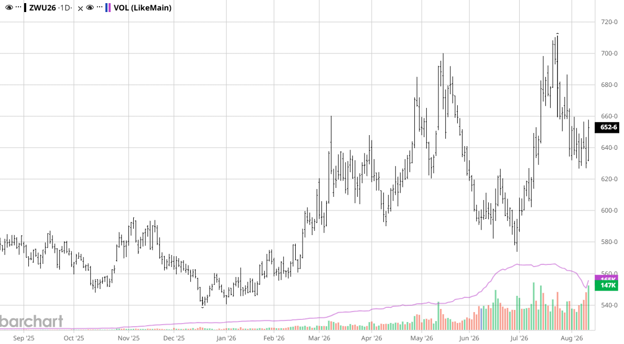
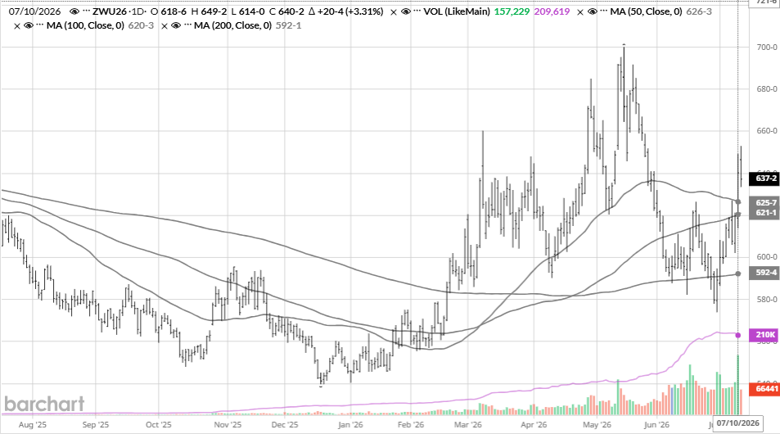
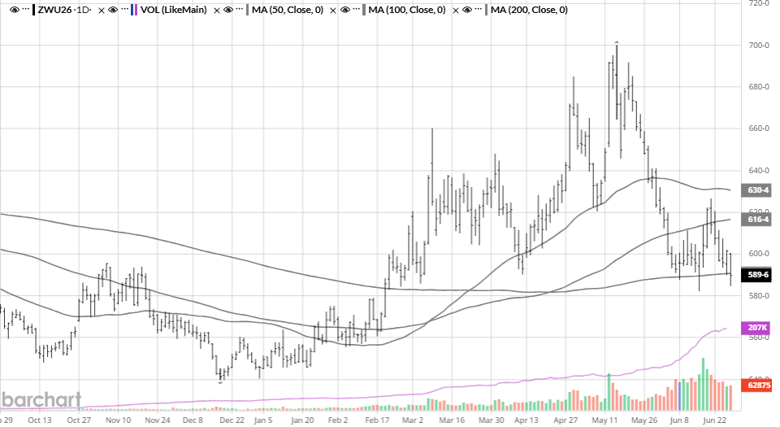
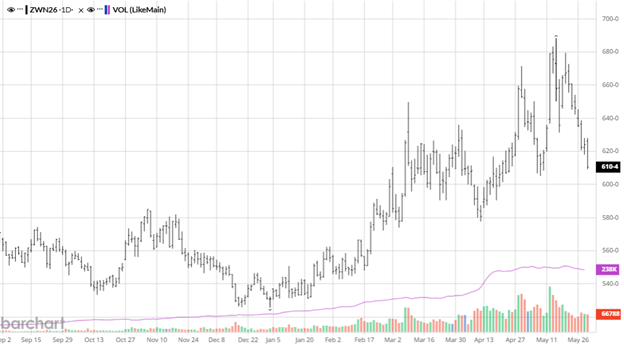
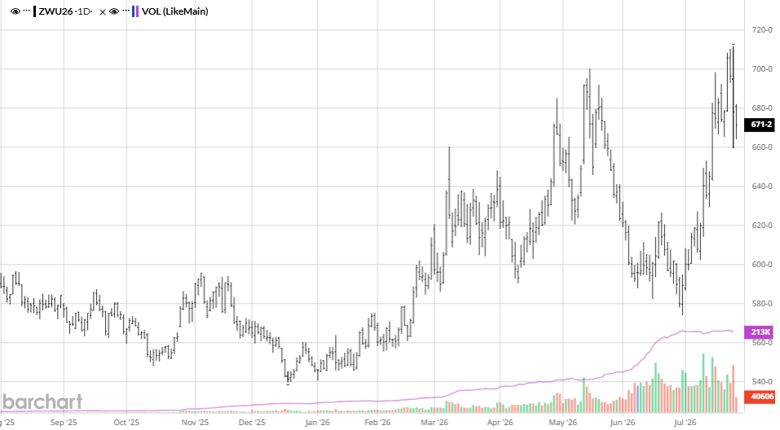
Wheat’s acreage story leaned bullish out of the June 30th report: all-wheat plantings came in at 42.740 million acres, down 6% from last year and below both the March intentions (43.775 million) and the trade guess, with winter wheat acreage at 31.5 million, down 5%. June 1 stocks were up 8% year-over-year at 920 million bushels. Friday’s WASDE confirmed just how tight the new-crop winter wheat situation is: production was cut to 990 million bushels (HRW at 471 million, SRW at 287 million), while stronger spring wheat production (475 million) helped total all-wheat production land at 1.536 billion bushels, the smallest crop since 1970. 2026/27 ending stocks came in at 722 million bushels, and the season-average price held at $6.00.

The bigger story for wheat this week has been geopolitical rather than fundamental. Ukraine’s drone forces reportedly carried out 35 strikes against Russian vessels in the Sea of Azov over a 96-hour span, hitting roughly a quarter of all ships in the area, and there are now unconfirmed reports that Russia may close the Don-Azov Canal and the Kerch Strait in response. With 30-35% of Russian wheat exports moving through that corridor and Russia projected to account for more than 22% of global wheat exports this year, as much as 20 million metric tons of wheat could be bottled up if the closure holds. Chicago wheat spiked more than 2% on Friday to $6.33, its best level since late May, a fast-developing story worth watching closely into next week.

Via Barchart

Equity Markets

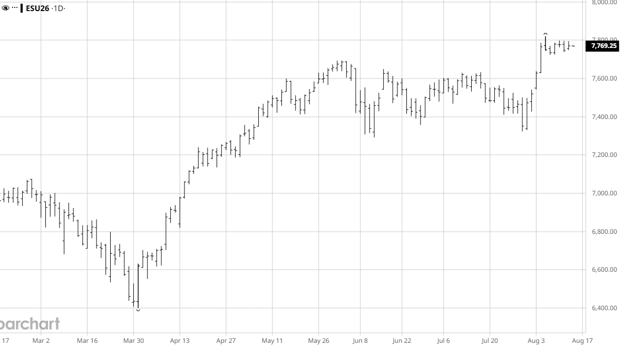
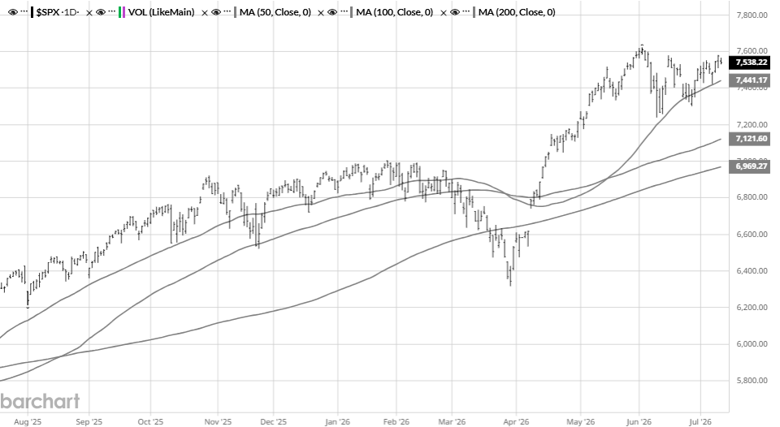
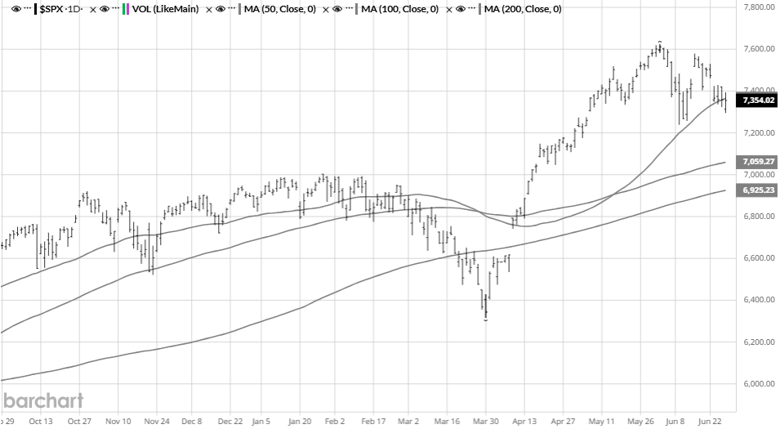
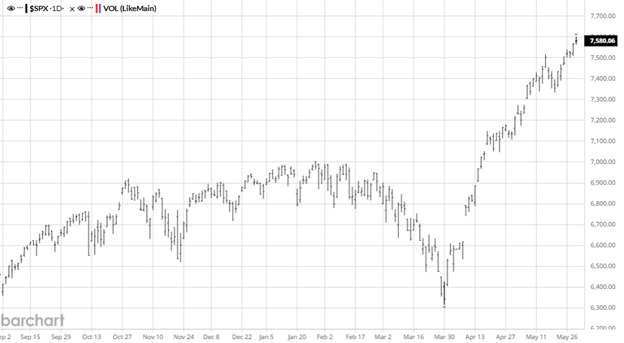
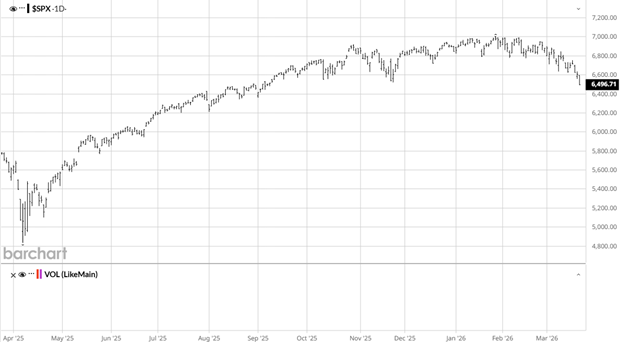
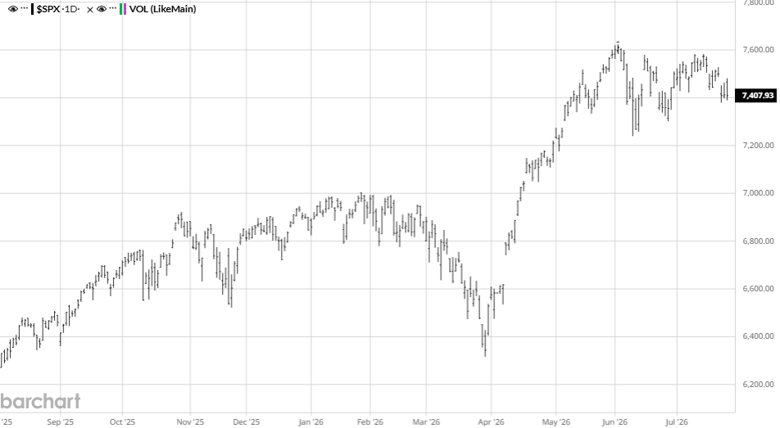
Equity markets closed out an outstanding first half of 2026 and haven’t slowed down since: the Dow gained 8.9% in H1, its best first half since 2021, while the S&P 500 and Nasdaq rose 9.6% and 12%, respectively, and the small-cap Russell 2000 posted its best first half since 1991 at nearly +22%. The Dow has continued notching fresh records since, closing above 53,000 for the first time on July 6th. AI-related names have been choppy, a sharp selloff in Micron, AMD, and Intel on valuation concerns gave way to a renewed rally after SK Hynix’s U.S. share offering came seven times oversubscribed. A soft June jobs report (57,000 vs. roughly 115,000 expected, though unemployment ticked down to 4.2%) and renewed U.S.-Iran hostilities, including fresh U.S. strikes on Iran July 8th, have added some volatility, but the VIX sitting near six-month lows below 16 shows just how much confidence remains in this market.

Via Barchart

Energy Markets

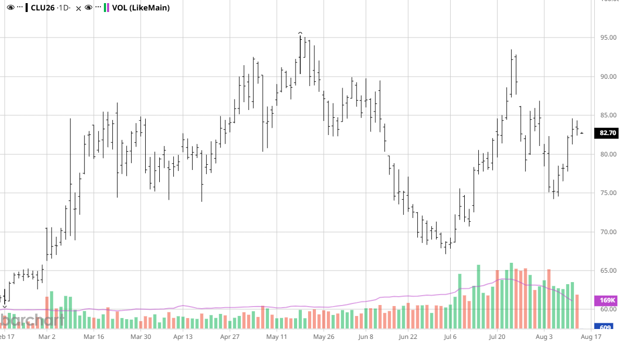
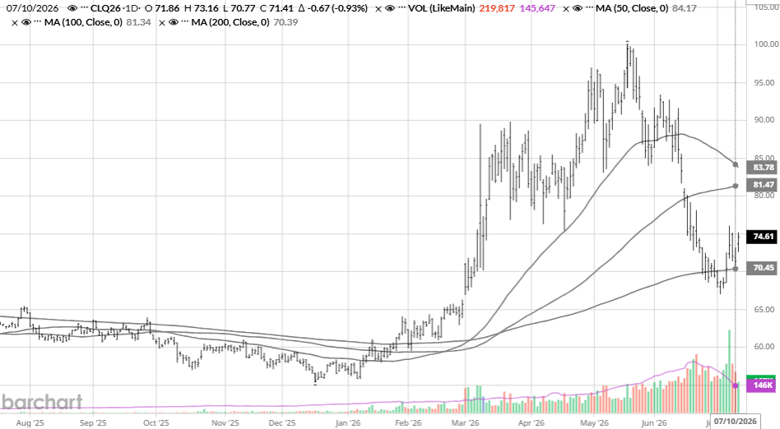
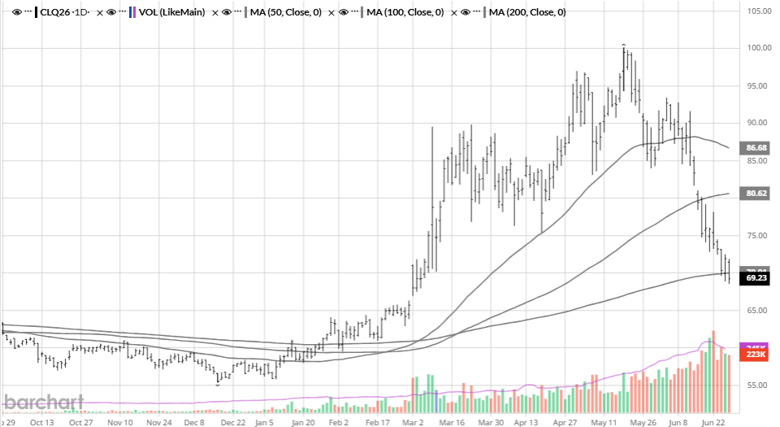
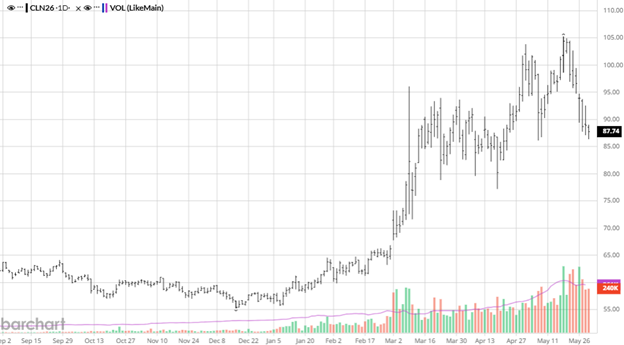
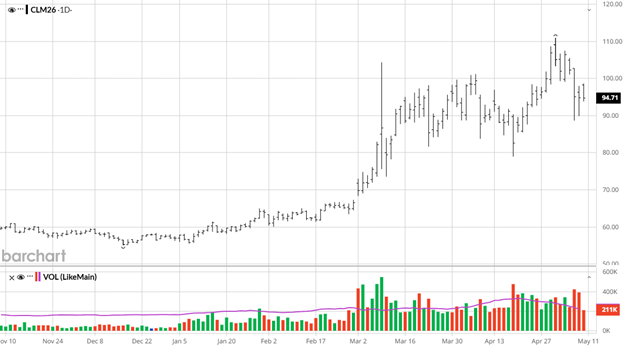
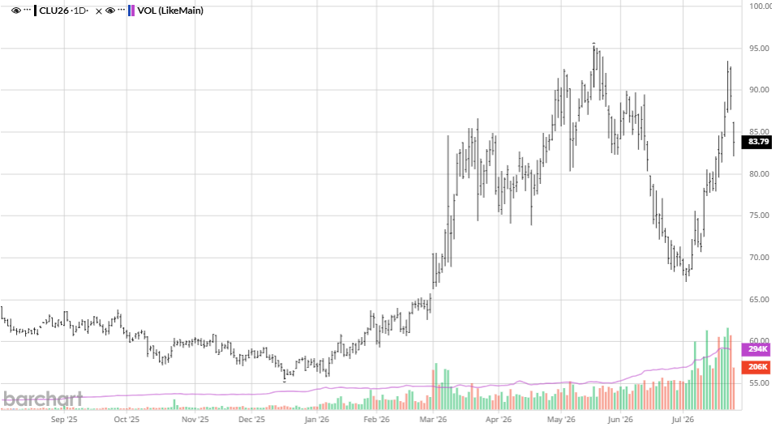
Crude oil has chopped higher since our last update as the Iran conflict flared back up. A weekend of tit-for-tat U.S.-Iran strikes in late June was followed by attacks on three commercial vessels, including a Qatari LNG tanker and a Saudi-flagged crude tanker, near the Strait of Hormuz on July 7th, prompting fresh U.S. strikes on Iran the next day. The Treasury also moved up its deadline on the temporary Iranian oil sanctions waiver, cutting it off July 17th instead of the original August 21st date. Brent has swung from below $70 back above $76, its highest since June 23rd, while WTI trades in the low $70s. The fertilizer and diesel cost relief that had been building since the spring ceasefire has stalled for now, worth keeping an eye on for fall input planning. Note: August crude oil (CLQ26) is approaching expiration later this month, so watch the roll to September when pricing off the front month.

Via Barchart

Other News

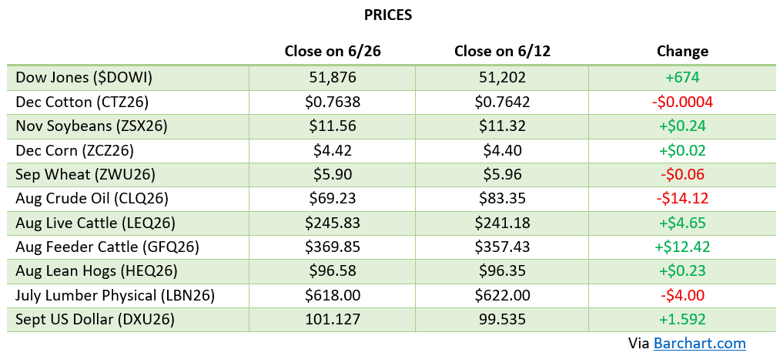
– Cotton acreage came in at 9.85 million acres in the June 30th report, up 6% from last year. The July WASDE followed by raising 2026/27 production 400,000 bales to 13.7 million on the larger acreage and a slightly higher yield, pushing ending stocks up 400,000 bales to 4.1 million (a 29.5% stocks-to-use ratio). The season-average price held steady at 73 cents/lb, and December cotton has ridden the broader commodity rally back above 78 cents.

– China’s follow-through on the May Trump-Xi summit commitments has been the clearest bright spot for beans, multiple confirmed purchases (17.3 million bushels, another 9.7 million bushels, and six cargoes booked by Cofco for Sept/Oct) suggest the $17 billion / 25 MMT annual ag purchase pledge is starting to show up in actual export data, not just headlines.

– Ukraine’s drone campaign against Russian shipping in the Sea of Azov has put the Don-Azov Canal and Kerch Strait in question, a fast-developing story that could bottle up a meaningful chunk of Russian wheat exports if the closure holds.

– Renewed U.S. strikes on Iran (July 8th) following attacks on three vessels near the Strait of Hormuz, plus an accelerated Treasury deadline on Iranian oil sanctions relief (now July 17th instead of August 21st), are keeping energy and fertilizer cost uncertainty alive heading into fall input season.

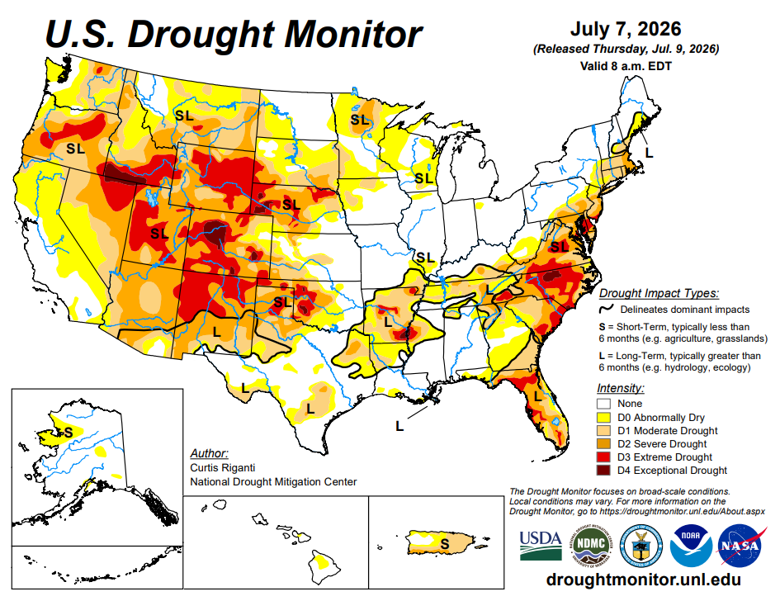
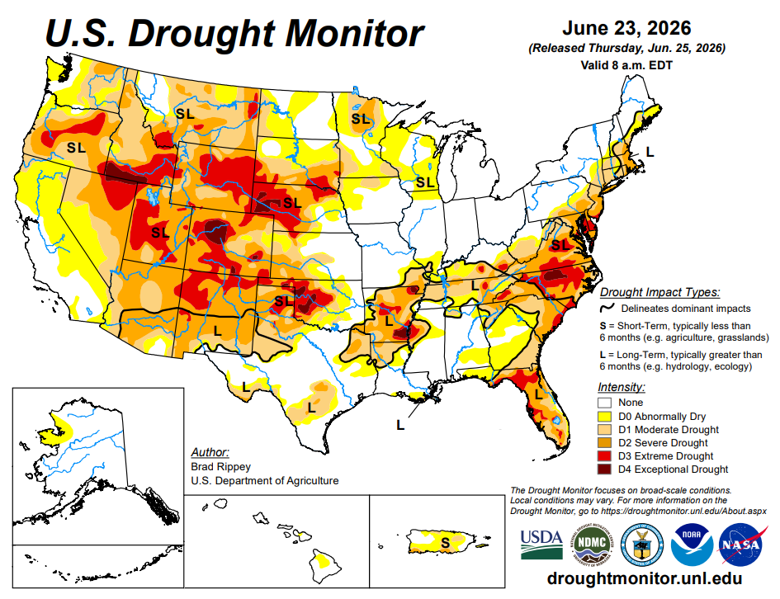
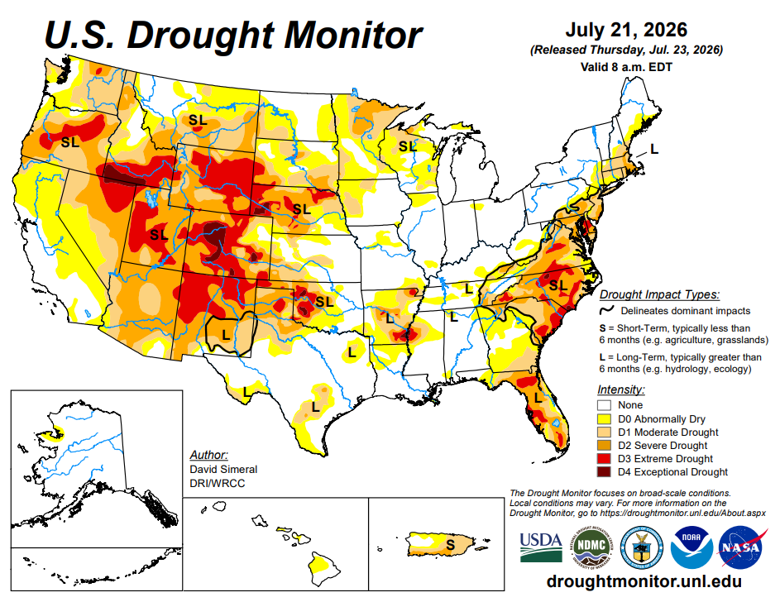
Drought Monitor

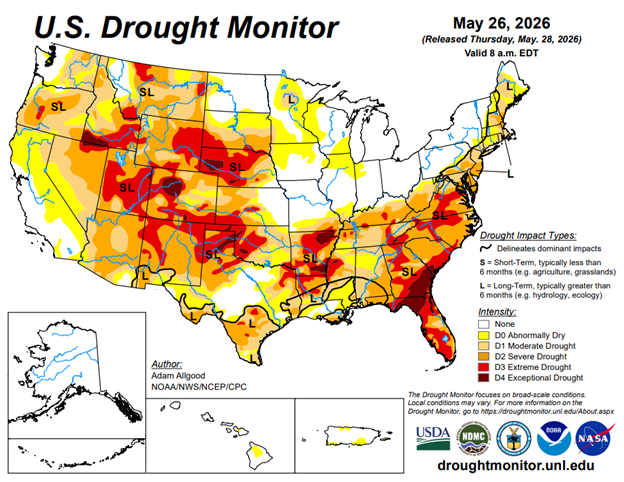
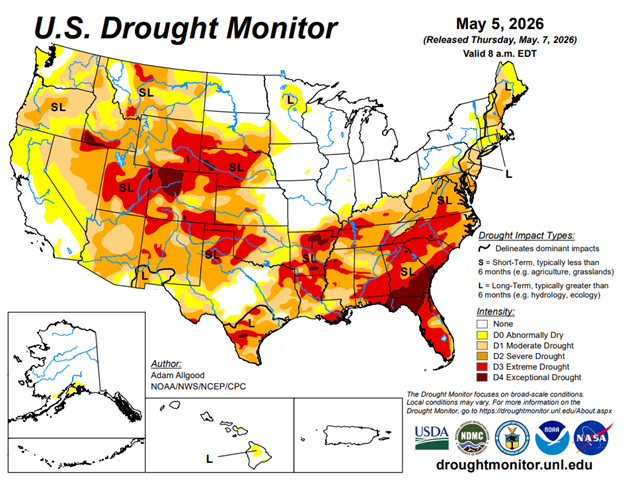
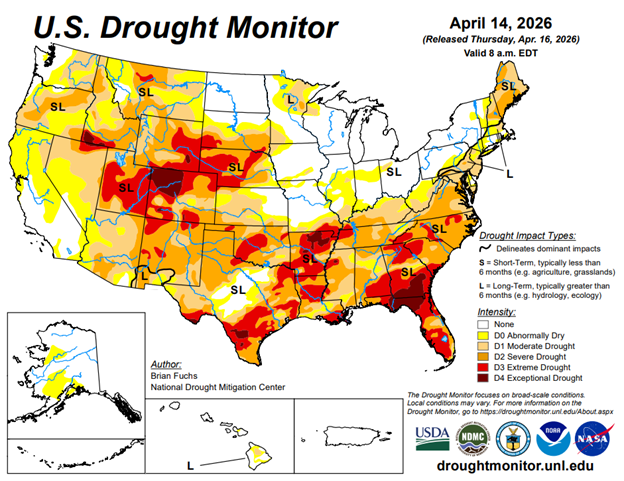
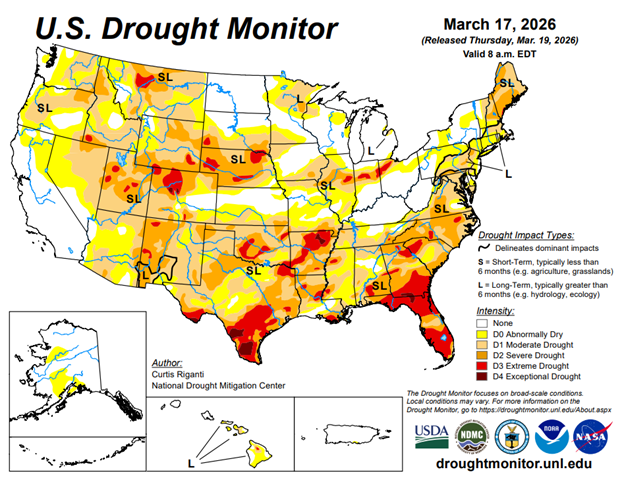
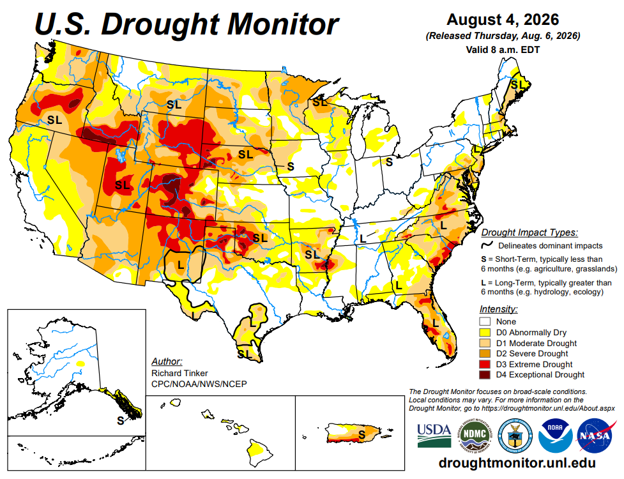
Here is the most recent drought monitor.
Contact an Ag Specialist Today

Whether you’re a producer, end-user, commercial operator, RCM AG Services helps protect revenues and control costs through its suite of hedging tools and network of buyers/sellers — Contact Ag Specialist Brady Lawrence today at 312-858-4049 or blawrence@rcmam.com.

26 Jun 2026

AG MARKET UPDATE: JUNE 12 – 26

Corn spent the last two weeks trying to carve out a bottom after the brutal three-week stretch of fund liquidation that ran from Memorial Day into mid-month. Managed Money had been selling aggressively, and while that pace finally cooled, the selling pressure left December corn defending the $4.40 area with the season-average farm price forecast sitting right on top of the market. The catalysts that drove the spring rally have all moved the wrong way: planting weather has been close to ideal, crop establishment across the Corn Belt has been excellent, and crude oil has continued to leak lower as the Iran peace framework has firmed up. With old-crop ending stocks comfortable at 2.145 billion bushels and the new-crop balance sheet described by USDA as essentially unchanged, there has simply been no fresh bullish fuel to pull the funds back to the buy side.

From here, the entire complex is positioning ahead of the June 30th Planted Acreage and Grain Stocks reports, which is far and away the next major scheduled event. Any meaningful deviation from the March Prospective Plantings number, especially given how much chatter there has been about corn acres slipping on elevated fertilizer costs, has the potential to move this market hard in either direction. The other watch item is the calendar itself: as we push toward pollination in July, the weather forecast carries more and more weight, and a hot, dry ridge building over the Corn Belt is the kind of thing that could put a weather premium back into a market that has very little of one priced in right now.

Via Barchart

Soybeans have once again been the more resilient half of the row-crop trade, holding up better than corn even as the same fund liquidation wave washed through the complex. July beans have been hovering in the $11.15 to $11.30 neighborhood, leaning on the tighter fundamental backdrop the May WASDE established, namely that 2026/27 ending stocks projection of just 310 million bushels and the booming crush demand story behind it. Board crush margins north of $3 per bushel remain historically strong and continue to do the heavy lifting on the demand side, with the RFS volumes finalized at record highs providing a structural floor under soybean oil. The drag remains the supply side: planting is all but wrapped up at well over 90% complete, Brazil is sitting on another enormous crop, and U.S. export shipments are still running behind last year’s pace. The long-delayed Trump-Xi meeting remains the wildcard that could flip the demand narrative overnight if a framework actually materializes, but the market has been burned enough times waiting on that headline that it is no longer paying up for it. Like corn, beans are squarely focused on what the June 30th acreage figure does to the new-crop picture.

Via Barchart

Wheat has continued the slide that began once it touched multi-year highs back in mid-May on the historically small U.S. winter wheat crop. The pullback has been driven by harvest pressure now that combines are rolling across the Southern Plains, timely late-May and early-June rains that pulled crop conditions up off the worst-case scenario, and funds booking profits after an extended run. July Chicago SRW has worked down into the high $5.80s and July KC HRW has slid into the low $6.30s. The important thing to remember is that nothing about the supply story has actually changed, this is still projected to be the smallest domestic wheat harvest since 1965, so the question is whether harvest lows are in or whether the seasonal pressure has more to run. Watch the pace of harvest results, spring wheat conditions in the Northern Plains, and whether the recent rains were enough to truly stabilize the HRW crop or just a temporary reprieve.

Via Barchart

Equity Markets

Equity markets have extended their remarkable run, with the major indexes pushing to fresh records even as volatility has picked up and some of the high-flying AI names have seen sharp, fast bouts of profit-taking. The dominant tension remains inflation: with price data still running hot, a growing share of investors now believes the Fed’s next move could be a rate hike before year-end rather than another cut, a notable shift in expectations. For now, the AI trade and strong earnings tone have been enough to keep dip-buyers in control, but the market feels increasingly two-sided after such a long stretch of one-way gains.

Via Barchart

Energy Markets

Crude oil has remained the single most important variable for the entire ag complex, and the direction has been lower. WTI has continued to retreat from its spring highs above $110 per barrel as the Iran peace negotiations have progressed, with the apparent Memorandum of Understanding to wind down the Middle East conflict taking crude back below $85 to close out the prior period and keeping pressure on prices since. The reopening of the Strait of Hormuz to international shipping is reportedly part of the framework, and if that holds, the war premium that propped up the grain complex this spring continues to bleed out. The practical takeaway for producers is that fertilizer cost relief is finally becoming more than partial, nitrogen and diesel have eased off their wartime peaks, though prices are not yet all the way back to pre-conflict norms.

Via Barchart

Other News

– The June 30th USDA Planted Acreage and Grain Stocks reports are the dominant near-term event for the entire complex. With so much debate over whether high fertilizer costs trimmed corn acres from the March intentions, and whether beans picked up the difference, any surprise in the final acreage figures will be a significant market mover heading into July.

– The New World screwworm situation in Texas continues to be monitored after its first mention in the WASDE narrative last month, a reminder that animal agriculture is carrying its own emerging risks alongside the geopolitical backdrop.

– Cotton has continued to drift with the broader commodity complex as crude has retreated, peeling away some of the energy-driven premium that had made natural fiber more attractive versus petroleum-based synthetics. Producers who can lock in profitable margins at current levels while keeping upside participation should continue to evaluate their hedging options.

– Any concrete movement on a Trump-Xi meeting remains the most important demand-side wildcard for soybeans. A genuine resumption of Chinese buying would change the bean story quickly, but the market has stopped pricing it in until it actually happens.


Drought Monitor

Here is the most recent drought monitor.
Contact an Ag Specialist Today

Whether you’re a producer, end-user, commercial operator, RCM AG Services helps protect revenues and control costs through its suite of hedging tools and network of buyers/sellers.

Contact Ag Specialist Brady Lawrence today at 312-858-4049 or blawrence@rcmam.com.


12 Jun 2026

AG MARKET UPDATE: MAY 29 – JUNE 12

Corn has been under persistent pressure since Memorial Day weekend, with funds aggressively liquidating long positions built up over the spring. Managed Money has sold hard across the corn market going on the last 3 weeks, while the pace has slowed, they could continue selling if they want. The primary catalyst has been a combination of favorable planting weather, excellent crop establishment across the corn belt, and a crude oil market that has been retreating as Iran peace talks progressed. The June WASDE brought few surprises on corn. USDA described the 2026/27 corn outlook as “virtually unchanged” from May, with ending stocks coming in at 1.942 billion bushels and the season-average farm price forecast held at $4.40 per bushel. Old-crop 2025/26 ending stocks ticked up slightly to 2.145 billion bushels on a modest increase in imports, keeping carry extremely comfortable. The one positive was exports, but it was not enough to keep corn up close to $5. 96% of corn has been planted with a 67% good/excellent rating to start the week.

Via Barchart

Soybeans have been caught in the same fund liquidation wave as corn, though they’ve shown more resilience given the tighter fundamental backdrop established in the May WASDE Report. July beans settled near $11.15 heading into the June 11th report. The soybean complex did find a brief bounce mid-period on continued strong crush margins and some renewed optimism around a potential Trump-Xi bilateral trade framework, but it didn’t hold. Planting pace has been exceptional, with 92% of beans in the ground and South American supply estimates remain large, with USDA maintaining Brazil’s 2025/26 crop and making only minor tweaks globally.

Via Barchart

Wheat has been the most volatile market of the period, but not in the direction bulls had hoped. After touching multi-year highs in mid-May on the back of the historically small U.S. winter wheat crop, both Chicago SRW and KC HRW futures have been in a steady slide. July SRW dropped from around $6.36 to the $5.86 area during the period before attempting a bounce, while July KC HRW fell from the mid-$6.70s to the low $6.30s. The catalyst for the pullback was a combination of timely rains arriving in Kansas and Nebraska late in May, some improvement in crop conditions relative to the worst-case scenarios, and funds taking profits after an extended rally.

Via Barchart

Equity Markets

Equity markets have continued an impressive run with volatility recently and profit taking in some of the high flyers leading to a few heavily lower days. With inflation still a worry many investors believe that we are likely to see a rate HIKE before the end of the year rather than another cut.

Via Barchart

Energy Markets

Crude oil has been the dominant macro variable across all markets and the primary driver of the grain complex selloff over the past two weeks. WTI has fallen sharply from its spring highs above $110 per barrel as Iran peace negotiations have progressed, at times with apparent momentum, though the path has remained anything but straight. The headline to end the week that there is an apparent Memorandum of Understanding to end the conflict in the Middle East took crude back below $85 to end the week.

Via Barchart

Other News

  • The June 30th USDA Planted Acreage and Grain Stocks reports are the next major scheduled market events. Any meaningful deviation in final corn or soybean planted acres from the March Prospective Plantings survey will be a significant market mover across the complex.
  • The New World screwworm situation in Texas received its first mention in the WASDE narrative this month, a reminder that animal agriculture has its own emerging risks to monitor alongside the geopolitical backdrop.
  • Cotton has pulled back with the broader commodity complex as crude oil retreated, removing some of the energy-driven premium that had made natural fiber more attractive relative to synthetics. Producers should continue to evaluate hedging strategies to protect margins at still-profitable price levels.


Drought Monitor

Here is the most recent drought monitor.

Contact an Ag Specialist Today

Whether you’re a producer, end-user, commercial operator, RCM AG Services helps protect revenues and control costs through its suite of hedging tools and network of buyers/sellers — Contact Ag Specialist Brady Lawrence today at 312-858-4049 or blawrence@rcmam.com.



29 May 2026

AG MARKET UPDATE: MAY 8 – 29

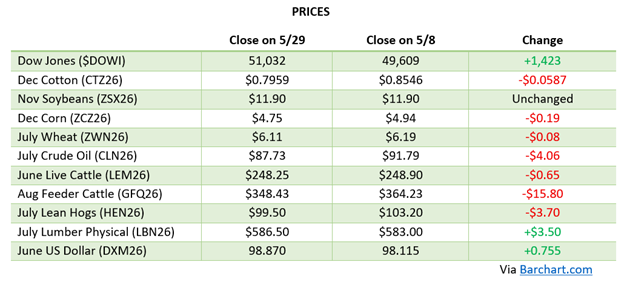
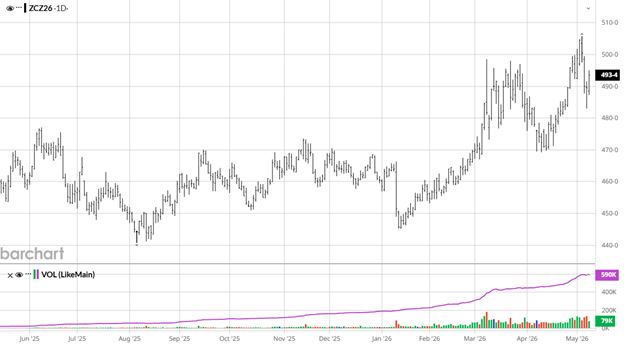
Corn has been a market defined by a tug-of-war between a bearish domestic supply picture and a geopolitical premium that refuses to fully disappear. Coming off the May 8th close, December corn had briefly flirted with the $5 level before pulling back as Iran peace talk optimism ebbed and flowed. The May 12th WASDE report, the first to include 2026/27 new-crop estimates, was the dominant event of the period. USDA pegged 2026/27 corn ending stocks at 1.957 billion bushels, down from 2.142 billion for 2025/26, a modest tightening but still well above comfortable levels. The initial reaction was muted, with the market already priced for a heavy supply picture. July corn futures settled in the $4.55 neighborhood in the days following the report, well off recent highs.

The real story in corn continues to be the fertilizer situation. Nitrogen prices, which spiked sharply when the Strait of Hormuz conflict erupted in late February, have only partially retreated from their peaks. Farmers across the country are scrambling for alternatives, manure, biofertilizers, and bio stimulants, but the economics remain challenged. This cost pressure has some analysts believing final planted corn acres could come in below USDA’s March intentions survey. Planting progress has been strong, with the week of May 24th showing approximately 89% of the crop in the ground, well ahead of the five-year average. Export inspections continue to run well ahead of last year’s pace, providing a supportive underpinning, and a flash sale of nearly 19.4 million bushels to Mexico was announced mid-month. If you can sell corn at profitable levels above your cost of production, it remains a reasonable conversation to have with your merchandiser given the uncertainty that still lies ahead.

Via Barchart

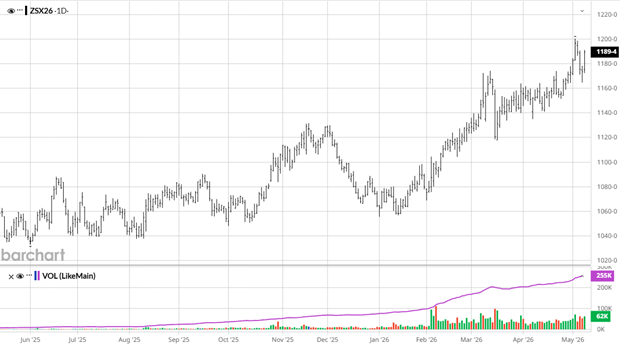
Soybeans were the standout performer of the period, posting their most significant rally in months following the May 12th WASDE. USDA surprised the trade by projecting 2026/27 soybean ending stocks at just 310 million bushels, a full 30 million below the 2025/26 figure and roughly 45 million below analyst expectations. The primary driver was a massive projected increase in crush demand, with USDA forecasting 2.750 billion bushels of crush for 2026/27, up 120 million from the current year, on the back of exceptional crush margins and booming soybean oil demand as a biofuel feedstock. Board crush margins holding well above $3 per bushel remain historically exceptional and are lending strong support to nearby contracts. July soybean futures spiked to two-year highs in the wake of the report.

The rally has since come under some pressure, with planting progress running exceptionally fast, 79% of intended soybean acres were in the ground as of May 25th, ahead of the 68% five-year average and significantly above last year’s pace. Brazil’s Conab and USDA left South American production estimates largely unchanged, with Brazil expected to produce another enormous crop in 2026/27. Year-to-date U.S. soybean export shipments trail last year’s pace by about 21%, which remains an overhang on any sustained rally. Still, with domestic crush demand as strong as it has been in years, beans have a fundamental story to tell that corn simply does not right now. The long-awaited Trump-Xi meeting, which had been delayed repeatedly, amid the Iran conflict negotiations, remains a potential catalyst for a fresh round of Chinese buying that could push beans meaningfully higher.

Via Barchart

Wheat has been the most compelling story in the grain complex over the past three weeks, and for good reason. The May 12th WASDE delivered a shocking number: USDA projected 2026/27 U.S. winter wheat production at just 1.048 billion bushels, down 25% from 2025/26 and the smallest domestic wheat harvest since 1965. Severe, persistent drought across the Southern Plains, particularly in Kansas, Colorado, and Nebraska, has devastated crop conditions. At last check, only about 30% of the winter wheat crop was rated good or excellent, with maturity running well ahead of schedule due to extreme dryness. The recent volatility off contract highs took a big chunk out of the market but still holding over $6 in July wheat.

Via Barchart

Equity Markets

Equity markets have continued their remarkable run, with the S&P 500 and Nasdaq posting new all-time highs during the period. The AI trade remains the dominant factor with AI being the dominant story during earnings. While PCE inflation came in at 3.8% for April the markets shrugged it off mostly. Some AI related names have gone parabolic in the last month creating a tough environment if you want to own those names.

Via Barchart

Energy Markets

Crude oil remains the macro wildcard for the entire ag complex. WTI has been in a volatile, two-directional range throughout the period, with prices whipsawing on every Iran headline. Peace talk optimism has pushed oil down meaningfully from its April peaks above $110 per barrel, with analysts at UBS noting that crude has fallen roughly 20% from its 2026 highs on ceasefire negotiations. However, Iran crude loadings in May have run below 0.3 million barrels per day, a dramatic collapse from March’s 1.7 million barrels per day, meaning actual physical supply has not improved despite the diplomatic noise.

Via Barchart

Other News

  • Wheat’s surge to two-year highs has been the headline, but cotton has continued its own quiet rally. Hedge funds turned net bullish on cotton for the first time in two years this month as the war-driven surge in oil prices increased the appeal of natural fiber over synthetic alternatives like polyester and nylon, which require petroleum inputs. Producers who can lock in profitable margins at current levels while maintaining upside participation should be exploring their hedging options.
  • Iran is reportedly reviewing a formal U.S. peace framework that includes reopening the Strait of Hormuz to international shipping. Markets are cautiously optimistic but skeptical.
  • The EPA’s finalized 2026–2027 Renewable Fuel Standard volumes, set at record highs, continue to provide a structural floor under corn and soybean oil demand. Soybean crush is already running at historic highs in response, and these RFS volumes ensure that domestic demand will remain exceptionally strong regardless of where export flows go.

Drought Monitor

Here is the most recent drought monitor.


Contact an Ag Specialist Today

Whether you’re a producer, end-user, commercial operator, RCM AG Services helps protect revenues and control costs through its suite of hedging tools and network of buyers/sellers — Contact Ag Specialist Brady Lawrence today at 312-858-4049 or blawrence@rcmam.com.


08 May 2026

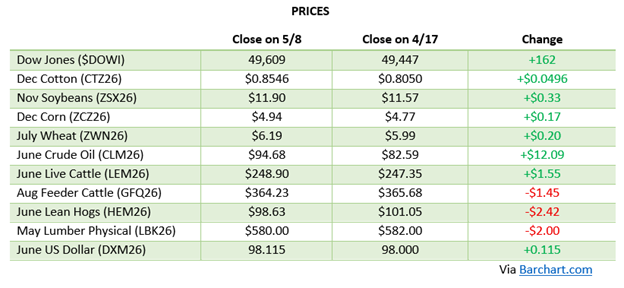
AG MARKET UPDATE: APRIL 17 – MAY 8

Corn has been a tale of two forces over the past three weeks. Coming off the euphoria of Iran’s Strait of Hormuz reopening announcement on April 17th, markets initially attempted to stabilize, but that news seemed short-lived as volatility in the middle east kept markets volatile. With the war premium in and out of the market, it has been trying to trade both geopolitical news and fundamentals, and those fundamentals remain heavy. U.S. ending stocks at 2.127 billion bushels, the highest in seven years, kept a ceiling on any sustained rally, and fast planting progress added some pressure. The USDA’s crop progress report showed nationwide corn plantings at 38% planted. Exports remain strong as the potential for a smaller US crop with higher fertilizer costs keep buyers in the market at these price levels. December corn popped above $5 for a couple days but quickly fell back as it fell with crude on peace talks. Geopolitical events are hard to predict, especially with this White House, so if you get the opportunity for profitable sales, it would be something worth considering because if crude drops back to $70-80/barrel and we have another record/near record crop it will be hard to hold these levels or move higher.

Via Barchart

The market continues to wait for a fresh demand catalyst, and the one most closely watched, a potential resumption of Chinese buying linked to a Trump-Xi summit, has been repeatedly delayed amid ongoing Iran conflict negotiations, but appears to be on for this month. The bullish case for soybeans continues to rest on crush economics. Board crush margins holding above $3 per bushel are exceptional by historical standards and are supporting the nearby contracts. NOPA March crush are expected to far exceed year-ago levels, underscoring the strength of domestic demand for meal and oil. Brazil’s Conab raised its 2025/26 soybean production estimate once more to 6.582 billion bushels, and May shipment estimates from Brazil’s Anec were raised to 533.8 million bushels, peak export season for the world’s largest shipper. That supply overhang remains the key obstacle to a sustained rally with South America having such a large crop. Beans planted were at 33% for the week of May 4th, slightly lower than expected but still very strong for this time of year.

Via Barchart

Equity Markets

Equity markets continue to make new highs on the back of the AI trade with names like Micron, SanDisk and Western Digital screaming higher and other tech names having a very strong April with the NASDAQ Index up over 15% in the month. Big players such as Google, Meta, and Amazon reported in the last 2 weeks with mixed results but the markets moved higher.

Via Barchart

Energy Markets

Energy has remained the dominant macro force across all commodity markets, though the price action has been far more volatile and two-directional compared to the one-way crude rally seen earlier in the spring. This push-pull between ceasefire hopes and renewed escalation threats has created a volatile and headline-driven energy market. For ag producers, the primary implication is that fertilizer cost relief remains partial and uncertain. Diesel costs have come down from peak levels but are not back to pre-war norms, and nitrogen prices, which spiked nearly 40% during the war, have only partially retreated.

Via Barchart

Other News

– Cotton has continued its run higher on demand from overseas buyers with alternative fibers such as polyester needing oil for production. Growers can be profitable at these levels so having a hedging strategy where you protect the downside but can still participate in any further upside is very important.

– EPA finalized 2026–2027 Renewable Fuel Standard volumes at record highs, a development that could meaningfully increase ethanol demand and provide a long-term supportive floor under corn prices.

– Iran is reportedly evaluating a U.S. peace proposal that includes a full reopening of the Strait of Hormuz by both sides. Markets expect Iran’s formal response in coming days, making this the single most important macro event in the near-term commodity outlook.

– The May 12th USDA WASDE report will include the first official 2026/27 production forecasts for all major crops. Given the wheat situation in the Plains and uncertainty around corn acres, this report has the potential to be a significant market mover across the complex.


Drought Monitor

Here is the most recent drought monitor.


Contact an Ag Specialist Today+

Whether you’re a producer, end-user, commercial operator, RCM AG Services helps protect revenues and control costs through its suite of hedging tools and network of buyers/sellers — Contact Ag Specialist Brady Lawrence today at 312-858-4049 or blawrence@rcmam.com.


17 Apr 2026

AG MARKET UPDATE: APRIL 2 – 17

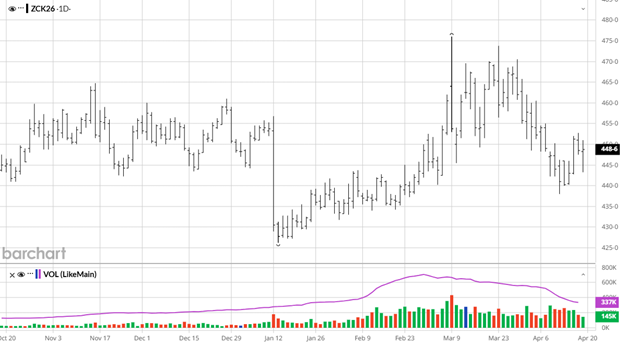
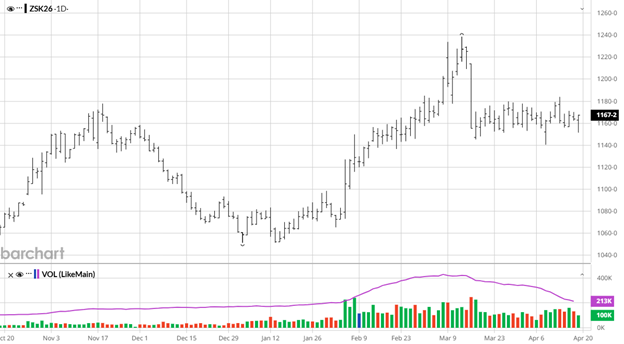
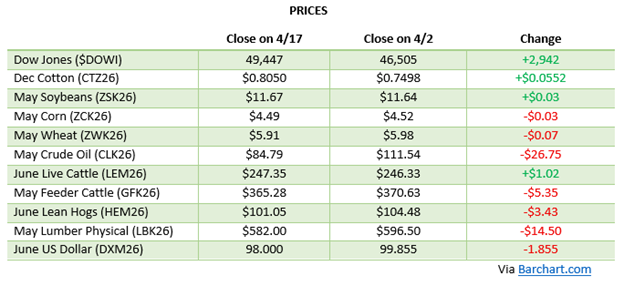
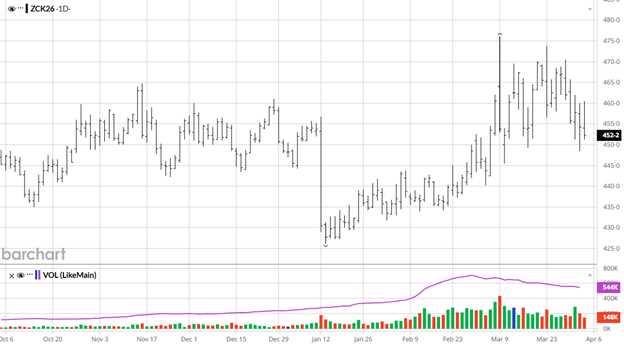
Corn spent the start of April grinding lower, posting a fourth consecutive weekly loss by April 10th as the April WASDE reinforced a burdensome supply narrative. The USDA left U.S. ending stocks essentially unchanged at 2.127 billion bushels, the highest in seven years, and global stocks came in above trade expectations at 294.81 million metric tons. A two week ceasefire between the U.S. and Iran, announced April 7th, removed much of the war premium that had propped up prices since March, as easing Strait of Hormuz concerns pulled crude oil sharply lower and dragged corn along with it. July futures slid to a fresh four-week low near $4.40, completing a nearly 62% retracement from the March 9th highs. The past week saw stabilization and a modest recovery. Faster than expected planting progress, U.S. corn planting reached 5% completion as of April 13th, slightly ahead of last year’s pace, combined with firming eastern Corn Belt basis and Mexico securing a large forward purchase of 12.4 million bushels helped steady sentiment. The old crop market remains locked in a congestion zone between $4.45 and $4.55 on May futures, with the 200-day moving average serving as key support. Speculators have been trimming their long positions aggressively, as shown in the latest CFTC Commitment of Traders reports, leaving the market less vulnerable to a large liquidation event but also with less upside fuel until a fresh catalyst emerges as money allocators reposition to the equity markets.

Via Barchart

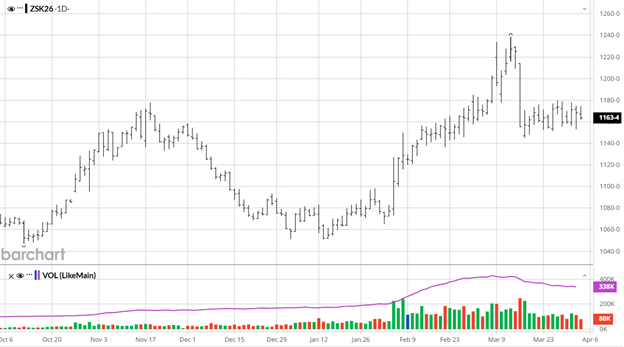
Soybeans have largely remained in a sideways grind, trading between $11.50 and $11.83 on July futures for most of the last 2 weeks. The April WASDE showed U.S. ending stocks unchanged at 350 million bushels with adjustments netting to zero, crush estimates raised while exports were trimmed by the same amount. The season-average price forecast was nudged 10 cents higher to $10.30 per bushel. Brazil’s CONAB raised its 2025/26 soybean production estimate again, this time to 6.582 billion bushels, keeping the global supply backdrop heavy and capping any sustained rallies. On the positive side, strong domestic crush margins, board crush pushing above $3 per bushel, have been the primary support story for the complex. NOPA March crush is expected to come in well above year-ago levels when reported. U.S. planting progress debuted at 6% complete as of April 13th, ahead of the 2% five-year average, with Mississippi and Tennessee leading at 39% and 36%, respectively. The market is waiting for a significant new headline to break out of the current range. Talks between President Trump and China’s President Xi, which were delayed amid the Iran conflict, remain a key watch item as any resumption of Chinese buying interest could quickly change the demand narrative for U.S. soybeans.

Via Barchart

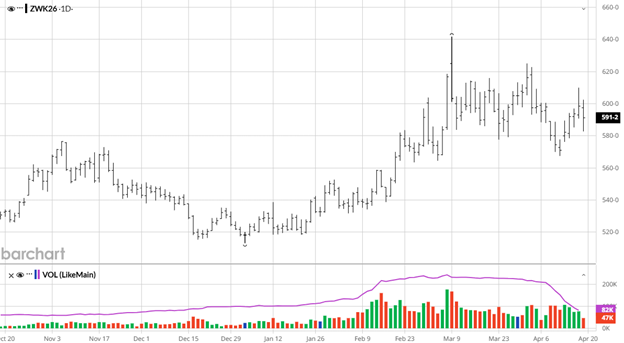
Wheat has done better the last couple of weeks, with Kansas City HRW futures rallying on the back of deteriorating U.S. crop conditions and persistent drought in the Southern Plains. USDA’s April 14th crop progress report showed just 34% of the winter wheat crop rated good-to-excellent, down a full 13 percentage points from a year ago, with 32% of the crop rated poor or very poor. Oklahoma and the Texas Panhandle remained in severe to extreme drought, and the recent widespread rain systems have largely missed the driest areas. Concerns about the long-term fertilizer supply disruptions caused by the Iran conflict have added a structural premium, with funds holding a record long position in spring wheat and a growing net long in Kansas City HRW. July HRW futures jumped nearly 20 cents on April 14th alone, reaching their highest settlement since March 31st at $6.36. Chicago SRW July futures also pushed above $6.00. The market sold off modestly to end the week but held the bulk of its gains. Longer-range forecasts suggest late April could bring more favorable moisture to parts of the Plains, which could temper upside. For now, weather, drought maps, and the weekly crop condition ratings are the primary price drivers.

Via Barchart

Equity Markets

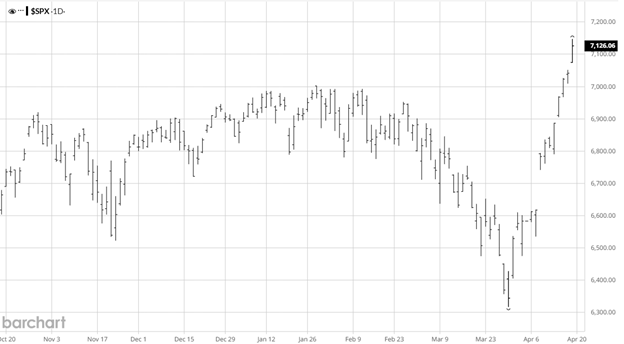
Equity markets have moved from deep stress to new record highs over this two-week stretch, tracking the Iran ceasefire developments closely. When Trump announced the two-week pause in operations on April 7th, the Dow Jones Industrial Average surged 1,325 points, its best single session since April 2025, while the S&P 500 gained 2.5% to 6,782. Through the balance of the period, stocks continued recovering as investors grew increasingly optimistic about a lasting peace deal, with the S&P 500 recouping all losses accumulated since the start of the conflict. The run to new highs has been impressive with the NASDAQ having a positive day for 14 straight days.

Via Barchart

Energy Markets

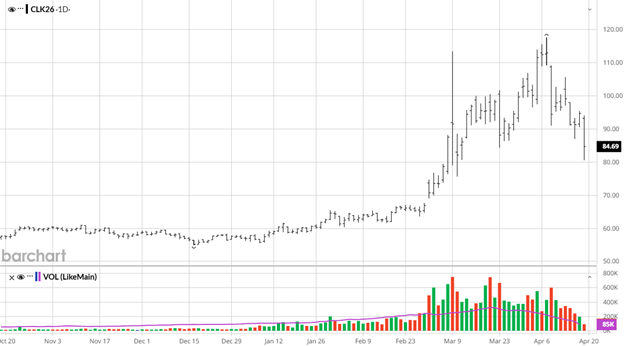
Energy markets have continued to be volatile over the past couple of weeks but the news of ceasefire and opening of the Strait of Hormuz. While the cease-fire does not mean the conflict is over, if good news continues to come out of Washington oil prices will fall. The ceasefire dynamics have already meaningfully reduced fertilizer cost fears and energy-linked inflation expectations.

Via Barchart

Other News

  • Cotton has been one of the most compelling commodity stories of the period, with July futures pushing to a nearly two-year high and new crop cotton reaching $0.80 in the Dec contract. The move has been supported by a combination of bullish factors: elevated crude oil prices increasing polyester production costs and driving synthetic fiber substitution back toward natural cotton, a weaker U.S. dollar, and persistent drought in key U.S. growing regions stretching from the Texas Panhandle westward. The USDA April WASDE raised global production by 900,000 bales while also lifting consumption by 560,000 bales, leaving the net balance slightly tightened.
  • USDA’s April WASDE raised the season-average farm price for wheat 5 cents to $5.00/bu, corn 5 cents to $4.15/bu, and soybeans 10 cents to $10.30/bu.
  • The Trump administration called out fertilizer giant Mosaic for idling two Brazilian plants, with Deputy Agriculture Secretary Stephen Vaden publicly questioning the timing as global fertilizer supplies face war-related disruptions.
  • A new survey found that only 60% of U.S. corn farmers have secured their nitrogen needs for the 2026 crop year, a reflection of the input cost uncertainty created by the Iran conflict.
  • Brazil’s CONAB raised its 2025/26 total corn crop estimate to 139.6 MMT (5.5 billion bushels), maintaining a heavy Southern Hemisphere supply backdrop.


Drought Monitor

Here is the most recent drought monitor. With planting starting later this spring, we need rain in a lot of places in March.

Contact an Ag Specialist Today

Whether you’re a producer, end-user, commercial operator, RCM AG Services helps protect revenues and control costs through its suite of hedging tools and network of buyers/sellers — Contact Ag Specialist Brady Lawrence today at 312-858-4049 or blawrence@rcmam.com.
02 Apr 2026

AG MARKET UPDATE: MARCH 20 – APRIL 2

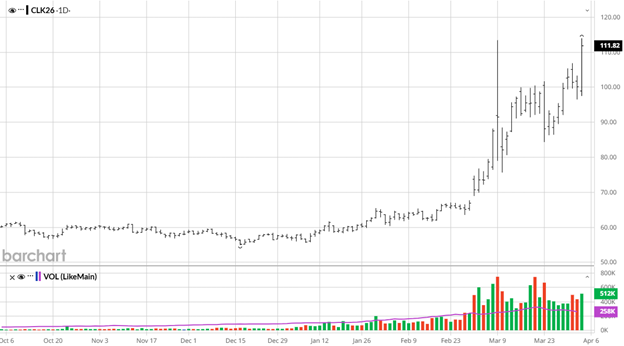
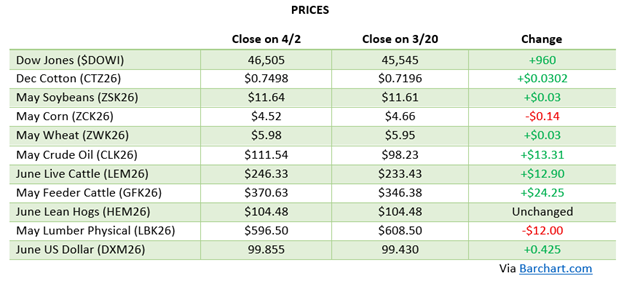
Corn has remained supported but volatile following the March 31st USDA Prospective Plantings and Quarterly Stocks reports, which reinforced a tighter-than-expected balance sheet narrative. The USDA came out with 95.338 million acres, near the lower end of trade expectations, confirming earlier concerns that higher input costs, particularly fertilizer due to war in Iran, would limit corn expansion, while stocks data did not show burdensome supplies. This has helped underpin prices despite sluggish export demand and limited Chinese participation, keeping the market more focused on supply risk than demand weakness. Combined with continued strength in energy markets and inflation-driven fund interest, corn remains in a supportive environment, though the large speculative long position leaves it vulnerable to sharp downside if macro sentiment shifts.

Via Barchart

Soybeans have struggled to find sustained strength even after the March 31st USDA reports, which confirmed expectations for increased U.S. acreage and relatively comfortable stocks levels. The larger planting outlook reinforces the idea of ample new crop supplies, especially when paired with ongoing pressure from South America’s record production. While periodic rallies have been driven by energy market spillover and inflation concerns, the lack of consistent export demand, particularly from China, and fading optimism around biofuel policy have kept the market defensive. Overall, the USDA data solidified a more bearish supply outlook, leaving soybeans reliant on external market strength rather than supportive fundamentals. Talks between president Trump and China’s president Xi will be watched under a microscope if they end up happening after already being delayed with the conflict in Iran continuing.

Via Barchart

Energy Markets

Energy markets have continued to dominate the macro landscape, with crude oil holding elevated and volatile levels as geopolitical tensions involving Iran persist and uncertainty around the Strait of Hormuz remains unresolved. The sustained strength in energy has amplified inflation concerns globally, driving investment flows into commodities and influencing planting decisions, input costs, and overall sentiment across agricultural markets.

Via Barchart

Equity Markets

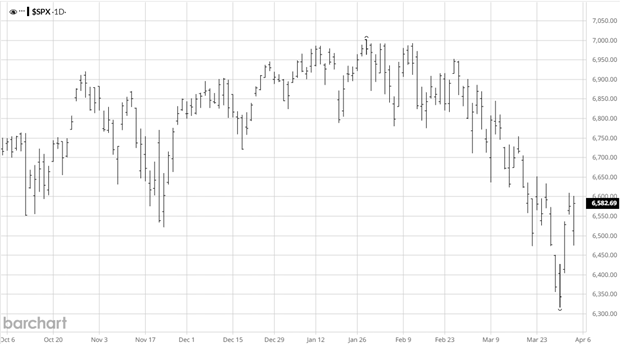
Equity markets have remained under pressure since late March, as the combination of higher energy prices and the inflationary implications highlighted in recent economic data have weighed heavily on investor sentiment. The indexes continues to reflect a risk-off environment, with concerns centered on slowing economic growth, tighter margins from rising input costs, and ongoing geopolitical uncertainty overshadowing otherwise stable underlying economic conditions.

Via Barchart

Other News

– Cotton acres in the prospective plantings report were 9.64 million for 2026, a 4% increase from last year.

– All wheat acres from the report were 43.8 million acres, down 3% from 2025.

Drought Monitor

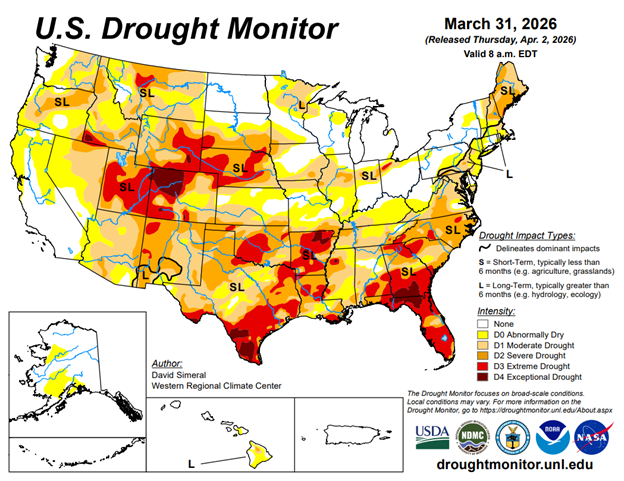
Here is the most recent drought monitor. With planting starting later this spring, we need rain in a lot of places in March.

Contact an Ag Specialist Today

Whether you’re a producer, end-user, commercial operator, RCM AG Services helps protect revenues and control costs through its suite of hedging tools and network of buyers/sellers — Contact Ag Specialist Brady Lawrence today at 312-858-4049 or blawrence@rcmam.com.


20 Mar 2026

AG MARKET UPDATE: MARCH 3 – 20

Corn has transitioned from early-week weakness into a volatile but constructive rally, driven far more by macro forces than traditional supply-and-demand fundamentals. Since the start of the Iran conflict, rising crude oil and diesel prices have injected inflation-driven buying into the grain complex, helping corn recover from Monday’s sharp losses and push higher into the end of the week. At the same time, the market is actively weighing the real impact of elevated input costs, particularly nitrogen, which could pull U.S. planted acreage below key thresholds near 94 million acres and provide longer-term support. However, that bullish narrative is being offset by softer export demand, limited Chinese participation, and concerns that high freight costs could further hinder competitiveness. With speculative funds now holding a large and increasingly crowded long position, corn remains technically supported but vulnerable to sharp corrections, especially if energy markets stabilize or geopolitical tensions ease.

Via Barchart

Soybeans have been the most volatile market of the complex, starting with a dramatic limit-down selloff early in the week tied to delayed U.S.-China trade talks and fading optimism around biofuel policy, before rebounding alongside strength in crude oil and the broader commodity space. Despite the recovery, the underlying fundamentals remain more bearish relative to corn, with record South American production, ongoing harvest pressure, and expectations for increased U.S. soybean acreage (potentially 85–86+ million acres) all weighing on the outlook. The earlier optimism around Chinese demand has cooled significantly, and with funds still holding a sizable position even after liquidation, rallies may continue to be sold. While inflation-driven money flow has provided temporary support, soybeans appear to be on more fragile footing, particularly if energy markets lose momentum or if acreage shifts materialize as expected this spring.

Via Barchart

Equity Markets

Over the past two weeks, equity markets have come under increasing pressure as investors grapple with the inflationary shock driven by surging energy prices and escalating geopolitical tensions surrounding Iran and the Strait of Hormuz. Early in the period, equities found brief support from a pullback in crude oil and optimism around global trade discussions, but that strength quickly faded as oil resumed its rally and inflation data came in hotter than expected. The Dow Jones Industrial Average has fallen sharply, shedding roughly 1,200+ points from recent highs and pushing to multi-month lows, as fears of a prolonged period of elevated fuel costs raise the risk of a global economic slowdown or recession.

Via Barchart

Other News

  • Energy markets had been volatile as the Straight of Hormuz remains closed with the war in Iran continuing.
  • Inflation is heating up a little but as energy prices surge, it causes ripples across the entire supply chain.


Drought Monitor

Here is the most recent drought monitor. With planting starting later this spring, we need rain in a lot of places in March.

Contact an Ag Specialist Today

Whether you’re a producer, end-user, commercial operator, RCM AG Services helps protect revenues and control costs through its suite of hedging tools and network of buyers/sellers — Contact Ag Specialist Brady Lawrence today at 312-858-4049 or blawrence@rcmam.com.


03 Mar 2026

AG MARKET UPDATE: JANUARY 12 – MARCH 3

Corn fundamentals remain quietly supportive. Domestic demand continues to provide a steady floor, with ethanol grind holding firm amid workable processing margins. Feed demand has also remained intact, supported by stable livestock numbers. Export business has been competitive but not aggressive, as global buyers weigh U.S. offers against South American supply. Overall, stocks are comfortable but not burdensome, keeping the downside limited while failing to create urgency on the upside. From a technical perspective, corn futures have respected both support and resistance levels throughout the month. The market continues to trade sideways, with carry in the futures structure signaling that end users are not pressed for immediate coverage. Until a weather premium develops or export demand accelerates meaningfully, rallies have tended to stall near the upper end of the range.

Via Barchart

Soybeans continue to be shaped by global supply clarity. South American production is largely known, which has limited the market’s ability to price in uncertainty. Domestic crush demand remains a supportive feature, particularly as renewable fuel feedstock demand underpins usage. However, export competition has kept shipments steady rather than explosive. The soybean market has struggled to sustain rallies, repeatedly testing higher levels before fading. Technically, the contract structure suggests hesitation from speculative buyers, with range-bound behavior dominating trade. Without a clear acreage shift or early-season weather concern, soybeans appear anchored between steady demand and comfortable global supply.

Via Barchart

Equity Markets

Equity markets traded with higher volatility over the past month as investors weighed solid economic data against persistent inflation concerns and firm energy prices. Major indexes moved within broad ranges rather than establishing sustained trends, with noticeable sector rotation throughout the month. Energy and defensive sectors generally outperformed, while rate-sensitive growth stocks faced intermittent pressure. Overall, the tone shifted toward cautious positioning, with investors quicker to trim risk on rallies while still supporting markets on pullbacks.

Via Barchart

Other News

  • Energy markets had been steadily moving higher heading into the weekend before the US bombed Iran which led to gains to start the week. How long the conflict lasts will be important to the global supply chain of oil.
  • Wheat is off recent lows but sold off from Monday’s high, the recent gains were needed but will need a little more help to get and stay above $6.

Drought Monitor

Here is the most recent drought monitor. With planting starting later this spring we need rain in a lot of places in March.

Contact an Ag Specialist Today

Whether you’re a producer, end-user, commercial operator, RCM AG Services helps protect revenues and control costs through its suite of hedging tools and network of buyers/sellers — Contact Ag Specialist Brady Lawrence today at 312-858-4049 or blawrence@rcmam.com.
 

12 Jan 2026

AG MARKET UPDATE: POST JANUARY 12 USDA REPORT

Corn took a dive on today’s USDA report with 1.3 million more harvested acres and larger yield than expected coming in at 186.5 bu/ac. With this comes more production leading to larger ending stocks, brutal two-sided hit for the corn bulls. Corn had done a great job of climbing higher since early December, but today’s report gives all the momentum back to the bears with South America’s growing season off to a great start. Corn’s big move lower sent it below all technical support and unless we see a quick turnaround this week what was a support level could turn into overhead resistance as we are now at levels last seen in August.
Via Barchart

While the USDA report was not as bad for beans, it did suffer double digit losses with a slightly higher than expected national yield of 53 bu/ac. One important item was that US exports were revised lower due to more world competition. This is important as we still need China to buy US beans as we do not have another major market catalyst as the Trump administration has not been friendly for the implementation of SAF (sustainable aviation fuel). The month and half of +$11 beans we saw will be a struggle to get back to as South America continues to roll on with another record crop expected.

Via Barchart

Equity Markets

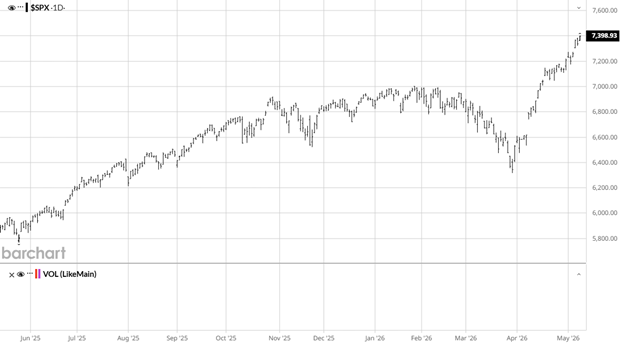
Equity markets roll on despite some days of volatility with headlines from the White House and drama surrounding the Fed. As you can see in the chart below since last April’s tariff scare the markets have been steadily moving higher.

Via Barchart

Other News

  • The precious metals trade continued its strong 2025 into the start of 2026 with new highs in gold and silver.
  • Wheat had ending stocks rose modestly and the price was dragged lower with corn.

Drought Monitor

Here is the most recent drought monitor.

Contact an Ag Specialist Today

Whether you’re a producer, end-user, commercial operator, RCM AG Services helps protect revenues and control costs through its suite of hedging tools and network of buyers/sellers — Contact Ag Specialist Brady Lawrence today at 312-858-4049 or blawrence@rcmam.com.